


Garage Door Spring Installation
Quick
Response
5 star
Rated
best offer
Guaranteed










Contact Us
Garage door springs are the most mechanically demanding component of any door system, and a spring that is incorrectly sized, improperly installed, or past its service life creates a real safety risk. Century Garage Door provides professional spring installation for residential and commercial garage door systems of all types and configurations. Our technicians are available 24/7, size every spring correctly for the door it will serve, and install and calibrate each system safely before the job is closed out.
Our Services:
- Emergency Garage Door Repair
- Garage Door Cable Repair
- Garage Door Cable Replacement
- Garage Door Drum Replacement
- Garage Door Hinge Repair
- Garage Door Keypad Installation
- Garage Door Keypad Repair
- Garage Door Keypad Replacement
- Garage Door Keypad Reset
- Garage Door Lock Installation
- Garage Door Lock Repair
- Garage Door Off Track Repair
- Garage Door Panel Replacement
- Garage Door Repair
- Garage Door Replacement
- Garage Door Roller Replacement
- Garage Door Safety Inspection
- Garage Door Spring Installation
- Garage Door Spring Repair
what your neighbors are saying about us
Signs You Need New Garage Door Springs
Springs do not always fail suddenly. In many cases they show clear signs of wear and fatigue before a complete break occurs. Recognizing these signs and scheduling replacement proactively is safer, less disruptive, and less expensive than responding to a spring failure after it happens.
Signs it is time to have your garage door springs inspected or replaced:
- The door will not open or opens only a few inches before the opener stalls, indicating the spring is no longer providing adequate counterbalance.
- You heard a loud bang from the garage — often described as a gunshot sound — which is the characteristic sound of a torsion spring snapping under tension.
- The door hangs unevenly or one side drops lower than the other when the opener is disengaged, suggesting one spring has failed or lost tension.
- A visible gap has appeared in the coil of the torsion spring above the door opening, confirming a break in the spring body.
- The cables appear slack or have jumped off the drums on one or both sides, which commonly follows a spring failure that removed the tension holding them in place.
- The door feels significantly heavier than normal when lifted manually with the opener disengaged.
- The springs are more than seven to ten years old and the door is used multiple times per day, placing them near or past their rated cycle life.
Types of Garage Door Springs We Install
Garage door springs come in two primary configurations, and the correct type for any door depends on the door’s design, weight, and the available mounting space. Century Garage Door installs both types across all residential and commercial door systems and will confirm the correct configuration for your door before any installation begins.
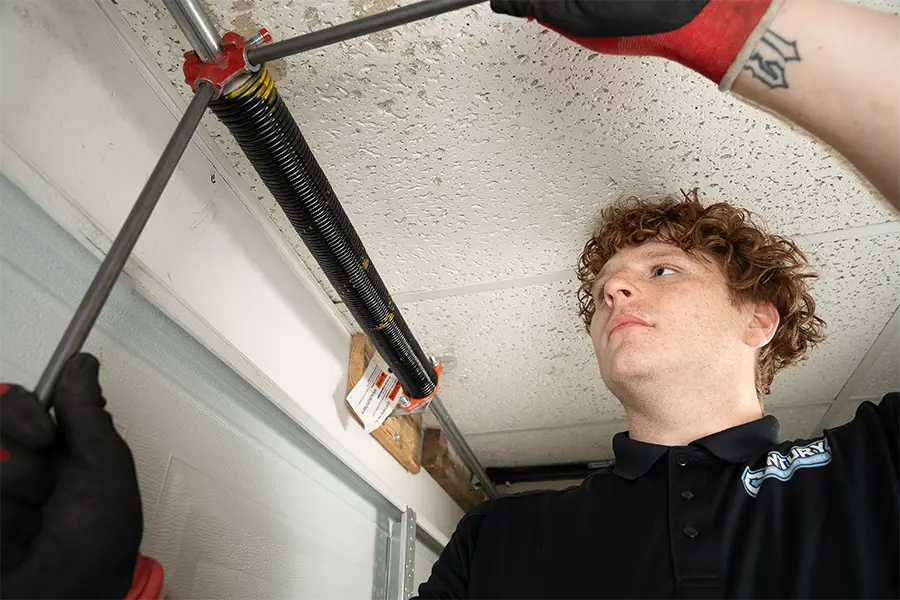
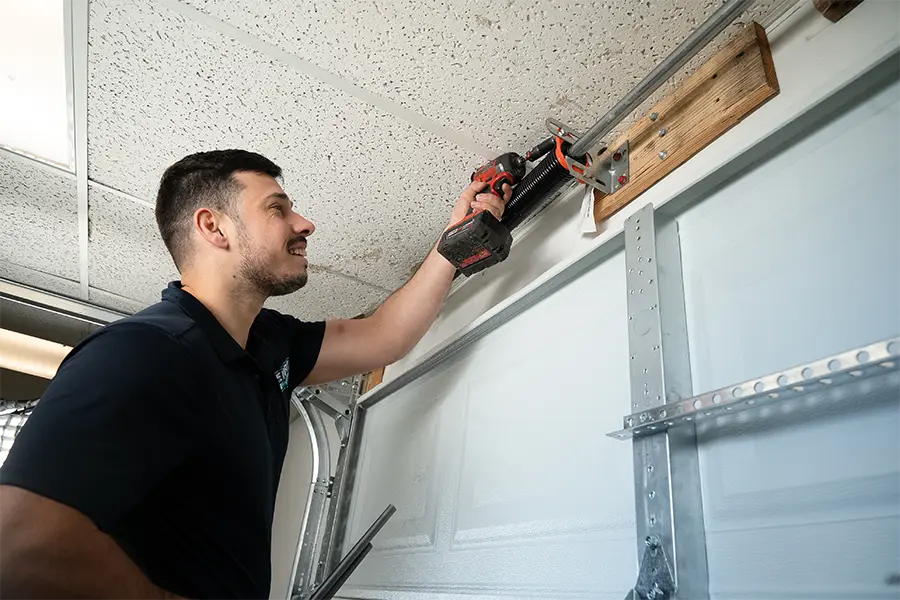
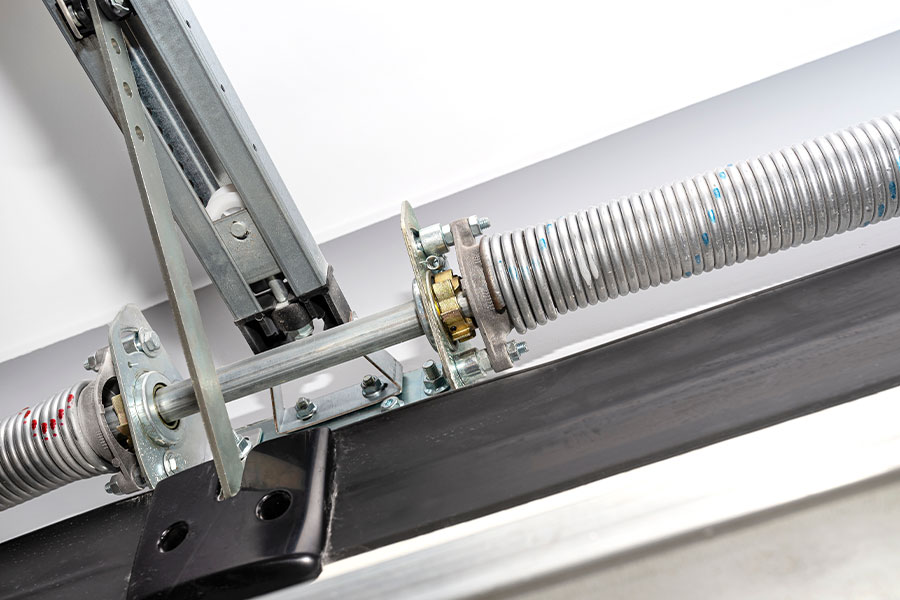
Torsion springs are mounted horizontally on a metal shaft directly above the garage door opening. They work by twisting and storing rotational energy as the door closes, then releasing that energy to assist the door in opening. Torsion systems are the most widely used configuration in modern residential and commercial applications because they operate more smoothly, last longer under equivalent use, and are inherently safer than extension spring systems — the spring body remains on the shaft even if it breaks, containing the failure rather than releasing it outward.
Most residential sectional doors use one torsion spring for single-car openings and two torsion springs on a shared shaft for double-car or heavier doors. Century Garage Door installs the correct number of springs for the door’s weight and sizes each spring precisely to the door’s height, weight, and required cycle rating.
Extension springs run along the horizontal tracks on either side of the door and stretch under tension as the door closes. They are common in older homes and garages with lower ceiling clearance where a torsion spring system would require structural modifications to install correctly. Extension springs are available in open-loop, double-loop, and clipped-end configurations depending on the hardware they connect to.
Century Garage Door installs safety cables through every extension spring as a standard part of every installation. A safety cable runs through the center of the spring and contains the coil in the event of a break, preventing the spring from launching across the garage — a serious injury risk that safety cables are specifically designed to eliminate.
Our Garage Door Spring Installation Services
Century Garage Door follows a complete, systematic spring installation process designed to ensure every spring is correctly sized, safely installed, and properly calibrated before the door returns to service. We carry springs in the full range of sizes needed for most residential and light commercial applications on every service vehicle.
Here is what to expect:
- A full inspection of the existing spring system, cables, drums, hardware, and door to assess overall system condition and confirm the correct spring specifications before any installation begins.
- Precise spring sizing based on the door’s measured weight, height, track radius, and required cycle rating — not a generic estimate.
- Safe winding and installation of the new spring or springs using correct winding bars and technique with spring tension fully controlled throughout the process.
- Cable inspection and replacement if the existing cables show fraying, corrosion, or uneven drum winding that warrants replacement alongside the new springs.
- Safety cable installation on all extension spring systems as a standard component of every installation.
- Tension calibration and door balance test to confirm the door holds steady at the midpoint of its travel with no drift in either direction.
- Drum alignment check to confirm cables are winding evenly on both sides under the new spring tension.
- Full lubrication of springs, cables, drums, and adjacent hardware after installation.
- Operational test running the door through several complete cycles to confirm smooth, balanced, centered movement before the job is complete.
Why Spring Work Should Be Left to the Pros
Garage door spring installation is one of the most hazardous home repairs a homeowner can attempt without professional training. Springs store an enormous amount of mechanical energy — a torsion spring on a standard residential door can store enough force to cause serious injury if it releases unexpectedly during winding or handling.
The tools required for safe spring installation are specialized and not typically available at general hardware retailers. Winding bars must be the correct length and material for the spring being wound. Using improvised tools — screwdrivers, rods, or incorrectly sized bars — during the winding process is a common cause of serious injury when the tool slips under tension. Even professional technicians approach spring installation with deliberate, controlled technique developed through training and repetition.
Beyond the immediate safety risk, an improperly installed spring creates ongoing hazards. A spring wound to incorrect tension places the door out of balance, strains the opener motor, accelerates cable and drum wear, and can fail prematurely — sometimes within weeks of installation. A spring that is the wrong size for the door’s weight compounds these effects and shortens the service life of every component it connects to. Getting spring installation right the first time protects the homeowner, protects the door system, and avoids the cost and risk of correcting a failed DIY attempt.
Why Choose Century Garage Door
Homeowners and businesses choose Century Garage Door for spring installation because we combine correct spring sizing, safe installation technique, and a complete post-installation system check on every job. A spring that is correctly sized and properly installed is the foundation every other component in the door system depends on.
Reasons to choose Century Garage Door:
- Available 24 hours a day, 7 days a week for spring installation and emergency spring replacement.
- Same-day service for most spring installation calls to restore safe door operation quickly.
- Precise spring sizing based on actual door measurements — not generic estimates or catalog defaults.
- Torsion and extension spring installation available for all residential and commercial door configurations.
- High-cycle spring upgrades available for households with high daily use seeking longer spring service life.
- Safety cable installation included on every extension spring system as a standard component of the job.
- Full balance test and operational check included with every spring installation at no additional charge.
- Transparent, upfront pricing with a free estimate and no hidden fees before any work begins.
- Consistent workmanship standards backed by a professional guarantee on every installation.
Call now for professional garage door spring installation. Get a free estimate from our team today.
Frequently Asked Questions
How long do garage door springs last?
Standard residential garage door springs are typically rated for around 10,000 open and close cycles, which translates to roughly seven to ten years of average use at four cycles per day. High-cycle springs rated for 20,000 or more cycles are available as an upgrade and are a practical choice for households where the door is used frequently throughout the day.
Should both springs be replaced at the same time?
Yes, in almost every case. Springs on the same door wear at the same rate, so if one has broken or failed the other is likely near the end of its service life as well. Replacing both at the same time restores balanced tension across the full door, avoids the cost and disruption of a second service call within a short period, and ensures the door is operating on two springs of equal condition and rating.
What is the difference between torsion and extension springs?
Torsion springs mount horizontally above the door opening on a metal shaft and store energy through rotational twisting. Extension springs run along the horizontal side tracks and store energy through linear stretching. Torsion systems are more durable, operate more smoothly, and contain a break more safely than extension systems. The correct type for any door depends on ceiling clearance, door weight, and existing hardware configuration.
Can a garage door opener damage springs faster?
Yes. An opener that is applying excessive force to compensate for a door that is out of balance — due to a weakening spring, cable tension issue, or misalignment — places mechanical stress on the spring system beyond its rated operating load. Regular maintenance that keeps the door balanced and the opener force setting correctly calibrated helps springs reach their full rated cycle life.
Is it safe to open my garage door manually if a spring is broken?
It is not recommended. A door with a broken spring has lost its counterbalance and can weigh 150 to 400 pounds depending on the door size and material. Attempting to lift it manually without the spring’s assistance creates a risk of injury from the door’s weight and the risk of the door falling if grip or footing is lost. Keep the area clear and call Century Garage Door for same-day spring installation.