
Garage Door Safety Inspection
Your garage door is the heaviest moving thing in your house and almost all that weight is carried by two parts that most homeowners never even look at. A garage door safety inspection is a systematic assessment of all load-bearing, door-reversing and fall-preventing parts. Springs, cables, drums, rollers, tracks, hinges, brackets and the safety features of the opener itself. Century Garage Door Service inspects the entire system, tests it as the safety standards recommend and informs you clearly about what is fine, what is wearing and what requires attention.
- Every load-bearing part inspected: springs, cables, drums, rollers, tracks, hinges, brackets and fasteners
- Photo-eye alignment, auto-reverse and closing force tested and set to spec
- Findings are described in layman’s terms prior to any quotes or replacements
Century Garage Door Service — talk to the company doing the work.
Request an Estimate
Who really knocks on your door
Many of the numbers you will see listed when you search for a garage door safety inspection service don’t even belong to garage door companies. They belong to lead brokers, which are call centers that take your address, sell it to whichever contractor is buying that zip code that week, and disappear. You don’t know who’s coming until a van pulls up. Century Garage Door Service is the company you are calling and the company that does the work. We’re the ones checking it, so the person on the phone can tell you what the technician will check.
It’s a simple process. You call and we talk about what the door is doing, the noises, the hesitation, the age of the opener and we schedule the inspection. A technician comes in and runs through the entire system and load tests it instead of eyeballing it. Anything broken, out of spec, or dangerous is shown to you on the door itself, not described on a clipboard. If something needs to be replaced, you get the price up front before any work is done and you decide.
Our vans are stocked to do what the inspection finds. Standard size torsion and extension springs, lift cables, drums, nylon and steel rollers, hinges, bearing plates, bottom brackets, safety sensors, opener gear and sprocket kits, remotes and receivers, and parts for LiftMaster, Genie, Chamberlain, Craftsman, Clopay, Amarr, Wayne Dalton and Overhead Door. And that matters, because an inspection that ends with “you’ll have to book another visit” is not much good to anyone.
What an inspection really reveals
The cable on the left had four broken strands around the drum. The door still opened and closed normally, and the homeowner had no idea anything was wrong — that’s exactly the kind of thing an inspection is for. Such failures don’t tend to announce themselves until they do.
What we check and what usually goes wrong
A garage door safety inspection is more than a walk around. Every part of the system is under tension or load or both, and each fails in its own way. Here’s what our techs look for and the most common problems we find.
Extension springs and torsion springs
Springs do most of the lifting. A residential spring typically carries a load for about 10,000 cycles, or about seven years for the average household (much less if your garage is the main entrance). We look for gaps in the coil, rust, stretching, uneven spacing and whether the spring is still the right size for the actual weight of the door, which changes if someone had added insulation or a new panel before. We also look at the containment. Torsion springs should have a shaft through the center and extension springs should have safety cables running through them so that a broken spring can’t become a projectile. One of the most common serious problems we see is missing safety cables.
Lift cables, drums and rollers
The cables carry the spring force and deliver it to the door. They fray from the inside out, often at the bottom bracket where moisture collects or at the drum where they wrap. We inspect the full length of both cables, making sure they are seated correctly in the drum grooves and under equal tension, and look for kinks or rust. Rollers are checked for cracked stems, flat spots, seized bearings and worn nylon. One roller jams and pulls the door out of square, putting a non-uniform load on the cables, and that’s how one cheap part leads to a door coming off its tracks.
Automatic reverse and safety sensors
Since 1993, all openers sold in the US must have an entrapment protection system. The photo-eyes across the opening have to work. The force reversal of the opener has to work, which makes the door go back up when it hits resistance. We verify the sensor alignment and mounting height, clean the lenses, test the beam and then run the physical reversal test with an obstruction on the floor. If the door doesn’t reverse and come back all the way, or the sensors have been bypassed or taped over — which we see more often than you’d think — that gets corrected before we leave.
Tracks, hinges, brackets and fasteners
Vibration will shake everything loose in the end. We verify track alignment and spacing, inspect for dents and bends, and ensure that vertical tracks are plumb and securely anchored to the framing. Hinges are checked for cracks and elongated holes, the normal indication that the door has been flexing due to a bad spring balance. We tighten the hardware to spec, check the bottom brackets, which should never be loosened by anybody but a technician, since they remain under cable tension, and we lubricate the moving parts with the right product, not the household spray most doors have been getting.
Inspection and tune up or inspection and replacement?
Most inspections have one of two outcomes. Either the door is basically fine and only requires adjustment, oiling and tightening — or the inspection shows parts that have outlived their usefulness and have to be replaced. It usually comes down to the age of the door and how much use it has had as to which one you are looking at.
Inspection and Adjustment
- The right call when the door is solid and all measurements are within spec.
- Complete system check with force, balance and reversal tests
- Track alignment fixed, hardware torqued to spec
- Sensors cleaned and aligned, re-tested; opener travel and force re-set
- Springs, hinges, rollers and bearings lubricated properly
Full Door Replacement
- The correct move when the inspection finds parts that are worn out, out of spec or unsafe.
- Springs replaced in matched pairs, re-rated to the actual weight of the door
- Lift cables that are chafed or rusted replaced, drums set to equal tension
- Replaced cracked or seized rollers, hinges and brackets
- Missing safety cables, failed sensors or worn opener drive addressed
Your Garage Door Safety Inspection Checklist
You can do a useful monthly check yourself, and you should — it takes about five minutes and it catches problems early. This garage door safety inspection checklist is intentionally limited to things that are safe for a homeowner to do: looking, listening, and testing. None of it requires you to touch a part that’s under tension.
- 1Look at the springs. Don’t touch them.
Stand back and look at the spring or springs above the door, or along the tracks on either side. What you are looking for above all is a visible gap in the coil. A gap means the spring is broken. If you see one, stop, don’t operate the door and call. Check for rust or coils that are stretched or unevenly spaced.
- 2Trace the cables and check the rollers.
With the door closed, trace each lift cable from the bottom bracket to the drum. You want tight, smooth, clean wire. Fraying, rust, kinks, or a slack looking cable while the other is tight all mean the same thing: call before the door is used again. While you’re there, check out the rollers — cracked stems, flat spots or missing bearings are easy to spot.
- 3Verify the photo-eyes.
There are two little sensors, about six inches off the floor, on each side of the opening. Wipe the lenses clean. Then hit the wall button and close the door. Wave a broom handle in the beam. The door should stop immediately and go back. If it keeps closing, the sensors are out of alignment, dirty, disconnected or bypassed — and the system that’s supposed to protect a child or a pet isn’t working.
- 4Test auto-reverse.
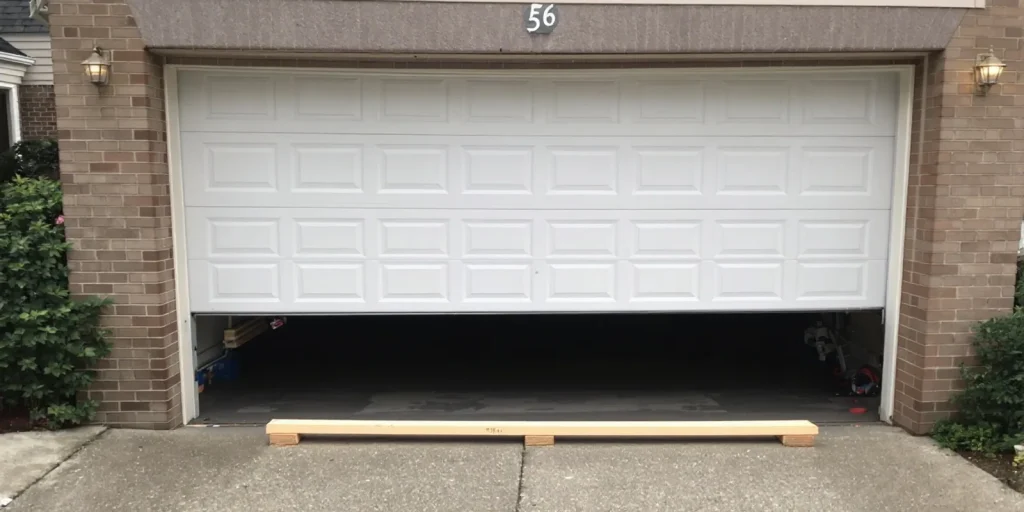
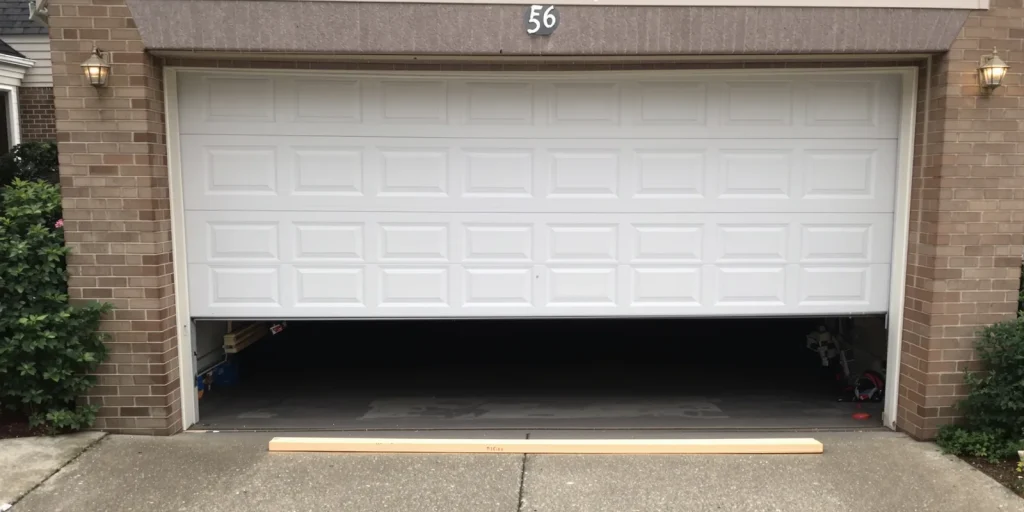
Place a roll of paper towels or a 2×4 flat on the floor in the door’s path, and close the door. It should hit the obstruction and reverse and go back up. If it stops and sits there, keeps pushing or only reverses partially, the opener’s force settings are out of adjustment. That is a genuine safety flaw, not a quirk.
- 5Run the full cycle and just listen.
Open and close the door once, nothing in the way, and you pay attention. Watch and listen for early symptoms of grinding, popping, scraping, a halfway shudder, one side lifting ahead of the other, or an opener that strains and slows. If the door is out of balance, the opener is supporting it instead of the springs, and openers are not built to do that job for long. Note what you hear and tell us when you call.
Stop there. Some of this is not a DIY job, and this is not about liability, it is about injury
→ Do not adjust, tighten, loosen or remove a torsion or extension spring. A household torsion spring stores enough energy to break bones, and has killed people. The winding cone needs special bars and technique, and the failure mode is instant.
→ Do not loosen the bottom brackets. Do not touch the lift cables. Even with the door closed and resting on the ground, these brackets are under full spring tension.
Do not lever a door back on to its tracks. If a door is off track, unequal tension on the cable can cause it to drop or twist without warning.
→ There’s also a hands-on balance test you’ll see recommended online — disconnect the opener and manually lift the door. It’s a legitimate test, but it puts you under a heavy door with springs of unknown condition. Let the tech do that one.
Everything above this box is safe for you. Everything in this box is a phone call: 833-435-4540
How to pick a company for the inspection
An inspection is only as good as what the person doing the inspection is willing to tell you. The industry has a well-deserved reputation for “free safety inspections” that exist to generate a replacement quote, and the tell is usually the same: a tech who spends four minutes at the door and then produces a five-figure number for a complete new system. It takes time to do a real inspection because it takes time to measure spring balance and test closing force.
Before you book the inspection, ask what it actually covers. A proper garage door safety inspection service will include the counterbalance system, the cables and drums, all the rolling and pivoting hardware, the track geometry, the mechanical condition of the opener and both entrapment protection systems, the photo-eyes and the force reversal. If the answer is vague, or the price is quoted before anyone has seen the door, you know what sort of visit it is going to be. Ask if the technician carries parts as well, because an inspection that just gives you a list is only half a job.
Before you book anyone, ask two questions: “Are you the company sending the technician, or are you selling my information to someone else?” and “Will the technician show me the worn parts on my door before you quote a price?” The answers will tell you nearly everything you need to know.
Garage Door Safety Inspection Frequently Asked Questions
How Often Do You Need to Check Your Garage Door?
Once a year, for a typical household. More often if the garage is your main entry and the door goes up and down a few times a day. Springs are rated by cycles, not years, by the manufacturers, so it’s usage that counts. Between professional visits, run the five-step homeowner check above monthly — it takes five minutes and catches most problems while they’re still small.
What is included in a garage door safety inspection?
Springs and containment hardware, lift cables, drums, rollers, hinges, brackets and fasteners, track alignment and anchoring, weather seal, door balance and the opener, including its drive mechanism, travel limits, closing force, photo-eye sensors and auto-reverse function. It tells you what’s wearing, what’s in spec and what needs attention now and the reasoning behind each.
My door is good. Does an inspection have to be done?
The door that works fine is the one most likely to have a problem you can’t see. Frayed cables, springs at the end of their life cycle, and disabled safety sensors all live together happily with a door that opens and closes on command. The failures are sudden, and they happen with the door in motion. That is the case for checking it before it tells you.
Can I do the inspection myself?
A part of it. The above checklist includes visual checks, the sensor test, the auto-reverse test and listening to a full cycle. All safe and genuinely useful. What you can’t do safely is anything with the springs, the lift cables, the bottom brackets or a door that’s off its tracks. Those parts have enough stored tension to cause serious injury, and there’s no careful-homeowner version of that kind of work.
What if the inspection reveals a problem?
We show you the part that’s on your door, explain what is wrong with it and what will happen if it’s left, and give you a price before any work is done. Most of the problems can be solved in the same visit if you want them to be solved because the vans carry springs, cables, rollers, hinges, sensors and opener parts. If you prefer to think about it, that’s fine — you’ll still get a good idea of the condition of the door.
Have the door checked before it makes the decision for you
Most garage door emergencies were obvious weeks before they happened — a frayed strand, a spring that was near the end of its cycle count, a sensor that had stopped reversing the door. That inspection is the cheap part of that timeline. Century Garage Door Service will run through the entire system, test it properly and let you know exactly where your door stands.
Call Century Garage Door Service at 833-435-4540 to schedule a garage door safety inspection.
Related Services
Repairing Garage Door Springs
Broken or worn torsion and extension springs replaced in matched pairs rated to the real weight of your door.
Replace Garage Door Cables
Replaced lift cables that were frayed, snapped or slipped; reset drum tension for square lift.
Garage Door Opener Repair
Sensors, force settings, travel limits, gears and drives — fixed on LiftMaster, Genie, Chamberlain and Craftsman units.