
Garage Door Maintenance Checklist: What to Check, How Often, and What to Leave Alone
The short answer
The best garage door lubricant for a residential door is a silicone spray or a white lithium grease, and the water-displacing penetrating spray most people reach for is neither one. For a full pass done by somebody who does it daily, call Century Garage Door Service at 833-435-4540.
It’s Saturday morning. The coffee is hot. The garage door is opening. Like it always does. Today it should be okay. But will garage door maintenance be enough to save you from that morning when the door simply won’t open?
The expensive parts that will fail (springs and cables) are not able to be serviced by the owner. They wear out on a cycle count regardless of how often the hinges are oiled. Regular garage door maintenance monitoring allows for that wear to be caught prior to failure, usually as a scheduled maintenance item and not with your car stranded.
Table of Contents
The short answer on garage door maintenance
Look at the door and listen to it for any signs of distress once a month. Twice a year, simply lubricate the hinges and roller bearings. Make sure the tracks are clean and any bolts are tightened up as needed. Have your door checked by a qualified technician annually for wear on the springs, cables, balance and for correct opener settings.
That’s the whole routine. Many people skip the monthly look because the door seems fine, but that is when the early signs of wear are usually visible, and a worn part will usually get louder or slower before it breaks.
Your garage door maintenance checklist
Print this out and stick it to the wall next to your opener button. The right-hand column is of equal interest to the left-hand column, because it shows where garage door maintenance stops being a homeowner job.
| Task | How often | Who does it |
|---|---|---|
| Watch and listen to a full open and close | Monthly | You |
| Test the auto-reverse with an object under the door | Monthly | You |
| Test the photo eyes by breaking the beam | Monthly | You |
| Look at the springs and cables from the floor | Monthly | You, looking only |
| Lubricate hinges and roller bearings | Twice a year | You |
| Wipe the tracks clean, no grease | Twice a year | You |
| Snug hinge and track bracket bolts | Twice a year | You, never the bottom corner brackets |
| Check the bottom seal and weatherstripping | Twice a year | You |
| Wash the door and look for rust or cracks | Twice a year | You |
| Replace remote and keypad batteries | Yearly | You |
| Springs, cables, drums and balance | Yearly | A technician |
| Opener force and travel settings | Yearly | A technician |
Note the dividing line here. All tasks that you perform with your own hands are done with your feet on the floor or on a short step stool near the hinges. All tasks under tension are the responsibility of the technician.
The monthly look: five minutes from the floor
The monthly monitoring part of garage door maintenance. Go stand in the garage and open and close the door fully several times. Watch it move. Does it move smoothly? Does it jerk? Is one side higher than the other? Is it louder than previously?
Then two quick safety tests, because they’re the ones that protect people.
Stop using the opener’s close button immediately if either test fails. A door that will not reverse may harm a child or a pet. Our garage door safety inspection visit will cover this.
The auto-reverse test
Lay a piece of scrap wood flat on the floor where the door closes, then close the door. It should touch the wood and reverse right away
The photo eye test
Start closing the door, then pass a broom handle through the invisible beam between the two sensors near the floor. The door should stop and go back up
The floor-level look
Without touching anything, look at the springs on the bar above the door and the cables running down the sides. You're looking for a gap in a coil, rust on the springs, frayed strands of cable or a cable riding loose on its drum
The twice-a-year job: lubricate and tighten
This is the hands-on part of garage door maintenance. It lasts about as long as it takes to make a pot of coffee. Do this in the spring and fall before the weather turns.
When lubricating your garage door, use a lubricant specifically designed for garage doors and avoid typical household cleaners that may clean but not lubricate. In this garage door lubricant guide, we reveal which lubricants are best and which to avoid.
Close the door and unplug the opener, so nobody starts it while your hands are near the hinges
Wipe the tracks with a dry cloth
Clean, not greased, because grease in a track collects grit
Spray each hinge where it pivots, then the bearings at the center of each roller
Snug the hinge bolts and track bracket bolts with a socket wrench
Snug, not cranked down
Look over the bottom seal for cracks or flattened spots, and check the weatherstripping along the sides
Plug the opener back in and run the door a few times to work the lubricant in, then wipe off any drips
Need a Professional Tune-Up?
Skip the ladder. Our local technicians perform full safety inspections and comprehensive lubrication to keep your system running silently.
How often should I service my garage door?
It’s the question everyone asks, and the honest answer is that it depends on how hard your door works. How often should I service my garage door if it’s the main way into the house? More often than a door that opens twice a day.
A good baseline for garage door maintenance:
- Monthly: the five-minute look and the two safety tests
- Twice a year: lubrication, tracks, bolts and seals
- Once a year: a technician’s check of springs, cables, balance and opener settings
- More often if the door is your family’s front door in practice, if you live near salt air, if the door sits through hard winters, or if it’s an older door
A busy door will burn up its spring cycles faster than a slower moving door so the yearly check by a technician will be even more relevant.
What an annual garage door inspection covers
An annual garage door inspection is the half of garage door maintenance that you hand off to the technician. This is the stuff that you have been warned not to touch, and these are the items the technician will check:
- Springs, checked for wear, rust, gaps and how much life they have left
- Lift cables, checked for fraying where they wrap the drums
- Drums and bearing plates at each end of the spring bar
- Rollers and hinges, checked for wear the lubricant can’t fix
- Balance, so the springs carry the door and the opener doesn’t have to
- Opener force and travel settings, plus the auto-reverse and photo eyes
- Door sections, looked over for cracks, loose hardware or water damage
The quote for any parts required will be given to you in writing before any work is undertaken, and nothing starts until you approve it. Where it makes sense, this work can be done alongside a full tune-up, and further details on the additional work included in a tune-up can be found in our garage door tune up cost guide.
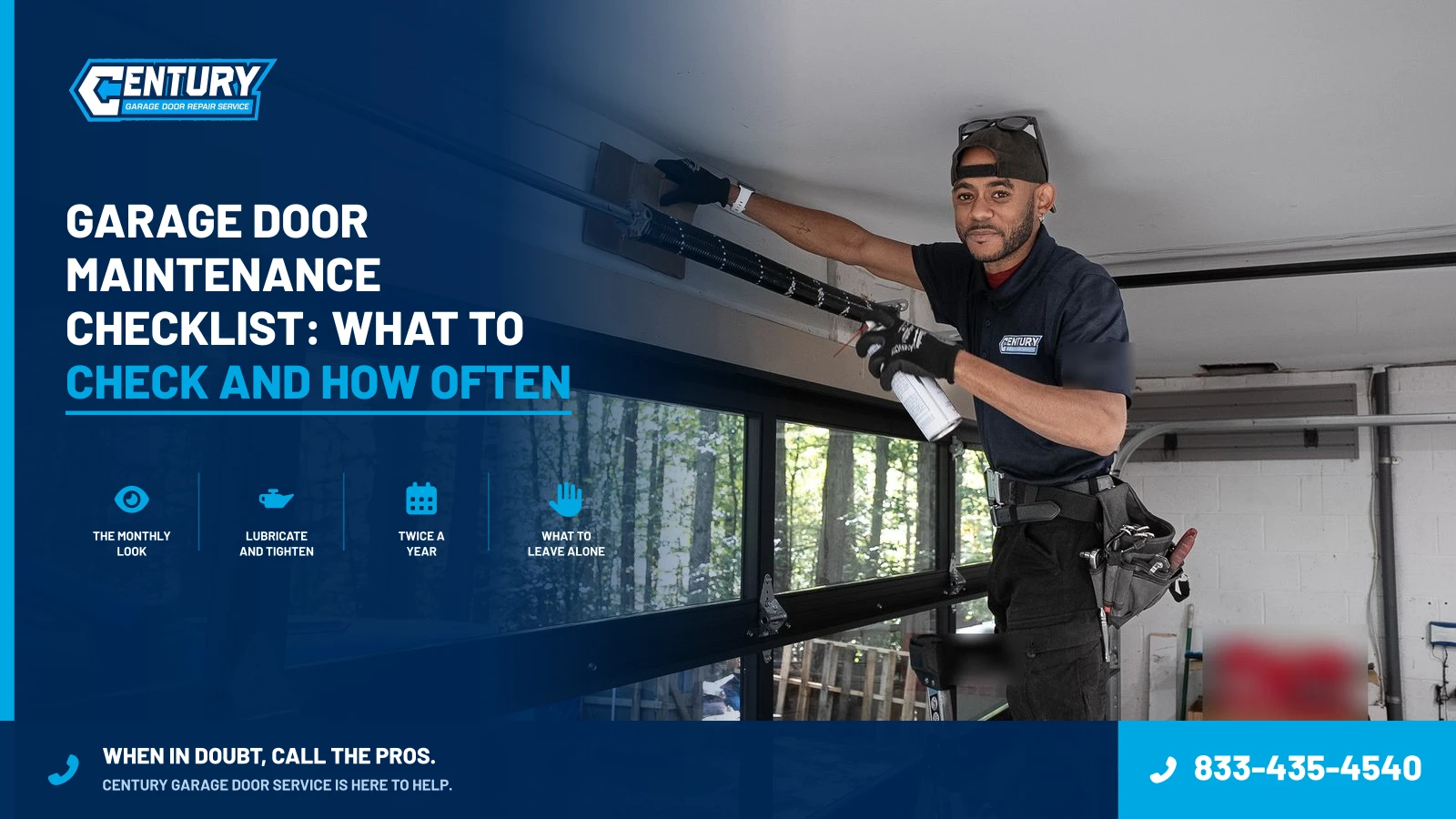
ALT: technician doing garage door maintenance on the springs and cables during an annual inspection
Seasonal garage door maintenance
Seasonal garage door maintenance is mostly about the weather your door lives in.
Before winter. Cold thickens old lubricant and stiffens rubber seals, so a door that was quiet in October can strain in January. Lubricate in the fall and check the bottom seal for gaps that let in cold air and snowmelt. Fresh batteries in the keypad help too, because it tends to quit on the first cold morning.
Summer and dust. Heat and dust dry out hinges faster. If your garage is dusty, wipe the tracks more often.
Near the coast. Salt air is hard on steel. Rinse the door with fresh water every so often and look for rust on hinges, rollers, track brackets and the spring bar.
After a big storm. Run the door and watch it. Wind and debris can knock a track or a panel out of line.
What to leave alone
This is the line that keeps garage door maintenance safe, and it’s not a suggestion.
Never adjust, wind, unwind, replace, or release the tension on the torsion springs above the door or the lift cables running down the sides, because they hold hundreds of pounds of stored energy and get replaced with winding bars by a trained technician. Drive gear internals and main power wiring are technician work too.
The bottom corner of the doors has brackets that attach to the lift cables under tension. Do not loosen any bolts in these areas and do not grease any tracks.
Signs maintenance won't fix
Your monthly maintenance check may uncover things that garage door maintenance cannot fix. In such cases, we recommend you contact a technician.
- A loud bang from the garage, followed by a door that feels much heavier
- A gap in the coil of a torsion spring
- Frayed or slack lift cables
- A door that hangs crooked or rides higher on one side
- An opener that strains, or a door that fails the auto-reverse test
That gap in the coil is a broken spring, and it changes the rules right away.
If a spring is broken, don’t run the opener at all and don’t try to lift the door by hand, because nothing is counterbalancing the door’s full weight and the motor will strip its drive gear attempting it.
This is a job for the garage door spring repair team. The International Door Association publishes homeowner care guidance outlining the same distinction between items that the homeowner needs to check and items that a technician needs to check.
FAQs: garage door maintenance
What happens if I skip garage door maintenance?
Nothing may appear to happen for long periods. However, a hinge may start to squeak as it dries out. A roller may start to wear flat. Bolts may start to rattle loose. It isn’t until the opener has to work harder to move a dragging door that the real cost of ignoring it becomes apparent. Then a worn cable or spring that a yearly check would have caught fails, often on a cold morning.
Should a new garage door get an annual garage door inspection?
Even new doors need to be checked every year. Springs and cables in the door start cycling as soon as the door is opened for the first time. A new opener has pre-set force and reversal settings, which can slowly start to drift. A simple check on a new door is mainly to verify that everything is in order. The check also sets a baseline of wear for the springs in your garage.
What should I never do during garage door maintenance?
Do not touch springs, lift cables, drums or bottom corner brackets, as they are under tension and can cause serious harm. Never grease door tracks or use household cleaners to lubricate them. Also, NEVER work on the door while the opener is plugged in. A simple gap in a spring coil is enough to warrant a call to 833-435-4540 rather than trying to run the door again.
How do I keep my garage door from rusting?
The door should be washed a couple of times a year with mild soap and water, then rinsed and dried along the bottom edge. Touch up any chipped paint before it starts to rust. If you are near the coast, rinse the door with fresh water as often as you can to remove salt. Rust on the springs or spring bar needs a technician, so note it for your yearly check.
Does the garage door opener need maintenance too?
Yes, a little. That’s part of normal garage door maintenance, and it’s all the same routine. The batteries for the remotes and keypads need to be replaced every year, and the photo eye lenses need cleaning from time to time. Once a month, run the auto-reverse test. A chain drive needs occasional tensioning as indicated in your opener’s manual. Whatever is inside the motor housing, like the drive gear and wiring, needs a technician.
Can I pressure wash my garage door?
In order to avoid damaging seals or paint, do not use a pressure washer. In addition to getting into small openings, high-pressure water can be damaging. Clean the exterior of your door with a garden hose and a soft brush with mild soap. Be careful to keep the spray away from your door opener and the photo eye sensors. Allow the door to completely dry before opening and closing it.
Is garage door maintenance different for a wood door?
Unlike steel doors, wood doors require more garage door maintenance. Every year or so you need to check the finish for peeling and bare spots and re-finish as necessary before the moisture seeps into the grain. The bottom of the door is particularly susceptible to rot so that needs to be inspected too. The springs and cables on a wood door are serviced annually just like any other door.
Keep the door running
If your checklist reveals something amiss, call Century Garage Door Repair Service at 833-435-4540. A real person answers your call 24/7 and sets a 2 hour window for your arrival time. You will receive a text message when the truck is en route. A written quote will be provided before work commences. Stocked trucks can usually complete repairs in a single visit. Seniors and military members receive a standing discount, and so do first responders.
Table of Contents
Emergency Repair?
Did a loud bang follow a door that won't lift? Don't risk injury. We offer rapid emergency response.