
Garage Door Lock Replacement: How to Change a Garage Door Lock
Your door has one piece of hardware that has a job to do even when nothing is moving, and that is the garage door lock. If the cylinder seizes, the key snaps off, the lock bars fail to reach the track or the handle wobbles loose in your hand, you are left with a door that will not lock or will not open. Century Garage Door Service replaces and repairs all types of garage lock hardware including keyed T-handles, side slide locks, interior deadbolts, latches and pull handles on residential and light commercial doors. Call 833-435-4540 and tell us how your lock is acting.
- All T-handles, slide bolts and all common garage door latches replaced with keyed and non-keyed hardware
- Realigned lock bars, side brackets and strike plates so the mechanism actually works
- Loose or broken garage door handle replaced and re-anchored to the panel, not just tightened
Century Garage Door Service · 120 NW 25th St #204, Miami, FL 33127
Request an Estimate
We’ll get back to you within 15 minutes.
Who Really Answers When You Call
Most of what you find when you search garage door lock replacement is a call center. You tell your problem to someone who’s never seen a garage door, they sell your details to whichever contractor bids on the ZIP code, and a stranger shows up not knowing what you were told on the phone. Century is not that. We are a garage door company that uses its own technicians, its own trucks and puts its own name on the invoice. The person who answers your phone works here, and the person who comes to your door works here too.
The process is deliberately simple. You call 833-435-4540 and describe the symptom – key will not turn, handle spins, lock bar misses the track, door locked shut with the car inside. The lock hardware that works depends on what kind of door you have and if you have an opener attached, so we ask. A tech will come out and check the lock and strike points and the panel the handle bolts through and give you a price before any work is done. If the fix is less than you feared, we tell you that.
Our vans have the hardware this job really needs: keyed T-handle assemblies with matched cylinders, non-keyed inside handles, side slide locks in standard and heavy-duty gauge, lock bars and guides, strike brackets, spring-loaded latches, pull handles, hasps, carriage bolts and backing plates for panels drilled out by previous repairs. Techs carry key blanks and cutting tools for common cylinders and drill bits for steel and for composite panel skins. Most of the lock work is done in one visit, because parts are already on board.
What a Proper Lock Replacement Should Look Like
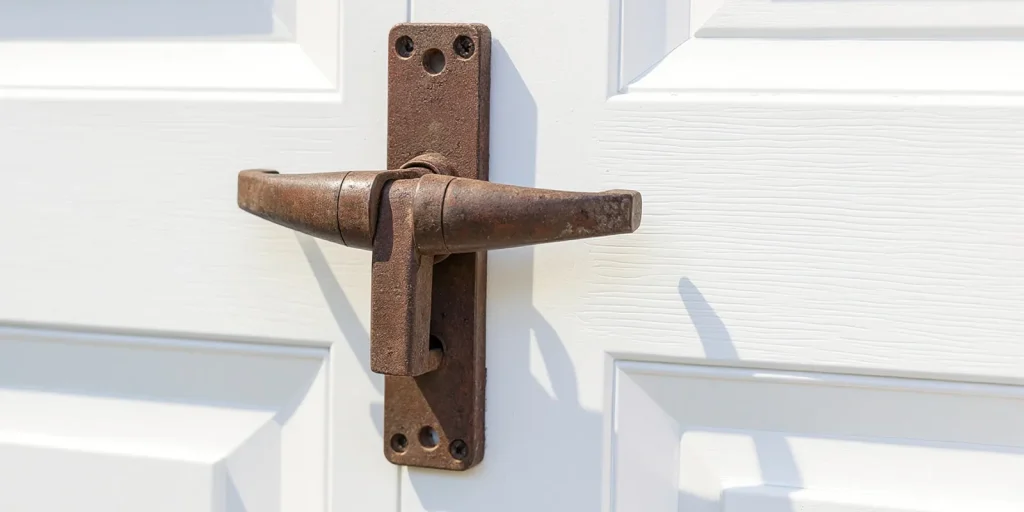
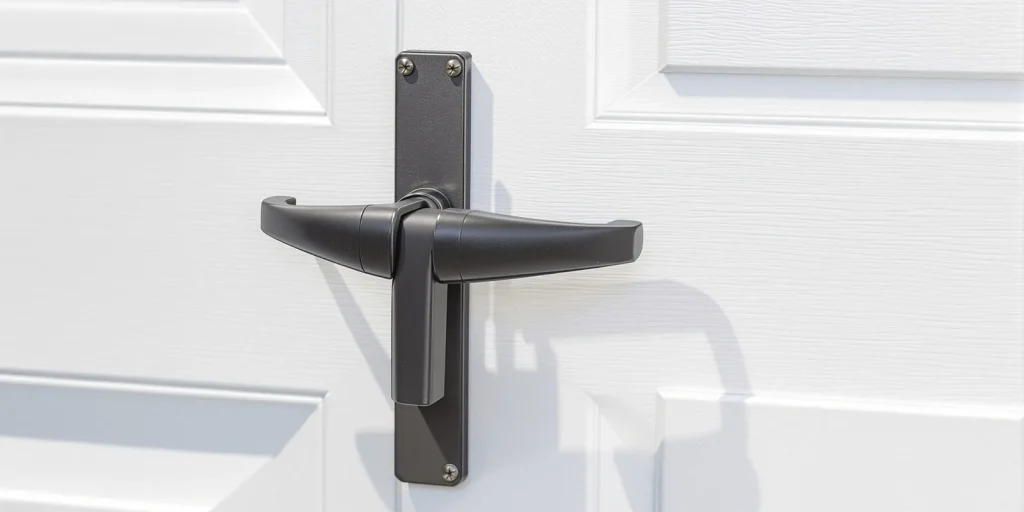
Same panel, same door. The old T-handle had rusted solid and the lock bars were a half-inch short of the track guides and the door read as “locked” without ever engaging. The new back plate was fitted to take the replacement handle, the bars cut and set to the correct throw and the strike brackets repositioned so the mechanism seats every time.
The Problems with Garage Door Locks and Our Solutions
A garage door locking mechanism is not just one part but is actually a series of parts. The handle turns a cam which pushes two lock bars out to the left and right, and these bars drop into guides or brackets fixed to the vertical tracks. Break the chain anywhere and the whole thing stops working, even though the part you can see and touch looks fine. These are the four failures we are most often asked to address.
The key won't turn, or it turns but does nothing
Garage locks live in the worst possible environment for a cylinder – road grit, sprinkler overspray, temperature swings and years without lubrication. Eventually the pins bind and the key no longer turns, or the cylinder spins freely because the cam behind it has been stripped or sheared off. On a t handle garage door lock, the cylinder is usually replaceable on its own, and that is the cheaper way. If the housing is corroded or the retaining clip has rusted into the casting, we replace the entire lock assembly and cut you new keys right there.
The lock bars miss the track, or one side only engages
Each garage door lock bar extends from the center handle out to a guide bracket on the vertical track. In time the bars will bend, the guides will loosen or the door will settle a fraction of an inch in its opening and the bar will suddenly hit the edge of the bracket rather than sliding through it. Homeowners usually find one side catches while the other side is fine to engage. We straighten or replace the bars, cut them to the proper length and reset the guides and strike brackets so both sides will throw fully. If a door has moved, we’ll realign it instead of just bending the hardware to make it work.
Handle is loose, cracked or pulled through the panel
Garage door handles take a lot of abuse and the panel behind them is thin steel or a composite skin. The years of pulling the garage door lift handle enlarges the bolt holes until the handle rocks in place and then the fasteners tear straight through. Tightening the nuts is a short term fix and makes the hole worse. A proper garage door handle replacement includes a new handle, new carriage bolts, and a steel backing plate that spreads the load across the panel, rather than concentrating it on two holes. Where the panel is already torn, often we can reinforce the section of panel rather than replacing it.
The latch will not release or the door is locked shut
A jam in the engaged position of a garage door latch is treated as urgent because your car is usually on the wrong side of it. This occurs when a spring-loaded latch has lost its spring, when a slide lock has been forced against a bound-up door or when an opener has tried to lift a manually locked door. Where possible we release the door without cutting panels, and then find out what caused the bind because a latch that jammed once will jam again if the underlying alignment is not corrected.
Repair the Lock or Replace the Whole Setup?
Not all lock issues require new hardware and we’d rather tell you that at the door than after the invoice. The dividing line generally is whether the housing and panel are sound. If the lock body is solid and the panel behind it is intact, we repair it. The honest answer is if the casting is corroded, the panel is torn or there is no real locking hardware on the door at all, then replacement is the answer.
Rebuild or Repair Existing Locks
-
It works best when the body and panel are in good condition and only one part of the chain has failed.
-
Replace a seized or spinning key cylinder and make new keys for it
-
Straighten, re-cut or replace bent lock bars and reset throw distance
-
Adjust loose strike brackets and track guides so both bars are fully engaged
-
Lubricate and re-tension a sticky latch or slide bolt, and clean it
Total Lock Replacement and Security Upgrade
-
Most effective when the hardware is corroded, the panel is damaged, keys lost or copied, or the door was never really secured.
-
New keyed T-handle assembly with matching cylinders, secured by a steel backing plate
-
Added heavy gauge side slide locks – inside garage door lock that does not use the key cylinder at all
-
Manual garage door lock hardware for detached and no opener doors, hasp and garage door padlock points
-
Fitted interior deadbolt or slide bolt where you want a second, non-keyed layer
How to Lock a Garage Door Properly and Check Your Hardware
Many people want to know how to lock garage door hardware when they just found out theirs does not actually lock. The handle turns but nothing engages. Checking and maintaining a lock is reasonable homeowner work. Always do all of the following with the door fully closed and the door opener unplugged and stop at anything requiring force.
-
1
Before you touch the lock, unplug the opener.
It is not optional. When a manual lock is engaged and an opener is instructed to open, it will try to lift a door that cannot move. Unplug at the ceiling outlet, not at the wall switch.
-
2
Figure out what you really have.
Look for a center T-handle with two horizontal bars that go to the tracks, a side slide lock near the bottom-left or bottom-right roller, an interior slide bolt or a hasp for a padlock. There are many doors that have a handle that looks like a lock but is a pull only. If turning the handle does not result in anything entering the track, the door has no operable lock regardless of what the handle does.
-
3
Watch the bars move.
Turn the handle and follow each lock bar out to its guide. Both should slide through the bracket and clear of the edge of the track by a good margin. The handle you are turning is not at fault. It is a bar that stops short, scrapes the bracket or drops below the opening.
-
4
Recheck fasteners and clean and lubricate.
Scrape grit from the bars and guides. Apply a light spray of lubricant to the moving hardware and graphite or dry lubricant to the key cylinder – never a heavy oil, which gathers dust and makes the cylinder worse. Ensure the handle bolts and bracket screws are tight. If a bolt is spinning and not tightening, the panel behind it is bad and needs a backing plate, not more torque.
-
5
Try it out, and then figure out how you’re going to use it.
With the opener still unplugged, put the lock on and see if you can lift the door up a few inches by hand. It must not move. If you want a roll up door lock from inside, or any interior slide bolt, make sure you can reach and release it from where you normally stand. Always unplug or relock consistently: if you have a manual lock on a door with an opener, use the lock or vacation mode on the opener simultaneously so no one can send a command to the door.
If any of these conditions occur, stop and call a technician.
Never lock a manual lock with the opener energized. The motor will try to push against a locked door and can bend panels, snap cables or destroy the opener's gear assembly. Never attempt to force, pry or cut a lock free on an off-track door, a door with a broken spring, or one with a visibly slack or frayed cable. Those doors are under stored tension and are the source of the most serious injuries we see with garage doors.
For any reason, including to reach a lock, do not disassemble or adjust springs, cables or the bottom brackets to which they are anchored. This is not a legal disclaimer – those things can fly off hard enough to break bones. Call 833-435-4540 and get a technician to safely release the door.
How to Select a Person to Change the Lock on Your Garage Door
The trouble with lock work is that it looks small, which is exactly why it is not done well. A hurried tech will slap on a new handle over a ripped panel, leave the lock bars at their factory length instead of cutting them to your door, and call it complete. It will feel okay for a month. Then the bar drifts, the handle starts rocking again and you are paying twice for the same repair. The difference between a lock that lasts a decade and one that fails by springtime is almost entirely in the parts you can’t see – the backing plate, the bar length, the position of the bracket.
Beware of anyone who will give you a set price to replace your garage door locks over the phone without asking you what type of garage door you have. Lock hardware isn’t one size fits all. A keyed T-handle for a sectional door is not the same part as a slide lock on a roll-up. A door that has an opener requires a different security approach than a detached garage with no power at all. A quote before anyone has seen the door is a number to get a van in your driveway, not a price you will actually pay.
Before you book anyone ask two questions. Are you just replacing the lock hardware or fixing what caused it to fail? And are the technicians your own employees or subbed out from a lead service? The answers tell you just about everything you are buying.
The Garage Door Lock Questions We Hear
Can you just change the lock or do you have to change the whole handle?
Normally just the lock. The cylinder is a separate piece on most keyed handles. It is held in by a clip. This allows you to change the cylinder while the housing stays on the door. That’s the cheaper repair and it’s always the first thing we’ll check for. If the casting is cracked or corroded, the cam behind the cylinder is stripped or the panel underneath has been chewed up by loose bolts, then the handle itself has to be replaced. A technician can tell which it is in a minute or two of looking at it.
I lost my keys. Can the lock be re-keyed instead of having to be replaced?
More frequently than not, we change out the cylinder rather than rekey it because garage door lock cylinders are cheap, and a new one includes new keys and none of the wear that the old one had. If you want your garage door handle with lock to be keyed the same as two doors or to match an existing set, let us know when you call so the correct cylinders come out on the van. Replacing the cylinder is the right call even if the old one still works, if your keys were lost somewhere they could be traced back to your address.
My door is automatic. Do I need a lock for garage door security?
An opener is not a lock. Under normal conditions it holds the door closed. Most homeowners with openers can benefit from an interior slide lock used selectively, when traveling, when the garage holds tools or a second vehicle, or on a detached garage that sees little traffic. The point is, this is a lock you can operate without having to wrestle with the opener. That is why we install interior locks that are simple to reach and release, and recommend that you use your opener’s lock or vacation setting at the same time. Garage door locks with openers should be secure, not a daily hazard.
What is the difference between an outside garage door lock and an inside garage door lock?
An outside garage door lock is the keyed T-handle that you operate from the driveway and it allows you to lock and unlock the door without having to go into the house. An inside lock is a slide bolt or bar that can only be operated from inside the garage (and is not pickable or drillable from the outside) but it can’t be released if you’re standing in the driveway. Many homes are best served by both: keyed hardware for everyday use, and a heavier interior garage door latch lock for longer absences. We fit whatever combination works for the way you actually use your garage.
My handle turns but the door opens still. Is it dangerous?
Most times a failed garage door lock handle just means the door is left unsecured. It’s not dangerous on its own. The risk is assuming it works. Homeowners leave for a week thinking the door is locked when the bars never left the housing. It’s a real problem in reverse too: if the mechanism partially engages without your knowing and the opener runs you can end up with bent panels and a much larger repair. If the handle moves freely and nothing happens at the tracks, consider the door unlocked. Have the mechanism checked.
Fix Your Garage Door Lock Properly
Whether the key broke off in the cylinder this morning, the handle has been rocking loose for a year, or you’ve just now realized the lock on your door has never actually engaged, it’s a fixable problem with a clear price attached. Call and tell us what the lock is doing. We will tell you if it sounds like a cylinder, bar, bracket or panel, and what the cost is to fix each of them.
If your garage door is locked shut with a vehicle inside, call instead of forcing it. Normally, you can open a door that’s stuck in the latch without damage, but not after someone’s pried at it.
Related Services For Garage Door
Garage Door Opener Service
Openers that grind, reverse or refuse to be controlled remotely – such as those damaged by running into a locked door.
Garage Door Off Track Repairs
Doors that have jumped the track or bind on the rollers or moved enough that the lock hardware no longer lines up.
Garage Door Panel Replacement
Single panel replacement for sections torn at the handle, dented at the bottom rail, or damaged by a forced entry attempt.