
Custom Garage Door Installation
- Doors built to your exact opening, out-of-square, oversized and low-headroom garages included.
- Clopay garage doors, plus Amarr, Wayne Dalton and Overhead Door — steel, wood-look, glass-and-aluminum, insulated and roll-up.
- Springs, garage door track and opener specced to the finished door’s weight, not to a generic chart
Openings for homes and businesses. If a stock size will serve you better than a custom build, we’ll tell you straight.
Request an Estimate
We’ll get back to you within 15 minutes.
Who Really Comes To Your House
Century Garage Door Service is a garage door company, not a lead broker. That distinction sounds like a small thing, but it’s a big one. If you’re searching for garage door installation, a good chunk of what you get are marketing companies. They get your address and phone number, then they sell that to whoever will pay them the most that week, and they’re out of the transaction completely. You never know who is coming, what they are carrying or who to call when a panel arrives damaged. So when you call 833-435-4540 you will reach us and the person who measures your opening is employed by the same company that installs the door.
The process for a custom door is intentionally slower on the front end than a standard garage door replacement, since everything downstream depends on getting the first visit right. A technician measures the rough opening, headroom, backroom and sideroom, checks to see if the jambs are square and plumb, notes your ceiling obstructions and where the power sits, and takes photographs of the elevation. Instead of seeing it in a showroom you can see the material, style of panels, window and finish choices against your own house. Then we quote the door, the hardware and the labor as one number and the order goes to the manufacturer built to those measurements. The same information goes to the install crew when the door is delivered.
Our vans are loaded to do a custom install in one visit, not half a visit. That includes torsion springs in a variety of wire sizes and lengths so the door can be balanced to its true weight, tracks in several radii for standard-lift, low-headroom and high-lift configurations, hinges, rollers, bearing plates, brackets, struts, cables, weatherseal, jamb material, fasteners and shims. It also means the tools for the awkward parts of a custom job — laser level, rotary hammer for masonry jambs, and the lift equipment for heavy insulated and solid-panel sections. If you want to hang onto your existing garage door openers we carry the rail extensions, brackets and reinforcement plates to marry an older opener to a new, heavier door.
See The Difference A Well Built Door Makes
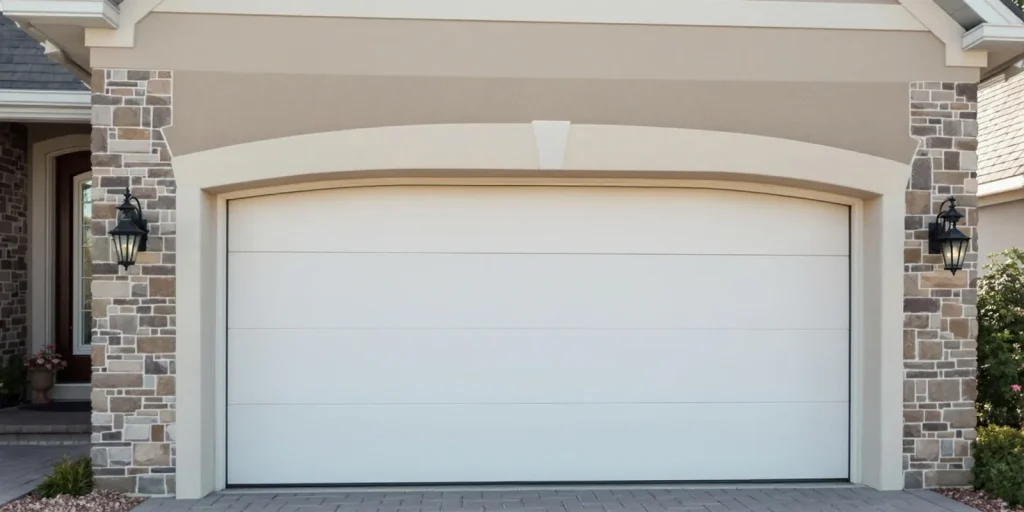
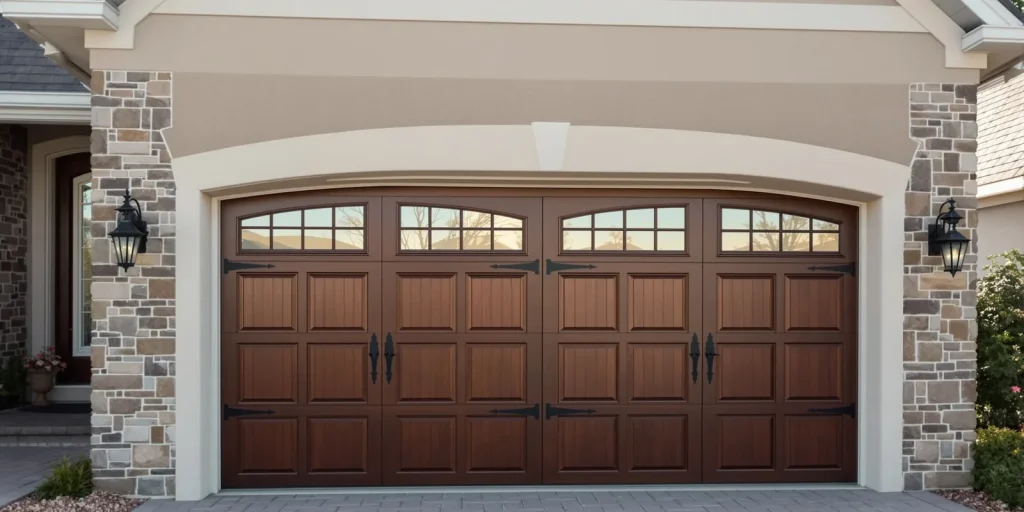
Same opening, same workday. The original door was a builder grade panel cut down to fit an opening it was never sized for, thus the gaps at the jamb never closed. The replacement is an insulated carriage-house door built to the measured opening, hung on a new track with springs matched to the finished weight.
What Makes a Garage Door Custom — And What We Do
“Custom” is a big word. Sometimes it means a size no manufacturer carries. Sometimes the size is normal and the look is not. Sometimes the door is standard, but the garage is not. The whole hardware package has to be reconfigured to make it work. Here’s what usually causes a garage door to need a custom installation, and how we handle each one.
Openings of non-standard sizes
Stock residential garage doors are only available in a few widths and heights. Older houses, converted carports, additions and commercial bays routinely don’t make that list — sometimes by a couple of inches, sometimes by two feet. Most long-term garage door problems start with cutting a stock door down or packing out the opening to force a fit: the panels no longer sit square in the track, the seal at the jamb never closes and the door wears its rollers and hinges unevenly. We measure the rough opening, see how far out of square and out of plumb the jambs are, and order the door built to those dimensions so the panels, track and weatherseal all fall where they should.
Materials, insulation and finish
Material impacts cost, weight and maintenance and the sound the door makes as it runs. Steel garage doors are the workhorse, durable and low-maintenance, in flush, raised-panel and carriage-house styles with wood-grain embossing that reads convincingly from the street. You get the real thing with wood and wood-composite — and the maintenance that goes with it. Aluminum and glass full view suits modern elevations and commercial frontages. Roll-up garage doors – where the curtain rolls up above the opening rather than back along the ceiling on track – are the answer for garages with little or no backroom, and are the usual choice for many commercial bays. In a Florida garage, insulation is more important than most people realize. An insulated sandwich-construction door with a polyurethane core cuts heat transfer into an attached garage, stiffens the panel against wind load, and runs noticeably quieter than a single-skin door.
Low headroom, high lift and awkward ceilings
The custom install is made or broken in the hardware package. A standard-lift door requires approximately 12 to 15 inches of headroom above the door opening, which is not available in many garages, particularly where there is ductwork, a water heater flue, storage racks, or a finished ceiling. That requirement can be significantly lowered with a low-headroom track with a double horizontal rail and a top-mounted or rear-mounted torsion assembly. In the other case – a shop, a lift bay, or garage with a tall ceiling you want to keep clear – a high-lift configuration moves the door higher up the wall before it turns, giving you overhead space. Both require the track radius, cable drums and spring package to be specified together. That is why we specify at the measurement visit and not on install day.
Springs, balance and the opener
You really don’t know the weight of a custom door until the panels, windows, insulation and hardware are in place. Each new door needs a spring package that matches its finished weight. The single most common reason a new door feels heavy, drifts closed or burns out an opener in a year is a garage door spring wound for the wrong weight. We figure wire size, inside diameter and length to the door as built and set the balance so the door stays wherever you stop it by hand. The same goes for the opener. We check whether your existing unit has the horsepower and rail length to support the new door, and reinforce the top section where the opener arm attaches. We’ll let you know if not. Usually it is cheaper to get a new garage door opener installed with the door than to have to replace a burned out unit six months down the road.
What You Really Need – Stock Garage Door Replacement Or Fully Custom
Not every awkward opening requires a custom door. Not every custom door costs what people think. The real test is whether a stock size can be installed square, sealed and balanced without any compromise. If it can, use the stock door and save the difference elsewhere. If it can’t then a custom build is cheaper over ten years than a forced fit you fight the whole time. This is the split.
Stock Or Semi-Custom Replacement
-
Your opening is standard size or within an inch of one. Your changes are cosmetic.
-
Opening to manufacturer’s stock width and height with normal headroom and backroom
-
You want a different panel style, color, window layout or insulation level, all available as catalog options
-
Existing jambs are good, square and plumb enough to seal against
-
New garage door on standard hardware – quickest lead time, lowest price
Full Custom Build
-
Your opening, your ceiling or your design brief rules out anything off the rack.
-
Non-standard width or height, oversized or double-bay opening, or jambs measurably out of square
-
Reconfigured track and spring package for low headroom, high-lift, or ceiling obstructions
-
Materials/finishes outside of catalog options – real wood, custom paint match, full view glass, specified hardware
-
Includes a spring package sized to the finished door weight and an opener evaluation, so the door functions correctly from day one
How to get ready for a custom garage door installation
A custom door has a real DIY element and that is long before anyone touches hardware. The measuring, planning and decision-making below is work you can do yourself, and doing it well makes the quote quicker and more accurate. Installation is not on this list and the safety box below explains why. Follow these five steps and you’ll be ready for a productive first visit.
-
1
Measure the rough opening, not the old door.
Measure the width at the top, middle and bottom of the finished opening and the height at the left, center and right. Write down all six numbers even if they are different, and especially if they are different. The variance tells us how far out of square the opening is. This is exactly the kind of information a catalog can’t give us.
-
2
Take measurements of the headroom, sideroom and backroom.
Headroom is from top of opening to lowest ceiling obstruction. Sideroom is the clear wall space to the left and right of the opening — you generally need about 4″ each side for the vertical track. Backroom is the distance from the opening, back into the garage, along the ceiling. For a standard opener set up, it should be greater than the door’s height by about 18 inches. Watch out for anything in the way. Ductwork, lighting, a flue, storage racks, a finished ceiling.
-
3
What does the door need to do besides look good?
Is it an attached, climate controlled garage or a detached shed? Is it office or bedroom upstairs? Lifted truck or boat, do you park in there? These answers will determine how much insulation, how the panels are constructed, and whether the added cost of an insulated, sandwich-construction door is worth it. Bring pictures of the front elevation of your house. Choice of panel and window should be guided by trim color, window shape and roofline and it is much easier to figure out with a picture in front of you.
-
4
Look at your opener and your power.
Write down the make and model on the motor housing — LiftMaster, Genie, Chamberlain, Craftsman — and whether it’s a chain, belt or screw drive. Make sure there is a grounded outlet at the ceiling near the motor, not a run across the rafters with an extension cord. A heavier custom door is likely to require a more capable garage door opener than the one that came with a light single-skin panel, and knowing what you have now will save a return trip.
-
5
Clear the work area before install day.
Remove vehicles, clear about 3 feet of floor on both side walls and directly in front of the opening, remove anything fragile from shelving on the common walls. If your garage ceiling is finished, or has plasterboard right at the header, let us know in advance – track and spring anchors need to go into solid framing, and knowing what’s behind the finish in advance helps us avoid having to open it up unnecessarily.
Do not try to remove the old door yourself and do not touch the springs.
The most common way people get injured preparing for a new door is trying to save an hour by pulling out the old one. Above your opening, a torsion spring holds enough energy to lift a 150- to 400-pound door. It holds that energy whether the door is up, down, or in pieces. If you don’t have the right bars and technique to unwind it, or if you cut a lifting cable while it’s under load, you can break bones, lose fingers or worse — and the panels themselves are heavy and awkward enough to cause serious injury just in coming free. The same goes for a door that has come off the track: leave it alone. This is not something that we would walk a homeowner through on the phone, because the failure mode is a trip to the emergency room, not a failed repair. Installation includes removal and disposal of the old door. Call 833-435-4540 and we’ll take care of it.
How to Pick a Garage Door Company for a Custom Installation
Search for “garage door companies near me” and the top of the first page is dominated by paid placements, a lot of it from lead-generation networks, not from anyone who actually owns a van. For stock repair that mainly costs you some hassle. If you order a custom door it costs real money. Custom orders are non-returnable. If it is measured or specced wrong, no one is taking it back. The company that sold you the lead has no obligation to fix it. First, find out who you are really hiring: a real garage door company with its own installers, or an intermediary.
Then see how the measurement is taken. Any quote from a photo from a phone or a single figure of width and height is a guess. After a visit that included measuring the opening at several points, checking head room, side room and back room, looking at the jamb condition and the ceiling and asking what is above the garage, comes a serious quote. Ask what’s included in the price. Does it include removal and disposal of the old door? New track, new spring package sized to the finished door? Weatherseal and jamb work? Are they included in the number or do they show up as line items on install day? Ask what manufacturers they install and why they are recommending that one for your opening. And ask about the warranty that covers the labor versus the manufacturer’s panel warranty because those are two different promises.
The two questions that separate the companies worth calling from the rest are: “Will the same company that measures my opening also install the door, and can I get that in writing?” and “What happens, and who pays, if the door arrives damaged or measured wrong?” A garage door repair company that installs its own work answers both without hesitation.
Custom Garage Door Installation Questions
How much more is a custom garage door than a regular one?
There’s no real single number, because “custom” runs the gamut from a repainted stock panel to a hand-built wood carriage door. The real determinants are the size, material, insulation level, window and glazing package and whether the hardware has to be reconfigured for low headroom or high lift. In insulated steel, a non-standard size is typically just a small step up from a comparable stock door. Real wood, full view glass and designated hardware is a bigger leap. What we can tell you is that the quote that you receive from us will be the door, the hardware, the spring package, removal of the old door and the labor as one figure so you can compare it against anything else on a like-for-like basis. Just call us at 833-435-4540 and we will get an accurate number in front of you.
How long does it take to order and install a custom door?
Build time is with the manufacturer, not us, and is different by brand, material and how busy their queue is when your order goes in — a custom panel configuration in steel moves faster than a hand-finished wood door. When we give you a quote, we’ll tell you the manufacturer’s current lead time and let you know if changing brands or going semi-custom will significantly shorten that lead time. The installation itself is normally a single visit once the door is on site.
Can I use my existing garage door opener with a new custom door?
Yes, often. But it must be checked, not assumed. The two things that determine this are the capacity of the opener to lift the finished weight of the new door and the suitability of the rail length to the new door height and track configuration. A custom insulated or solid wood door can weigh a lot more than the single skin panel it replaces. Running a marginal opener against that weight shortens its life. In your quote, we will examine your present unit and reinforce the upper area where the arm connects. We will only recommend a new garage door opener installation if the numbers indicate that your present one will not be able to cope.
My garage opening is out of square, will a custom door fit?
That’s the kind of situation where a custom door handles better than a stock one. Old homes and garages that have settled often have out-of-square openings and a stock door fitted into one will always have a wedge-shaped gap at the jamb that no amount of weatherseal will close properly. Since we measure width and height at several points, we know how much out of square you’re dealing with, and we adjust for it by combining the ordered door size, jamb correction and the seal package. And sometimes the right answer is a little carpentry to get the opening back a little closer to true before the door goes in. We’ll flag that at quoting instead of on install day.
Do you also install custom doors for commercial buildings?
Yes. Commercial openings often require a custom approach because bay sizes don’t often fit residential stock and the duty cycle is much higher. Depending on the opening, the backroom available and how many cycles a day the door will run, sectional steel overhead garage doors, full view aluminum and roll up door systems are available. Commercial specs affect the spring package too — a door that opens thirty times a day needs a higher-cycle spring than the residential default. Call us at 833-435-4540 with your bay dimensions and we can discuss what will work for the building.
Want to talk about your opening?
A custom garage door is one of the few home improvements that changes the look of the house from the street and how it works every single day. It deserves more than an estimate from a picture. Call Century Garage Door Service and we’ll come out and take a proper measurement of the opening, show you material and panel options against your own elevation, and give you one clear number for the door, the hardware and the labor – with no obligation to proceed.
Plus we will tell you if a stock door will do just as well. That answer costs you nothing, and it is the answer that a lead broker will never give you.
Related Garage Door Services
Garage Door Repair
Rollers. Hinges. Cables. Panels. Garage door track. We can diagnose and repair these on doors we didn’t install just as easily as the ones we did.
Garage Door Opener Installation
New LiftMaster, Genie and Chamberlain units sized to your door’s weight with the top-section reinforcement done right.
Garage Door Spring Replacement
Broken torsion or extension springs replaced and balanced to your door. One job never worth doing yourself.