
Aluminium Garage Doors: What Homeowners Should Know Before Buying
The short answer
Aluminium garage doors trade surface toughness for light weight and rust resistance, which makes them the right call within reach of salt air and the wrong call where a basketball hoop hangs over the driveway. To talk through what your opening will take, call Century Garage Door Repair Service at 833-435-4540.
Aluminium garage doors are the lightest thing you can hang on a residential opening, and the metal doesn’t rust, which is the whole reason they keep going on coastal streets where steel gives up early. The trade you make is surface hardness. Aluminium creases where steel would flex and come back, so the same door that ignores years of salt spray will carry the mark of one delivery cart forever.
That’s the deal in two sentences.
The rest of this page is about whether the deal fits your opening, your weather, your traffic, and the people who bang through that door twice a day.
Table of Contents
What aluminium garage doors are made of
Aluminium garage doors are built as a frame with fillers rather than as one solid slab. Extruded sections make up the stiles and the rails, and the openings inside that frame get filled with something else. The filler is where all the variation lives. It might be a thin aluminium sheet, a laminated composite panel, tempered glass, an acrylic sheet, or a perforated screen.
So two doors filed under the same metal can behave nothing alike. A frame packed with insulated composite infill is a different product from a bare full-view frame carrying glass.
The extrusions are hollow. That’s what keeps the weight down, and it’s also why a hard knock tends to bow a stile rather than crease it.
One naming note, because it turns up on paperwork. American spec sheets spell the metal aluminum while most of the world spells it aluminium, so a quote for garage aluminium doors and a quote for aluminum sectionals can describe the identical product. Read the alloy and the infill instead of the spelling.
Weight, and how aluminium garage doors treat an opener
Lift one section off a pallet and you have the whole story. An aluminium garage door weighs a fraction of what a comparable insulated steel door weighs, and that single fact drives most of what follows.
Light is mostly good news. The opener works less on every cycle, so the chain, the drive gear, the trolley, and the bearings above the opening all see less strain. A door an average adult can move by hand during a power cut matters on a garage that’s the only way in.
Light is not all good news. Wind gets a vote.
A big light door flexes and drums in a gust, so in a coastal or high-wind area it has to be rated and braced, usually with extra struts across the back of each section. Skip that and the first real storm bows the panels outward.
Lightness changes the counterbalance too, which gets a section of its own further down.
Salt air, and why aluminium garage doors last on the coast
This is the reason the category exists. Steel rusts because iron oxidizes into flakes that lift and spread, and they carry the paint off with them as they go. Aluminium oxidizes as well, and the film it forms is thin and tight, so it seals the surface instead of shedding off it.
Put a painted steel door within reach of onshore wind and the bottom section is where it shows first. Aluminium garage doors don’t have that failure ahead of them, which is why you see them on beach houses and on canal-front garages.
Here’s the honest catch, and it’s a big one.
The skin is aluminium. The hardware mostly isn’t. Hinges, rollers, tracks, fasteners, brackets, cables, and the counterbalance above the opening are all steel, and salt doesn’t care that the panel in front of them is immune. Galvanized or stainless hardware is worth asking for on a coastal install, and either way the hardware becomes your maintenance item rather than the door.
Wherever a steel fastener passes through aluminium you get dissimilar metals touching, and corrosion speeds up right at that point. Coated fasteners and isolating washers earn their place here.
Need a Professional Tune-Up?
Skip the ladder. Our local technicians perform full safety inspections and comprehensive lubrication to keep your system running silently.
Denting, the honest weakness of aluminium garage doors
These doors dent, and they dent in a particular way. The metal has very little spring-back, so where steel of a similar thickness flexes and returns, aluminium takes a shallow crease and keeps it. A car door edge, a bicycle handlebar, hail, a hard-thrown ball, or a delivery cart will each leave something you can still find years later.
Two things soften that. A dent in a hollow extruded stile can sometimes be worked out from behind, because there’s air back there instead of foam. And these are sectional doors, so a badly marked section comes off and gets replaced on its own, which our garage door panel replacement page covers.
Finish match is the wrinkle nobody mentions in the showroom. A section that has weathered for years reads differently next to a factory-fresh one, and replacement glass has to match the rest of the door too.
Full-view glazing and the aluminium garage door frame
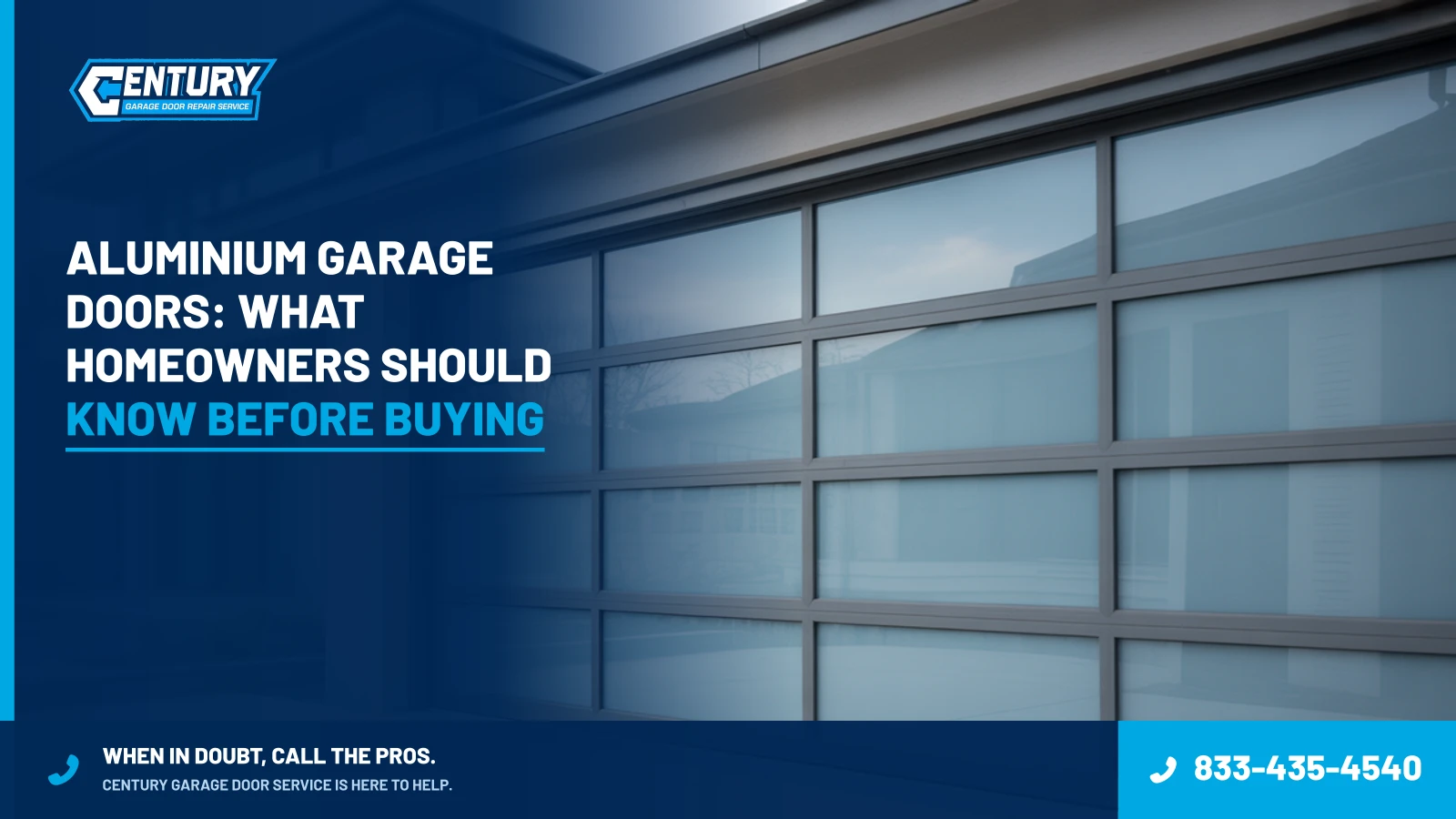
Almost every full-view door you’ve admired on a modern house is an aluminium garage door frame holding glass. Glass is heavy, so the frame around it has to be as light as it can be while staying stiff, and extruded aluminium does that better than the alternatives.
Your glazing choice changes the door completely. Clear tempered glass gives you the magazine look and no privacy at all. Frosted glass keeps the daylight and hides whatever the garage is really full of. Tinted glass cuts glare and heat gain. Insulated double glazing buys thermal performance and costs you weight.
Now the part the brochures skip. Aluminium conducts heat readily, which is the flip side of everything good about it. A full-view door is a weak thermal barrier whatever you fill the frame with, and even a solid infill door loses ground at the frame itself, because the metal bridges inside air to outside air. Thermal-break extrusions and insulated infill close part of that gap. A conditioned garage, or one under a bedroom, changes that calculation, and our garage door insulation guide covers it.
Panel layout runs wider than any one metal, and our garage door styles guide surveys it across every material.
Aluminium garage doors versus steel, side by side
Steel is the default on most streets, so aluminium garage doors get measured against it. The right-hand column is the part to read twice.
| Trait | Aluminium | Steel | What it means for you |
|---|---|---|---|
| Weight | Very light for its size | Heavier once insulated | Gentler on the opener |
| Salt air | Holds a stable oxide film | Rusts from any cut edge | Aluminium wins near onshore wind |
| Denting | Takes a crease and keeps it | Flexes before taking a set | Steel suits bikes and balls |
| Insulation | Needs a thermal break | Takes a thick foam core | Steel is the warmer door |
| Glazing | Frames large glass panels | Inserts in a solid panel | Full-view belongs to aluminium |
| Wind | Needs bracing and a rating | Stiffer to start with | Ask about the rating either way |
Neither column wins outright. The winner is whichever one matches the abuse your opening takes.
What a lighter door does to the torsion springs
The counterbalance above your opening is sized for one specific door weight. Change the door and you change the requirement.
This is the mistake I see most often on retrofits. A heavy insulated steel door comes off, a light aluminium one goes on, and nobody touches the counterbalance. The assembly is now over-sprung, so the door creeps upward on its own, fights the opener the whole way down, bangs into its stops at the top, and eventually somebody cranks the force settings around to compensate until the safety reversal stops behaving as designed.
Correct sizing is part of a correct install, not a follow-up visit. Whoever hangs the door works out the finished weight and checks the drum and shaft sizing against it. Then they fit the matching counterbalance and prove the result with a balance check.
Never adjust, wind, unwind, replace, or release the tension on the torsion springs above the door or the lift cables running down the sides, because they hold hundreds of pounds of stored energy and get replaced with winding bars by a trained technician. Drive gear internals and main power wiring are technician work too.
So this is a conversation you have with the installer, not a Saturday project. Counterbalance and cable work lives at garage door spring repair. The International Door Association homeowner safety resources (doors.org) say the same in plainer words.
A maintenance checklist for aluminium garage doors
The metal asks less of you than steel does, and most of what it does ask concerns the steel parts bolted to it.
- Rinse the skin. Fresh water after onshore wind. Mild soap and a soft cloth when the finish looks dull. No abrasive pads, because they cut the coating and the coating is the protection.
- Hunt for rust bleed. Run your eye along every hinge, fastener, bracket, and end plate. An orange streak down an aluminium panel started at a steel part above it.
- Check the glazing gaskets. Dried-out rubber lets water sit inside the frame, and water sitting in a frame goes looking for the fasteners.
- Keep the bottom seal flexible. It meets a wet slab every time it rains, and a hardened seal lets water under the lowest section.
- Listen to the door. Aluminium is a loud material. A new rattle or a drumming panel usually means a loose strut or a fastener backing out, and both are quick fixes early.
The schedules in the DASMA technical data sheets on residential garage doors (dasma.com) are what the trade works from, whatever the panels are made of.
What moves the cost of aluminium garage doors
Size and section count lead, then whether the frame holds solid infill or full-view glass, the finish, any wind rating, and the removal of the old door on a retrofit, so call Century Garage Door Repair Service at 833-435-4540 and get that written down against your own opening.
FAQs: aluminium garage doors
Are aluminium garage doors a good choice?
They’re a strong choice in the right setting and a weak one in the wrong setting. Within reach of salt air, aluminium garage doors outlast steel by a wide margin, because the panel can’t rust. Inland, on a door that takes knocks from bikes and bumpers, steel gives you far more surface hardness.
Do aluminium garage doors rust?
No. Rust is an iron reaction and there’s no iron in the panel, so what forms instead is a thin oxide film that seals the surface and stays put. The steel hardware bolted to the door is another story. Hinges, rollers, tracks, brackets, and fasteners all corrode in salt air, so ask for galvanized parts.
How long do aluminium garage doors last near the ocean?
Longer than the steel parts holding it up, which is the useful way to think about it. The panel keeps its oxide film instead of rotting away, so aluminium garage doors near onshore wind usually get retired for damage or a remodel rather than for corrosion. Hinges, rollers, fasteners, and the counterbalance hardware are what wear out on that street, and those get serviced long before the door does.
How easily does an aluminium garage door dent?
Easily enough that it should change your decision. The metal has very little spring-back, so a knock a steel panel would flex and shrug off leaves a shallow crease that stays. Hail, a car door edge, a bicycle handlebar, and a hard-thrown ball all count. The upside is that one section gets replaced on its own.
Do aluminium garage doors insulate well?
Not on their own. The metal conducts heat readily, so the frame bridges inside to outside even when the infill panels are insulated, and a full-view glass door is weaker again. Thermal-break extrusions and insulated infill help without solving it. If the garage is heated, call 833-435-4540 and weigh steel against the look.
Can I hang an aluminium door on my existing springs?
Not without resizing the counterbalance first. Springs are matched to one door weight, and dropping a light aluminium panel onto hardware set up for heavy insulated steel leaves the assembly over-sprung, so the door creeps up on its own and fights the opener coming down. Your installer sizes the counterbalance to the finished weight.
Are aluminium garage doors more expensive than steel?
Not automatically. Specification decides this more than the metal does, so a full-view glazed frame lands well above a solid infill door of the same size, while a plain aluminium panel and a comparable steel one sit closer together. Coastal hardware and wind bracing add to either. You get a written quote before any work, and the price is approved before a tool comes out. If you decline, no work is done. Call 833-435-4540.
Get a straight answer on aluminium garage doors
Aluminium garage doors suit some openings beautifully and suit others badly, and the deciding factors are your distance from salt air, the kind of traffic the door takes, whether the garage is heated space, and how much glass you want in the wall. Century Garage Door Repair Service answers live around the clock at 833-435-4540 and gives you a two-hour arrival window with a text when the truck rolls. Our trucks run stocked, so most visits finish in one trip. You get a written quote before anybody picks up a tool, and if you decline, no work is done. Seniors and military get a standing discount. So do first responders. If you’d rather have the current door and its hardware assessed first, book a garage door safety inspection.
Table of Contents
Emergency Repair?
Did a loud bang follow a door that won't lift? Don't risk injury. We offer rapid emergency response.