
Custom Garage Doors: What Homeowners Should Know Before You Order
The short answer
Custom garage doors exist for openings and specifications the stock grid can't reach, and the deciding factor is almost always the hole in your wall rather than the look you're after. To get an opening measured properly before you commit to anything, call Century Garage Door Repair Service at 833-435-4540.
You need one of the custom garage doors on the market when your opening falls off the standard grid, when it stopped being square, when the clearances around it are unusual, or when the build you want isn’t something the volume lines carry. Everything else sold as custom is a stock-sized door wearing a nicer coat.
That distinction runs through this guide, because one of them changes how the door gets engineered and the other only changes how it looks.
And the opening decides that, not the catalog.
Table of Contents
What actually makes custom garage doors custom
Two products get sold under one phrase, and mixing them up is how people end up disappointed.
The first is a garage door custom built to dimensions that don’t exist in any warehouse. A width nobody stocks, a height between the standard steps, a shape following an arched opening, or all of that at once. It’s a dimensional build, and it changes how the whole assembly gets specified.
The second is a stock-sized door dressed up. A finish nobody carries, glass laid out your way, hardware off a different page, and a color match to the front door. The size still lands on the grid, so the tracks plus the counterbalance come out of the ordinary parts bin.
Neither is wrong. But ask which you’re buying, because they differ on lead time, cost drivers, paperwork, and who can service the thing later.
Panel designs are their own decision, covered in our garage door styles guide, and standard widths and heights in our garage door sizes guide. What follows is the dimensional side of custom garage doors.
When custom garage doors are the right call
Nobody orders custom garage doors for fun. You order one because the opening leaves no shorter road, and five situations cover most of it.
- The opening is off the grid. Width or height falls between the standard steps, so a stock door won’t cover the hole or won’t clear the hardware.
- The garage was converted. A closed-in carport, or a barn bay somebody decided to make weathertight.
- The house is old. Masonry settles, timber headers deflect, jambs move, and the hole you have today isn’t the hole somebody built.
- Two bays have to match. Where one opening is standard and its neighbor isn’t, matching sections beat two doors that almost agree.
- The build isn’t stock. A finish, a glazing layout, an insulation build, or a wind-rated construction the volume lines don’t offer.
Notice what’s missing. Nobody needs a custom garage door because a stock one felt boring, and a decent technician will say so.
Out-of-square openings, and what one tape measure won't tell you
Measure the width at the top of the opening. Then measure it again down at the floor.
If those two numbers disagree, you’ve found the reason build-to-order doors exist. A sectional door is a rigid rectangle running in two straight tracks, and the opening it covers is masonry or timber that has been moving since the day it went up. Headers deflect under the load above them. Slabs heave and settle. Jambs drift out of plumb, and a garage framed dead square gets pulled crooked by the house around it.
So the measurement that counts is four of them plus a diagonal check taken both ways. Equal diagonals mean a rectangle. Unequal diagonals mean a parallelogram, and no rectangle will seal against that evenly.
The strip of daylight people complain about after a stock door goes in? The hole was never square, and nobody told the door.
A build-to-order door answers that two ways. Panel dimensions get set to the opening you actually have rather than the nominal one, and the perimeter seals plus track placement absorb what’s left.
Need a Professional Tune-Up?
Skip the ladder. Our local technicians perform full safety inspections and comprehensive lubrication to keep your system running silently.
Custom garage doors versus reframing the opening
An odd opening gives you two roads, and homeowners usually hear about only one.
| Question | A door built to the opening | Reframing to fit a stock door |
|---|---|---|
| What changes | The door | The wall above the opening and its finishes |
| Structural work | None | A new header sized for the new span |
| Permit and inspection | Rarely | Often |
| Lead time | Weeks while the door gets built | Days of work, then the door order on top |
| What can go wrong | A measurement error, caught at the measure | Load-bearing work over a garage opening |
| Best when | The opening is genuinely off the grid | The opening is nearly standard and that wall is already coming apart |
That structural row deserves more than a table cell. The header over your opening carries the wall above it and whatever roof load lands there, sized for the span it crosses today. Widen the opening or raise it and that header comes out for one sized for the new span, with posts at each end carrying the load down to something solid. That’s structural work, and in most places it’s permitted work with an inspection to close it out. Then the finishes go back on inside and out, and the door still has to be ordered.
Here’s my honest read after long enough in this trade. Reframing gets pitched as the shorter road and rarely stays that way.
Material and glass choices behind custom garage doors
Volume lines carry what sells in volume. Steel in a couple of gauges, plus a short menu of finishes over an insulated sandwich build. Step outside that and you’re ordering a build.
Wood is the obvious one. Solid stile-and-rail work, or a wood overlay bonded to an insulated core, and both arrive with a finish schedule you’ll have to keep up. A stained wood door in full sun is a commitment rather than a purchase.
Aluminum with full glazing is the other. A frame-and-glass door in a width nobody stocks, with the glass specified for privacy, tint, tempering, or an insulated unit.
Then there are builds that exist for a reason instead of a look. A thicker insulated core than the stock line offers. A wind-rated construction where the county wants one. A build sized around unusual headroom. Or a deliberately light one, because the framing above your opening won’t take anything heavier.
Glass is weight, and weight is the counterbalance. A full-view door and an insulated steel door of identical size are very different doors to hang.
Custom garage doors, finished weight, and torsion springs
A one-off door’s finished weight decides its counterbalance, and the counterbalance isn’t a line item you tick on an order form.
On a stock door the torsion springs arrive pre-specified, because the factory already knows what that door weighs. Order a one-off and the weight has to be calculated from the build first, then a torsion spring set gets chosen to match. Wire size, inside diameter, wound length, and cycle rating all follow from that one number. Get it wrong and the door either sits heavy at the floor or drifts up off its seal on its own. The lift cables get sized to the same weight, and the drums have to suit the door’s travel.
Which is why a one-off door is a poor place to economize on installation.
Never adjust, wind, unwind, replace, or release the tension on the torsion springs above the door or the lift cables running down the sides, because they hold hundreds of pounds of stored energy and get replaced with winding bars by a trained technician. Drive gear internals and main power wiring are technician work too.
So the counterbalance is a specification you buy, not something you set later, and that work lives at garage door spring repair. The technical data sheets published through DASMA residential garage door technical data sheets (dasma.com) are what the trade specifies from.
Lead time on custom garage doors, and planning around it
This is the real trade-off, and it’s the one that catches renovations out.
A stock door can be on a truck quickly. Custom garage doors get built after you order them, and no amount of goodwill shortens that. Plan on weeks rather than days, then add for a wood build, for a specialty finish, for a wind-rated construction, or for glass cut then tempered to a size nobody keeps on a rack. Then add whatever the shop’s queue is doing.
So sequence the work properly.
- Measure and order early in a renovation, because the door has the longest tail of anything in that garage.
- Keep the existing door running until the new one lands.
- Don’t book painters or a driveway pour against a door date until the build is confirmed.
- Keep the build paperwork somewhere you’ll find it again, because it’s the only record of what you own.
If a section takes a knock in a few years, a one-off door is harder to match than a stock one, and garage door panel replacement is the page for that conversation.
What moves the quote on custom garage doors
A one-off door is priced off the opening it has to fit, the construction and glazing you specify, the counterbalance the finished weight demands, and the finish, all of it written out before anybody picks up a tool, and the drivers behind any replacement door are in our new garage door cost guide.
The measurements an order for custom garage doors needs
A stock order needs a width and a height. Custom garage doors need the shape of your opening, and these are the numbers that describe it.
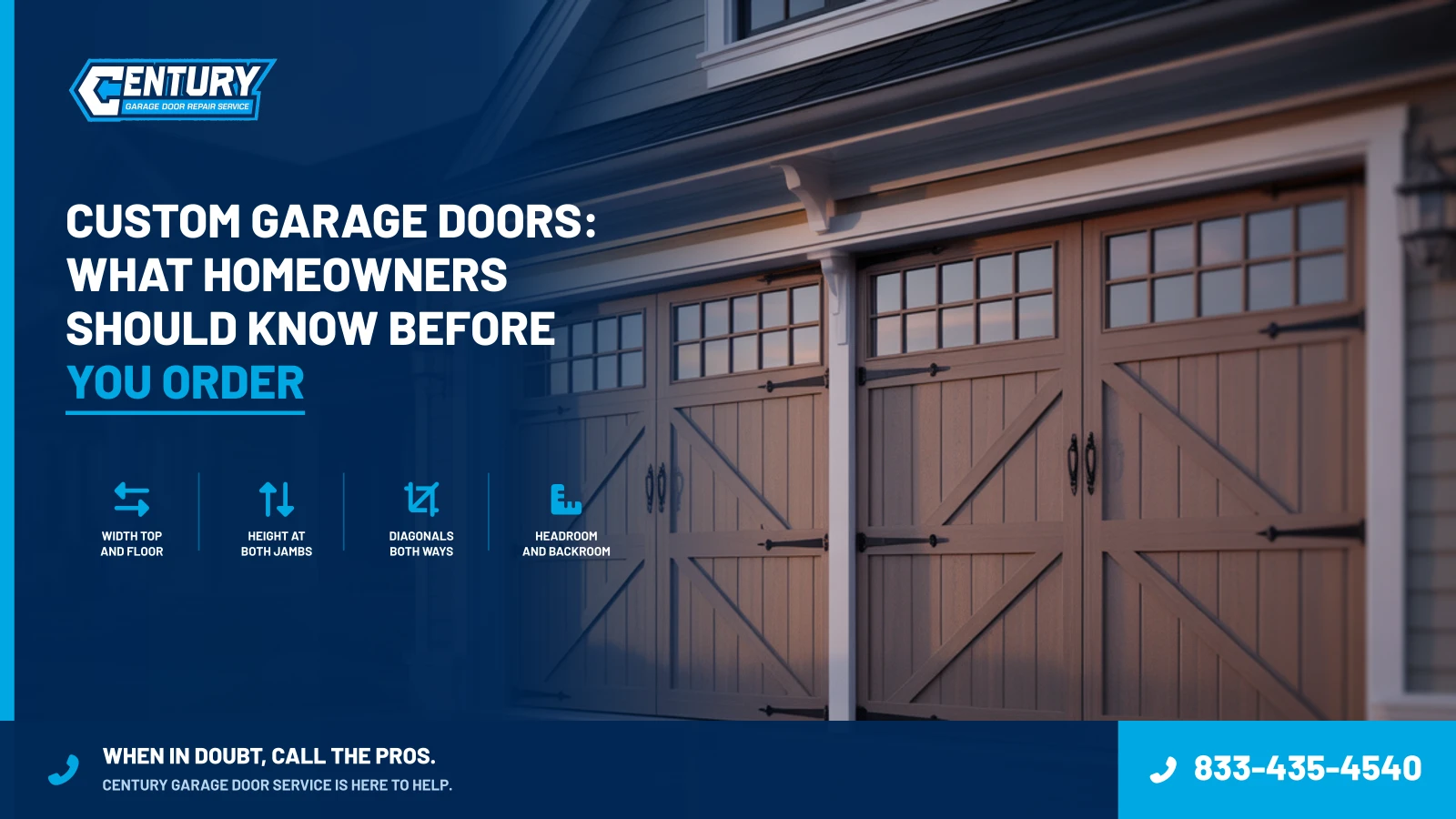
Width at the top and at the floor
Measure the finished opening, jamb to jamb, not the framing behind the trim.
Height at both jambs
Floor to the underside of the header at the left jamb, then the same on the right.
Diagonals, both ways
Corner to corner in each direction. Equal numbers mean square, and a difference tells the shop what the door has to forgive.
Headroom
From the top of the opening up to the ceiling or the lowest thing in the way.
Backroom
From the face of the opening straight back along the ceiling line.
Sideroom and photographs
Clear space each side of the opening. Add wide shots plus close-ups of the header and both jambs.
Then have it confirmed. Hand your numbers to a technician and let them re-measure on site, because a build-to-order door has no return path.
FAQs: custom garage doors
How do I know if I need custom garage doors?
Measure the opening width at the top and again at the floor, then the height at both jambs. If those numbers disagree, or if the width or height lands between the standard steps, a stock door will leave a gap somewhere. A site measure settles it. Call Century Garage Door Repair Service at 833-435-4540 with your numbers.
Does an arched or angled opening need custom garage doors?
Often, though not always. A curved or sloped header can sometimes be covered by a square-top door with the arch filled in above it, which keeps the door itself standard. Where the shape of the opening has to be followed, the top section gets built to that curve and the tracks get set to suit. A technician will tell you which of those your opening allows.
How long does a custom garage door take to arrive?
Weeks rather than days, because the door gets built after your order goes in. Wood construction, a specialty finish, a wind-rated build, or glass cut to an unusual size all stretch that out, and the shop’s queue moves it as well. Order early in a renovation and keep the existing door working until the new one lands.
Can I keep my existing opener and tracks?
Sometimes, and it turns on the finished weight and the travel. A heavier door than the one coming out asks more of the opener than it may have left to give, and the vertical hardware has to suit the new door’s height plus the headroom above the opening. A technician checks both at the measure.
Should I reframe the opening instead of ordering a custom door?
Rarely, and only where the opening already sits close to a standard size and that wall is coming apart for other reasons. Widening or raising an opening means a new header sized for the new span. That’s structural work and often permitted work. The door is usually the shorter road, and it leaves the wall alone.
What happens if I measure the opening wrong?
Custom garage doors have no return path once the sections are cut, which is why the measure carries so much weight. A technician re-measures on site before anything is ordered, and the diagonals plus the clearances get checked again at that visit. Treat your own numbers as a starting point rather than the figures a shop builds from.
Can a damaged section on a one-off door be replaced?
Usually, though matching it takes longer than on a stock door, because the section has to be built again rather than pulled off a warehouse shelf. Keep the paperwork from the original order, since it names the construction, the finish, the glazing, and the exact dimensions a shop needs to reproduce it.
Get custom garage doors specified for your opening
Start with the measure, because everything downstream follows from it. Century Garage Door Repair Service answers live around the clock at 833-435-4540 and gives you a two-hour arrival window with a text when the truck rolls. A technician measures the opening, checks the diagonals, looks at the clearances, and tells you straight whether a stock door will do the job before anybody quotes you custom garage doors. You get that quote in writing before a tool comes out, and if you decline, no work is done. If there are any problems within 24 hours, we’ll come back and check it out. Seniors and military get a standing discount. So do first responders. If the door you have is the one staying, book a garage door safety inspection instead.
Table of Contents
Emergency Repair?
Did a loud bang follow a door that won't lift? Don't risk injury. We offer rapid emergency response.