
How to reset garage door keypad: the four-minute version, and what a reset actually clears
The short answer
The best garage door lubricant for a residential door is a silicone spray or a white lithium grease, and the water-displacing penetrating spray most people reach for is neither one. For a full pass done by somebody who does it daily, call Century Garage Door Service at 833-435-4540.
A garage door keypad is the weatherproof number pad on the outside jamb, and the thing most people get wrong about it is where the code is stored. The PIN does not live in the keypad. It lives in the opener’s receiver, which is why resetting a garage door keypad means clearing the code at the motor unit and pairing the pad again afterwards.
Get that one fact straight and the rest follows. A keypad with a flat battery behaves nothing like a keypad that has lost its pairing, and the two get treated as the same fault constantly.
Table of Contents
What a garage door keypad is, and where the code actually lives
The keypad is a transmitter. Press the right digits and it sends the same kind of radio signal a handheld remote sends, which is why a garage door keypad has to be paired to the opener exactly as a remote does.
That has three consequences worth knowing before you start pressing buttons.
- The opener holds the code, so a factory reset at the motor unit wipes the keypad along with every remote.
- The keypad holds only its own battery and its buttons, so replacing the pad does not carry your old PIN across.
- Range problems are radio problems. A pad that works at the jamb and fails from three feet away is an aerial or a battery issue, not a code issue.
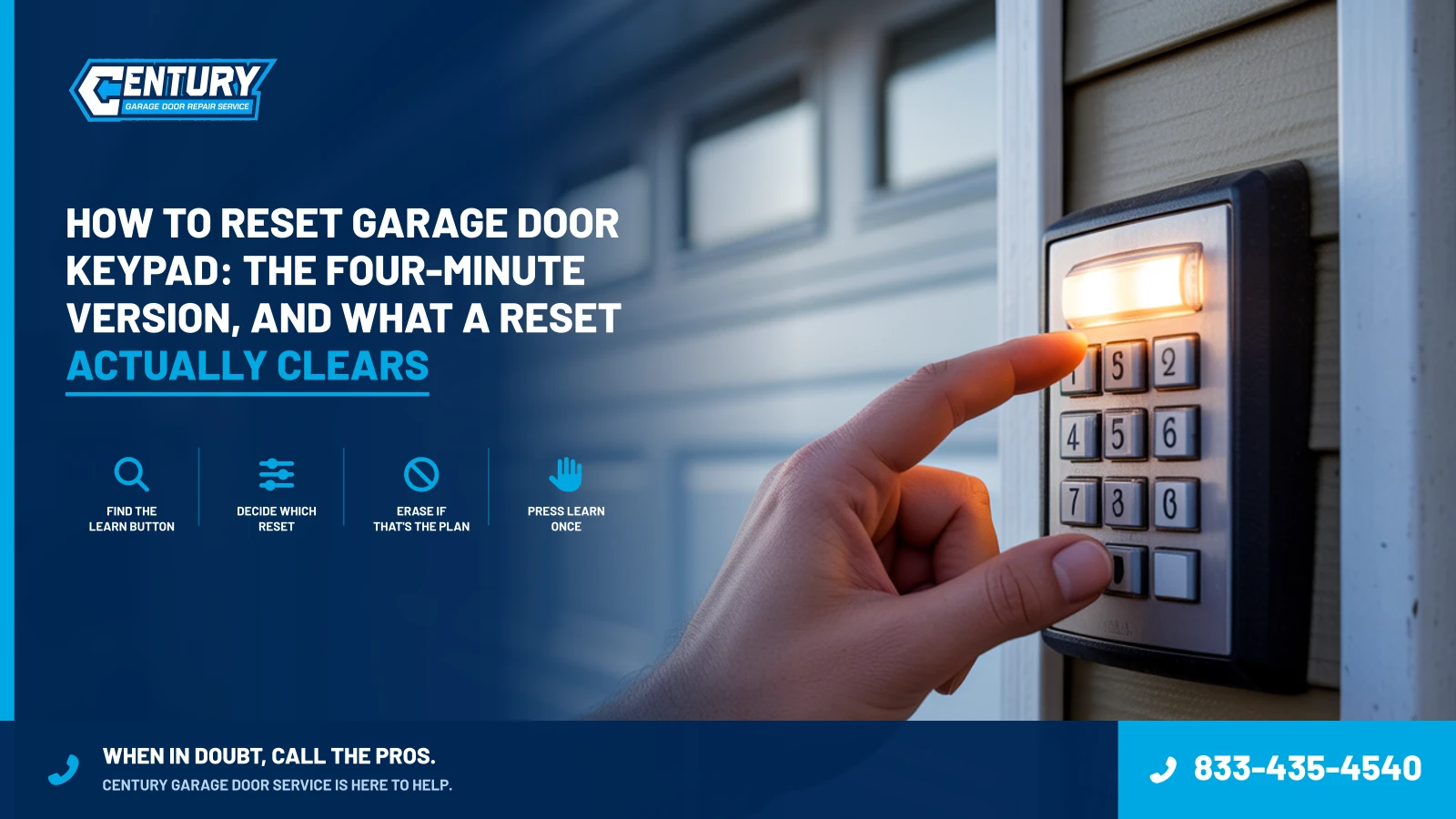
How to reset garage door keypad, step by step
The question people actually type is how to reset my garage door keypad, and this is the sequence for a pad that already worked and now does not, or one whose code you want to change because somebody who knew it has moved on.
Step 7 is the one that catches people. Knowing how to reset keypad on garage door units is easy. Remembering that the reset took the car remotes with it is the part that generates the second phone call.
ALT: garage door keypad pairing sequence being confirmed at the opener learn button
Put a ladder under the motor unit and find the learn button
Put the door all the way down, then unplug the opener so nothing can start a cycle while your hands are in the hardware.
Decide which reset you want
Put the door all the way down, then unplug the opener so nothing can start a cycle while your hands are in the hardware.
Erase, if that is the plan
Put the door all the way down, then unplug the opener so nothing can start a cycle while your hands are in the hardware.
Press the learn button once to open the pairing window
Put the door all the way down, then unplug the opener so nothing can start a cycle while your hands are in the hardware.
At the keypad, enter your new PIN and press enter or the program key
Put the door all the way down, then unplug the opener so nothing can start a cycle while your hands are in the hardware.
Test it twice from where you actually stand, not from arm's length at the jamb
Put the door all the way down, then unplug the opener so nothing can start a cycle while your hands are in the hardware.
Re-pair your remotes, because step 3 wiped those too
Put the door all the way down, then unplug the opener so nothing can start a cycle while your hands are in the hardware.
Choosing a PIN that survives the winter
A garage door keypad code has a different threat model to a phone passcode. Nobody is brute-forcing it. Somebody is watching you type it from a parked car, or remembering it from when they used to live there.
- Four digits is normal, more is better if the pad allows it.
- Avoid the house number, the year, and anything printed on the mailbox.
- Avoid a pattern your hand makes obvious. A straight line down one column reads from twenty feet away.
- Change it when a household changes, not on a schedule. The realistic risk is a person, not a computer.
- Do not share the code you also use elsewhere. A garage code that opens a house is one code doing two jobs.
Cold matters too. On a pad mounted in full weather, choose digits you can hit with a glove on, because the alternative is bare fingers on a metal jamb in February and a code entered wrong three times.
Need a Professional Tune-Up?
Skip the ladder. Our local technicians perform full safety inspections and comprehensive lubrication to keep your system running silently.
Pairing a garage door keypad that has never been used
A brand-new pad is the same sequence without the erase. Fit the battery first, then pair, then mount it, in that order, because mounting it before it works means taking it off the jamb again.
Two fitting details decide how long it lasts. Mount it high enough that snow thrown off the driveway does not reach it, and mount it on the jamb rather than the brick where you can, so the fixings land in something that will hold a screw. Knowing how to program garage door keypad units is five minutes of work. Siting one badly costs you a replacement in three winters.
If the pad and the opener are different generations, pairing may simply not be available. That is the point at which the compatibility question stops being about the keypad and becomes a question about the opener, and our automatic garage door guide covers how to read what you have.
The battery is the fault far more often than the keypad
Before anything gets reset, rule the battery out. It is the single most common cause and the cheapest to eliminate.
The tell is behaviour rather than a dead pad. A weak battery in a garage door keypad still lights the buttons and still beeps, because those draw almost nothing, and then fails to transmit because the radio burst needs real current. So the symptom reads as “the keypad works but the door ignores it”, which sounds exactly like a lost pairing.
Change the cell, then test before you touch the learn button. If the door responds, you were never resetting anything. Batteries across the whole system, including the opener’s backup, sit in our garage door battery guide.
When a garage door keypad is genuinely finished
Some pads are past helping, and the signs are consistent.
| Symptom | Likely cause | Worth replacing? |
|---|---|---|
| Buttons light, door ignores it, new battery fitted | Failed transmitter | Yes |
| Some digits dead, others fine | Water in the membrane | Yes |
| Cover cracked, contacts green | Corrosion, will return | Yes |
| Works cold, fails in heat, or the reverse | Failing board | Yes |
| Pairs, then loses the code within days | Opener receiver, not the pad | No, look at the opener |
The last row is the one that saves money. A pad that pairs correctly and then forgets is reporting an opener fault, and replacing the keypad twice is a common way to find that out slowly. Learning how to reprogram garage door keypad devices does not fix a receiver that will not hold a code.
Lockout, wrong entries, and the pause nobody expects
Enter the wrong PIN several times in a row and many openers stop responding for a while, deliberately. It is an anti-guessing feature and it looks exactly like a broken keypad.
The behaviour varies, but the pattern is the same: a short lockout that clears itself. If your garage door keypad has gone silent right after somebody stood there guessing, wait it out before you start a reset you do not need. Cutting power to the opener also clears it on most units.
Guidance for homeowners on operator features and safety is published through the DASMA technical data sheets on residential garage door operators (dasma.com), which is what a technician works from rather than the packaging.
FAQs: garage door keypad questions
Does resetting the keypad erase my car remotes too?
If you hold the learn button until the indicator goes out, yes. That is a full erase and it clears every paired device, keypads and remotes alike. A short press instead opens a pairing window and adds a device without wiping anything. Choose the full erase only when you do not know who still has a working code.
How do I reset my garage door keypad without the manual?
The sequence is the same across most residential units. Find the learn button on the motor housing, hold it until the LED goes dark to erase, press it once to open a pairing window, then enter your new PIN at the pad and press enter. If nothing confirms within about thirty seconds, press the learn button again and repeat.
My keypad lights up but the door does not move. What is that?
Almost always the battery. A weak cell still powers the backlight and the beeper, which draw very little, then fails to send the radio burst, which needs real current. Fit a fresh battery and test before resetting anything. If it still does nothing, the transmitter has failed and the pad needs replacing.
Can I use the same PIN as the old one?
Yes, the opener does not remember what was there before. Whether you should is a different question. If you are resetting because somebody who knew the code no longer needs it, reusing that code undoes the entire point of the exercise. Pick something new and avoid the house number while you are at it.
Why does my keypad forget the code every few days?
That is the opener rather than the pad. A receiver that accepts a pairing and then loses it is failing to hold its stored codes, and fitting a second keypad finds that out expensively. Call 833-435-4540 and have the motor unit looked at before buying another pad, because the symptom points away from the part you can see.
Can a keypad be added to an older opener?
Sometimes. It depends on whether the opener has a learn button and a receiver on a frequency a current pad can talk to. Units old enough to use fixed-code dip switches generally cannot take a modern keypad at all. That is an opener compatibility question rather than a keypad question, and it is worth answering before buying.
Is a keypad less secure than a remote in the car?
They fail in opposite directions, which is why plenty of homes use both. A remote can be stolen out of an unlocked car. A code can be watched from the street. The keypad wins on the case where the car is not there, and it loses on the case where somebody is looking. Neither is a substitute for a mechanical lock.
Get a garage door keypad paired and tested
Most garage door keypad problems are a battery or an opener that will not hold a code, and telling those two apart in five minutes is worth more than another pad from the shelf. Century Garage Door Service answers live around the clock at 833-435-4540 and gives you a two-hour arrival window with a text when the truck rolls. A technician checks the pad, the battery, and whether the receiver is holding codes at all, then pairs it and tests it from where you actually stand. You get a written quote before a tool comes out, and only the quoted trip fee if you decline. Our trucks run stocked, so most jobs finish in one visit, and the workmanship is warrantied. Seniors and military get a standing discount. So do first responders. To have the pad and the opener sorted together, book a garage door keypad visit.
Table of Contents
Emergency Repair?
Did a loud bang follow a door that won't lift? Don't risk injury. We offer rapid emergency response.