
Garage Door Window Inserts: What Homeowners Should Know Before You Buy
The short answer
An insert is a glazed unit inside a frame, sized to sit in an opening that is already cut through the top panel. An interior frame and an exterior frame clamp together over that cut edge and trap the skin of your door between them. A top panel of solid steel has no opening in it yet, so the steel has to be cut before window inserts can go anywhere. Call Century Garage Door Service at 833-435-4540 before you order parts.
Somebody on your street put daylight across the top of their garage door, and now you want the same. It does change how a house reads from the curb. But window inserts aren’t a handle you bolt on afterward, and one question decides which job you’re actually looking at. Does your top section already have openings cut in it?
Go look. Right now, from the driveway.
Holes with frames means you’re shopping for parts. A structural panel made of solid steel is another job. That’s the part most listings for garage door window inserts skip right past.
Table of Contents
What a garage door window insert actually is
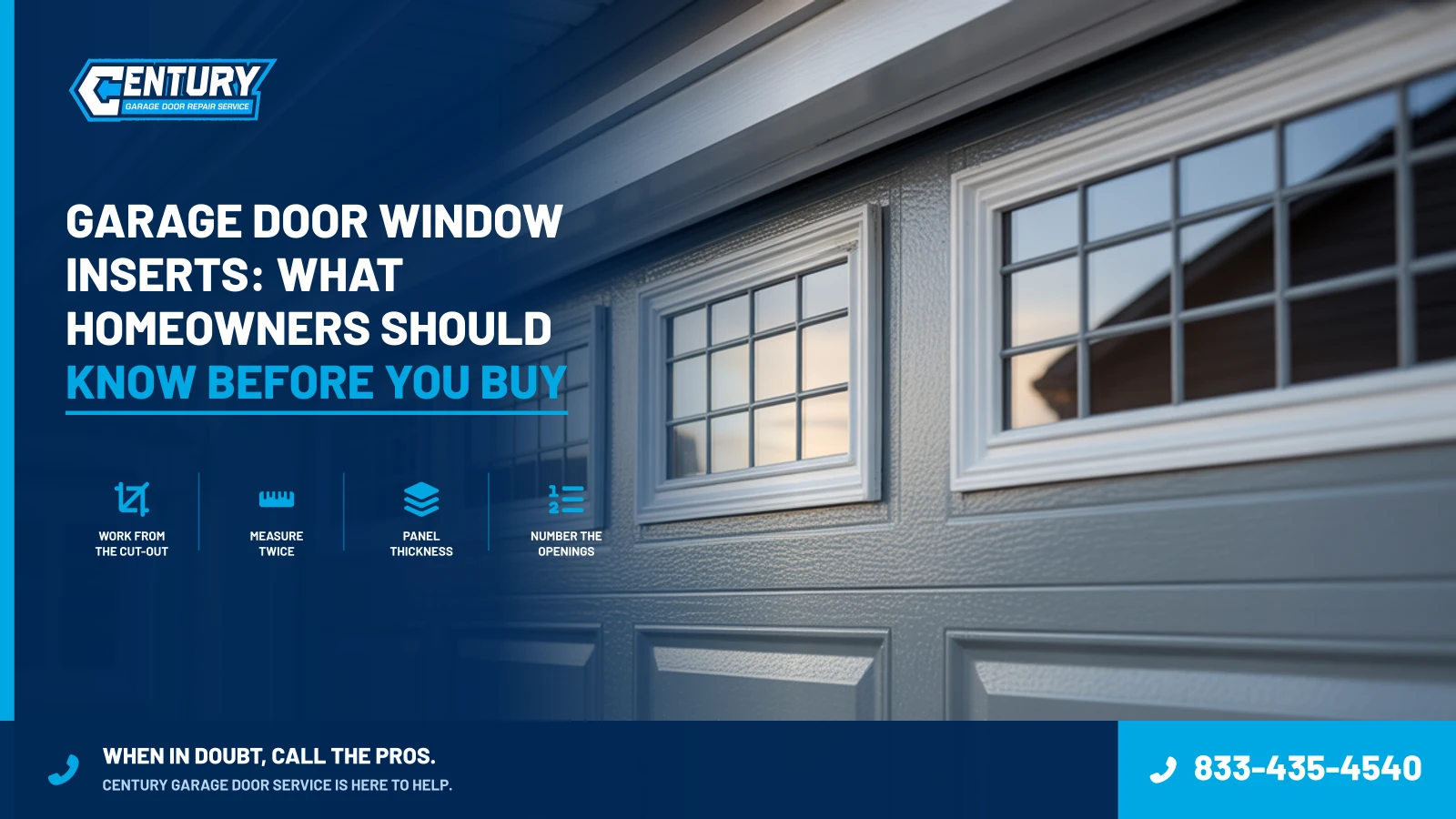
Strip the marketing away and a garage door window insert is a sandwich. Glazing sits in the middle. An exterior frame goes on the outside and an interior frame on the inside, and clips or short screws draw the two together until they grip the cut edge of the door skin. The frames do the holding and the sealing.
This is different than a section with factory glazing, in which the glass and frame are often formed directly into the steel stamping rather than being clipped onto it. Factory work holds its seal longer.
The sizes are not all the same. Window inserts are built for one specific cut-out, so a set pulled off one door rarely drops into another.
A single garage door window insert and a full run of garage door windows inserts get ordered the same way, off the cut-out rather than off the panel. Our garage door parts diagram guide names every part of the door.
Cutting a solid panel to add window inserts
Here’s the honest version, and it’s why this page exists. A solid top panel has no opening, so window inserts can’t go in until somebody cuts one, and that removes material from a panel carrying load across the full door.
Steel sections take their stiffness from the formed shape of the skin as much as from the struts or foam core sitting behind it. Cut a rectangle out of the middle and that section flexes more than it did. On a door carrying four openings, the added flex shows up as a bow in the upper travel, and it wears the top rollers unevenly.
Then the paperwork. Most manufacturers read a field-cut opening as a modification, and from that point on the modified section generally sits outside the door warranty.
Then there is the hardware holding the door up. A sectional door is counterbalanced by torsion springs on a shaft above the opening, and lift cables carry that load down each side to the bottom brackets. Neither the torsion springs nor the cables come off load because somebody wants to work on a panel, so the door sits under spring tension the whole time. Cutting a section in place, or pulling one out to cut on a bench, means running a power saw right beside a loaded lift cable, and it isn’t a homeowner job. Never adjust, wind, unwind, replace, or release the tension on the torsion springs above the door or the lift cables running down the sides, because they hold hundreds of pounds of stored energy and get replaced with winding bars by a trained technician. Drive gear internals and main power wiring are technician work too.
Cut once, wrong, and you’ve bought a section.
Glazing and frame styles for window inserts
The choices get more enjoyable once the openings exist. Clear glazing gives you the most daylight and no privacy at all. Frosted glass still passes light while keeping anyone outside from seeing into your garage. Opaque glazing takes the view away too, but it does not pass usable daylight, so it reads as a solid infill from either side. A tinted unit cuts glare and solar heat gain, which suits a garage that takes hard afternoon sun.
The material is more important than most people think. Tempered glass breaks in blunt fragments rather than sharp shards. It is also heavier, and it stays clearer for longer than the plastics. Acrylic is light and shatter-resistant. Polycarbonate is tougher but can become hazy if not properly cleaned.
| Glazing type | Light | Insulation | Durability | Notes |
|---|---|---|---|---|
| Clear tempered glass | Highest | Poor alone | Very good | Clear for decades, heavier |
| Clear acrylic | High | Poor | Fair | Light, shatter-resistant, yellows in UV |
| Polycarbonate | High | Poor | Good | Best impact strength, hazes if scrubbed |
| Obscure or frosted glass | Medium | Poor alone | Very good | Light, no view either way |
| Tinted glass | Lower | Poor | Very good | Cuts glare, reads darker |
| Insulated double glazing | High | Best of group | Good | Fogs if the seal fails |
Frame styles carry the curb appeal. Grille patterns split the glazing into panes, though the names for them shift from one maker to the next. Sunburst arches read traditional, and a leaded pattern reads expensive whether it was or not. A cathedral pattern puts a shallow arch across the top of each opening. A criss-cross of muntins suits a carriage house door. A plain rectangle looks right on a flat modern one.
Need a Professional Tune-Up?
Skip the ladder. Our local technicians perform full safety inspections and comprehensive lubrication to keep your system running silently.
How to measure for garage door window inserts
Measure the opening, not the panel. It’s a simple trick that people often get wrong.
Work from the cut-out
Measure width and height of the existing hole. Not the old frame, and not the panel. Frames overlap the cut edge, so a frame reading runs larger.
Take each dimension twice
Width at the top of the opening and again at the bottom, then height at both ends. Older doors settle, and a hole square at one end can sit an eighth out at the other.
Measure the panel thickness
Frames are built for a specific skin-to-skin depth, and one sized for a thin non-insulated section won't clamp a thick insulated one.
Number the openings
Most doors carry an even count across the top, and arched or handed patterns have a left and a right. Mark them on masking tape.
Photograph the interior frame and any stamp on it
Snap clips and screw bosses differ between makers, and many old frames carry a part number on the inside face, the fastest route to an exact match.
And if the opening has yet to be cut, the measuring is not yours to do. That layout has to account for strut positions, hinge locations, the lift-plate footprint, and remaining panel stiffness.
Trade-offs before you buy window inserts
The daylight is the reason why anyone does it. A garage with window inserts across the top stops feeling like a cave, and if you work out there it’s worth something.
The costs aren’t all financial. Glazing is the weakest thermal spot anywhere on a door, so one single-pane opening performs far worse than the insulated panel around it, and six of them compound the loss.
Privacy pulls against daylight. Clear glazing at standing height tells anyone on the sidewalk whether your car is home. Obscure or frosted glazing lets nearly all of that light through and none of the view, which is why it outsells clear.
Now the gripe. Low-grade acrylic window inserts are the thing I’d steer you away from hardest. They look fine on delivery. Then a few summers of hard sun turn them a faint tea color you don’t notice until you park a white car in front of them, and the thin frames snap their clips the first time anybody removes one.
Sealed double glazing carries a flaw of its own. The edge seal traps a dry gas between the two panes. When that seal lets go, moisture reaches a cavity no cloth ever will, and the unit fogs from the inside. That’s a replacement, not a cleaning job.
How window inserts fail, and the upkeep
Window inserts don’t wear out the way a roller does. They degrade. Sunlight and water do the work, and they do it to the frame more than to the glazing.
Frames go brittle. Years of UV work the plastic down until a frame that once flexed simply cracks instead, usually at a corner or right beside a clip. You find out during a removal.
Water is the other one. A channel in the exterior frame is there to shed rain, and once grit packs that channel or the sealant shrinks back, water stands in the frame and works its way to the cut edge of the steel. Rust showing at the opening nearly always traces to a seal that gave up two winters ago.
Upkeep is light. Mild soap on a soft sponge cleans the glazing. Acrylic and polycarbonate are permanently hazed by solvents and cleaning pads. Twice a year, clear out whatever has packed into the bottom channel of each exterior frame.
That’s the whole maintenance schedule.
Replacing one insert or the whole top section
Often a single cracked pane swaps out on its own, and if the frame survived you may only need glazing. Availability is the catch. Patterns get discontinued, so a grille style from a decade ago can leave you matching one new opening against three that don’t agree.
Color is the other catch. Frames weather where they sit, so years of sun pull the brightness out of the old ones while a replacement arrives at its original shade. Even an exact pattern match reads as new when it lands beside frames that have faded around it.
Replacing the whole top section makes sense when the steel around an opening has rusted through, when the section is bent, or when you want a pattern it can’t accept. It is called a section swap. It means the torsion springs come off load and the lift cables come off their drums before the door can be opened up, and it isn’t a homeowner job on any door.
Wind load ratings and impact zones
Read this if a sticker inside one of your sections lists a wind rating. Rated doors are tested as complete assemblies with their glazing included, so fitting window inserts the test never covered breaks the rating. Cutting a fresh opening into a rated section is worse, because that rating is why the door is permitted where you live.
Coastal and high-wind counties often want impact-rated glazing too, which is a specific tested product rather than thicker acrylic. Ratings publish as design pressures and impact classes, and the DASMA technical data sheets on wind load and impact ratings (dasma.com) explain the classes.
If the sticker is there, call before you buy.
What drives the cost
Cutting is the big fork, because a door with openings already in it is a parts and labor swap off the truck while a solid door is a modification that drags warranty and structural questions with it, so call 833-435-4540 to have it looked at, and our new garage door cost guide covers the wider replacement picture.
FAQs about window inserts
Can I add window inserts to a solid garage door panel?
Yes, but the opening has to be cut first, which turns a parts swap into a modification. Cutting removes material from a section that carries load across the whole door, and most manufacturers treat a field-cut opening as outside the warranty. Call 833-435-4540 first.
Are acrylic or glass window inserts better?
Tempered glass stays clear for decades and breaks into blunt pieces rather than shards, which is why it is the default on better doors. Acrylic is lighter and harder to break through, so it suits a detached garage. But low-grade acrylic yellows in direct sun.
Can I add window inserts without giving strangers a view of the garage?
Yes. Obscured, frosted, seeded, and tinted glazing all pass daylight without giving a clear view of what you park or store. Placement helps too, since inserts in the top section sit above sight line from the driveway. Clear glass at eye level is the combination that shows the most, so decide glazing and row together rather than separately.
Can I replace just one broken insert?
Often yes, and if the frame survived you may only need the glazing. The catch is availability, because insert patterns get discontinued and a ten-year-old grille style may no longer exist. A new white frame beside five aged ones also reads as new.
How long do garage door window inserts last?
Longer than most people expect, though the frame gives up before the glazing does. Plan on a service life running from roughly a decade to a couple of decades on plastic frames. Hard sun shortens that. A sealed double unit ends when its edge seal ends, and that failure is what usually retires window inserts.
Will new glazing change my door's wind rating?
It can, and that is the part people miss. Rated doors are tested as complete assemblies with their glazing included, so fitting something the test never covered voids the rating. Cutting a fresh opening does the same. Check the sticker before you order.
What does it cost to add window inserts to a garage door?
There’s no honest number until somebody sees the door. What moves it is the opening count, the glazing you choose, whether a solid panel still needs cutting, and whether the door carries a wind rating. You get a written quote first and approve the price before a tool comes out. Decline it and only the quoted trip fee is owed. Call 833-435-4540.
Pick the right window inserts
It comes down to one look at your top section. If the openings are already cut, window inserts are a straightforward swap and your only real decisions are glazing and pattern. If the top is solid steel, somebody is cutting a structural panel, and that deserves eyes on the door first. Century Garage Door Service answers live around the clock at 833-435-4540, gives you a two-hour arrival window with a text when the truck rolls, and puts a written quote in your hand before work begins. Decline it and you owe only the quoted trip fee. Seniors and military get a standing discount. So do first responders. Start at our garage door panel replacement page if a section is already damaged.
Table of Contents
Emergency Repair?
Did a loud bang follow a door that won't lift? Don't risk injury. We offer rapid emergency response.