
Swing Out Garage Doors: What Homeowners Should Know Before Choosing Outswing
The short answer
The best garage door lubricant for a residential door is a silicone spray or a white lithium grease, and the water-displacing penetrating spray most people reach for is neither one. For a full pass done by somebody who does it daily, call Century Garage Door Service at 833-435-4540.
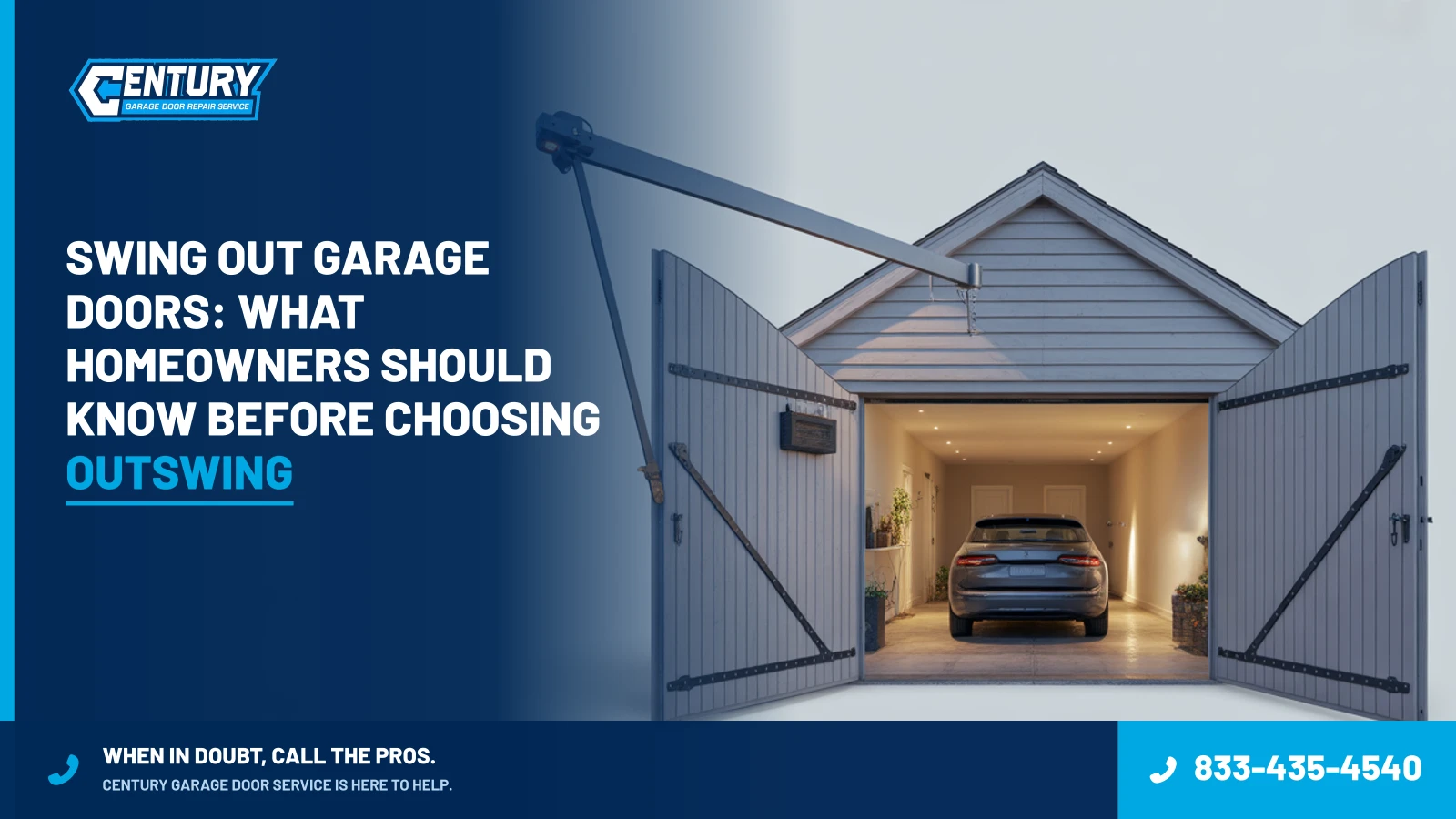
Swing out garage doors hang on hinges fixed to the jambs and open outward like a pair of gates, which means the whole ceiling above the opening stays free and the ground in front of it does not. That trade is the entire decision.
Everything else about them follows from it: where the snow goes, what the driveway slopes toward, how you hold a leaf open in wind, and what kind of operator can move a swinging leaf rather than pull a trolley.
Table of Contents
How swing out garage doors actually work
Two leaves, hinged at the outer jambs, meeting at a centre stile when closed. No track above the opening, no rollers, no counterbalance shaft, and no trolley.
That absence is worth dwelling on, because it removes most of what goes wrong on a sectional door. There is no spring to break, no cable to fray, no roller to seize, and no door to come off a track. What replaces those failure modes is a different set: hinge wear, sag at the outer edge of each leaf, and a latch that stops meeting properly as the leaves drop.
The mechanism is old and simple, which is why swing out garage doors are still specified on barns, workshops, and houses where the look matters more than the convenience.
The apron is the constraint, not the headroom
A sectional door needs headroom above the opening. Swing out garage doors need a clear arc outside it, and that arc is bigger than people expect.
Each leaf sweeps a quarter circle with a radius of roughly half the opening width. On a double opening that is a substantial area of driveway that has to be empty every time the door moves, and it has to be empty of everything: a parked car, a bin, a bike, a snow bank, a delivery.
So the honest test is to stand in the opening and mark the arc. If the driveway is short, shared, or slopes away steeply, the arc is where the product fails, and no amount of hardware quality fixes a leaf that cannot fully open.
Slope, snow, ice and gravel
This is where swing out garage doors get a bad reputation, and mostly fairly.
- Slope. A leaf hung on a level jamb swinging over ground that falls away will foul at the bottom edge as it opens. Ground that rises is worse.
- Snow. Anything ploughed or drifted against the doors has to be cleared before they open at all. A sectional door lifts away from a snow bank. An outswing door pushes into it.
- Ice. A leaf that freezes to the apron takes the seal with it when forced.
- Gravel. Loose stone migrates against the bottom edge and jams the sweep.
None of these is fatal on its own and all of them are chores. If the opening faces weather and the drive is unpaved, swing out garage doors will ask more of you every winter than a sectional will.
ALT: swing out garage doors bottom edge clearance over a sloping gravel apron
Need a Professional Tune-Up?
Skip the ladder. Our local technicians perform full safety inspections and comprehensive lubrication to keep your system running silently.
Hinges, jambs, and what carries the weight
On a sectional door the weight goes up into the springs and along the track. Here it goes sideways into the jambs, and that changes what the opening has to be.
Each leaf’s entire weight hangs off two or three hinges bolted to a jamb, as a cantilever. The load is not just vertical, it is trying to rotate the jamb out of the wall, and it does that hardest when the leaf is fully open. A jamb that was fine holding a sectional’s track brackets may not be adequate here.
What that means practically: solid framing, correct fasteners into it, and hinges sized for the leaf rather than for the look. Sag is the diagnostic. A leaf that has dropped at its outer edge, so the latch no longer meets or the doors rub at the centre, is telling you the hinge or the jamb is moving. Hardware grades are covered in our garage door hardware guide.
Cane bolts, drop rods, and holding a leaf open
Two jobs, and both need hardware people forget to ask about.
Holding closed. A centre stile latch plus a cane bolt or drop rod at the bottom of each leaf, dropping into a socket in the apron. That is what stops the pair being pulled or levered apart, and it is doing the work a sectional’s track and lock share.
Holding open. This one gets underrated. A leaf standing open in wind is a large sail on two hinges, and the gust that catches it will either tear the hinge out or slam the leaf into whatever is beside it. A hold-open stay, hook, or ground catch is not optional on any exposed opening.
Ask specifically about both when quoting. Doors supplied without hold-open hardware get it added after the first windy day, usually after something is already bent.
Automating swing out garage doors
Automating swing out garage doors is possible, less common, and mechanically different from a sectional opener.
A trolley operator pulls a door along a rail. There is no rail here, so automation uses gear built for a swinging leaf: an arm operator or an underground unit per leaf, of the kind used on driveway gates rather than on garage doors.
Three consequences. It is two operators rather than one, because each leaf moves independently. The safety devices are the ones used for swinging gates, since a closing leaf presents a different hazard from a descending panel. And the sequence matters, because two leaves meeting at a centre stile have to arrive in order rather than together.
If automation is a requirement rather than a preference, that is worth weighing early, because it is the point at which a sectional starts to look simpler. Opener anatomy for the sectional case is in our automatic garage door guide.
Where outswing genuinely wins
Fair to be clear about, because the drawbacks above are real and so are these.
Ceiling you want to keep. Storage, a loft, exposed beams, a lighting plan, a room above with no space for a rail. Swing out garage doors leave all of it alone.
Low headroom openings. Where there is genuinely no room above the opening for track and a shaft, outswing sidesteps the problem rather than solving it with low-headroom hardware.
Appearance on the right house. Swing out carriage garage doors read differently from the same face pressed into a sectional panel, and some houses carry a genuine pair of swinging leaves far better.
Occasional use. A barn, a store, a workshop opened once a week. The apron chore matters far less when the door is not part of a daily routine.
Swing out garage doors against a sectional
| Swing out | Sectional | |
|---|---|---|
| Space needed | Clear apron outside | Headroom inside |
| Snow and slope | Sensitive | Tolerant |
| Failure modes | Hinge wear, sag, latch | Springs, cables, rollers, track |
| Automation | Two gate-type operators | One trolley operator |
| Ceiling | Left completely free | Occupied by rail and shaft |
| Daily convenience | Lower | Higher |
The mechanism taxonomy across all door types sits in our garage door types guide, which names outswing in a sentence and leaves the depth here. Manufacturer construction standards are published through the DASMA technical data sheets on residential garage doors (dasma.com).
FAQs: swing out garage doors
How much room do swing out doors need outside?
Each leaf sweeps roughly a quarter circle with a radius of about half the opening width, so a double opening claims a large area of driveway. Mark the arc on the ground before committing. It has to stay clear of parked cars, bins, bikes and snow every single time the door is used.
Are they worse in snow than a sectional?
Yes, and it is the main practical drawback. A sectional door lifts away from a snow bank. A swing out garage door pushes into it, so anything ploughed or drifted against the leaves has to be cleared before they open. Ice freezing a leaf to the apron is the related problem.
What fails on a swing out garage door?
Different things from a sectional, and generally fewer. No springs, cables, rollers or track to go wrong. Instead you get hinge wear and sag, which shows up as a leaf dropping at its outer edge so the latch stops meeting or the doors rub at the centre. The jamb itself can also move.
Can they be automated?
Yes, with gate-type gear rather than a sectional opener. There is no rail to pull along, so each leaf gets its own arm or underground operator, and the two have to arrive in the right order at the centre stile. It is two operators and a different set of safety devices, so it is worth pricing early.
Do I need hold-open hardware?
On any exposed opening, yes. An open leaf is a large sail on two hinges, and a gust will either pull the hinge out of the jamb or slam the leaf into whatever is next to it. A stay, hook or ground catch is the fix, and it is much cheaper than the hinge repair it prevents.
Will my existing jambs take them?
Not automatically. A sectional door sends its weight up into the springs and along the track, while a swing out door hangs each leaf off the jamb as a cantilever that tries to rotate the jamb out of the wall. Call 833-435-4540 and have the framing checked before ordering anything.
Are swing out doors better for a low garage?
They sidestep the headroom problem rather than solving it, which is genuinely useful where there is no room above the opening for track and a shaft. The catch is that you trade a ceiling constraint for a ground constraint, so the question becomes whether the apron outside is any more available than the space inside.
Get swing out garage doors assessed for your opening
Swing out garage doors are the right answer on a barn, a workshop, or a house where the ceiling has to stay clear, and the wrong answer on a short sloping drive that fills with snow. Century Garage Door Service answers live around the clock at 833-435-4540 and gives you a two-hour arrival window with a text when the truck rolls. A technician marks the arc each leaf needs, checks what the jambs are actually fixed into, looks at how the ground falls away, and tells you straight whether outswing or a sectional serves the opening better. You get a written quote before a tool comes out, and only the quoted trip fee if you decline. Our trucks run stocked, so most jobs finish in one visit, and the workmanship is warrantied. Seniors and military get a standing discount. So do first responders. To have the whole opening and its hardware assessed, book a garage door safety inspection.
Table of Contents
Emergency Repair?
Did a loud bang follow a door that won't lift? Don't risk injury. We offer rapid emergency response.