
Garage Door Rails: What Homeowners Should Know Before the Rattle Gets Worse
The short answer
Your garage door rails are the steel channel running from above the opening back to the motor unit on your ceiling, and the trolley inside them is what actually pushes and pulls the door. If the rattle up there has turned into a grind, call Century Garage Door Service at 833-435-4540.
Garage door rails are the steel channel bolted up at your ceiling, and the trolley traveling inside that channel is the part that moves the door. They aren’t the vertical track your rollers ride in, which is the biggest mix-up on this subject and the reason people order the wrong part.
So this page stays on the opener side of the garage. The rail itself, the trolley, the drive member inside it, the brackets holding all of it up, and the cord that separates your door from the machine.
Rail trouble almost always announces itself as noise first.
Which is lucky, because noise is easy to chase and a stranded car is not.
Table of Contents
What garage door rails actually are
A garage door rail is one long steel channel with a trolley inside it. That’s the whole idea, and everything bolted to the assembly exists to hold that channel straight.
Garage door rails run from a header bracket lagged into the framing above the opening, back along the ceiling to the motor unit hanging on a pair of straps. A curved door arm links that trolley to the top section of the door, so the door rises when the trolley slides back toward the motor and drops when it slides forward. The motor isn’t lifting anything, though. It drags a trolley along a rail, and the counterbalance above the opening carries the weight.
Get that picture straight and most of this page explains itself.
Your opener's rail is not the door track
Plenty of homeowners use the word rail for the vertical steel the rollers sit in. Fair enough, it looks like a rail from below. But that part is the track, and it belongs to the door rather than to the opener.
Garage door rails belong to the opener. One assembly per garage, working the same few feet of travel for years. If your trouble is a roller binding partway up the vertical steel, or a length of that steel that took a bumper, then garage door off track repair is the page you want.
Two different parts, two different repairs. And the words for them will never sort themselves out.
The parts of a garage door rails assembly
Six pieces do the work, and knowing their names shortens a phone call.
- Rail sections. Most garage door rails arrive in pieces that bolt together. Every joint is a place a step can develop.
- The trolley, or carriage. The sliding block the chain or belt is clamped to. On most units it’s two nested pieces, and the release cord separates them.
- The drive member. A chain or a belt on most units, and a threaded rod on a screw drive.
- Sprocket and idler. A toothed wheel at the motor end and a smooth one at the header end, with the drive looped around both.
- The header bracket. A steel plate above the door anchoring the front of the rail. It has to be lagged into solid framing rather than into drywall and hope.
- Hanger straps. Perforated angle iron holding the motor end off the joists. Length and bracing decide how much the unit sways.
Add the door arm and you’ve named the whole system.
Need a Professional Tune-Up?
Skip the ladder. Our local technicians perform full safety inspections and comprehensive lubrication to keep your system running silently.
Four drive types, and what each asks of the rail
The drive member decides how the rail sounds and how it gets maintained. The rest stays about the same.
| Drive type | What rides the rail | What it asks of you |
|---|---|---|
| Chain | A steel chain over a sprocket and an idler | Grease along the rail’s top face, slack checked yearly |
| Belt | A reinforced rubber belt, same layout | Grease the rail, never the belt, since a slick belt slips |
| Screw | A threaded steel rod turning inside the rail | Its own low-temperature grease on the threads |
| Wall mount | Nothing, because there’s no rail at all | Ceiling space stays clear |
That last row matters if you’re shopping. A wall-mount unit sits beside the door and turns the shaft above the opening directly, so it skips the rail and the trolley altogether.
Chain and belt units are what most garages have, and the noise gap gets oversold right up until you’ve slept under one.
Signs your garage door rails need a look
Match the sound to the row. The right-hand column is the honest next move rather than a wish.
| What you hear | Likely cause on the rail side | Your next move |
|---|---|---|
| Rhythmic slap as the door starts | Slack chain, or a worn sprocket | Check slack against your manual’s figure |
| A jolt at the start of travel | Loose header bracket, or a rail drooping at the front | Tighten the lags, then have alignment checked |
| A click at the same spot every trip | A step at a rail joint | Book a technician, since a joint gets shimmed |
| Grinding at the motor end | Sprocket wear, or drive gear trouble inside the head | Stop using it and call, the head is technician work |
| Bang at the ceiling when the door stops | Hanger straps too long, or a unit swinging on its bolts | Bracing and hardware, an easy fix |
| Opener hums, door stays put | Trolley uncoupled from the drive member | Re-latch the trolley, covered below |
Two of those rows send you straight to the phone. The rest are yours if you like a wrench.
How garage door rails fall out of line
Alignment is the quiet failure. Nothing snaps. Nothing bangs. The door just gets rougher each season until somebody notices the shudder.
Four things pull garage door rails out of line. A header bracket works loose, or was fastened into something soft to begin with, letting the front of the rail droop. Hanger straps running long without a cross brace let the motor end sway, so the rail traces a small arc every cycle. A rail set off-center makes the door arm pull at an angle for its whole life. And a section bolted with a lip at the joint gives the trolley something to climb at the same point on every trip.
Slack belongs in the same conversation, since it’s the one adjustment a careful homeowner can reasonably own. Too loose and the chain slaps the rail at start-up, then skips a tooth on the sprocket. Too tight and the trolley becomes a drag that loads the motor and cooks the sprocket bearing. Your manual prints the figure for slack at the midpoint, and it’s a small one. Use theirs, since it moves with rail length and drive type.
Belts are different. They arrive tensioned and stretch a little through break-in. After that they get left alone. A belt that has gone visibly loose is tired rather than mis-set.
And a bent section gets replaced, not persuaded back with a hammer, because kinked steel has a memory and takes the same shape again under load.
The trolley and the emergency release cord
That red handle hanging off your trolley has one job. It separates the inner trolley from the outer one so the door can be moved by hand when the power’s out.
Put the door all the way down before you touch it. Never pull the release cord while the door is open or jammed, because a door with a weak or broken spring has nothing holding it up once the opener is uncoupled. With the door flat on the slab there’s no height for it to fall from.
Re-latching is where people get stuck. On most units you run the opener and the inner trolley clicks back onto the outer one. On others the handle gets tugged back toward the door. Either way the door stays closed while you do it, and the full walkthrough lives in our garage door manual release guide.
Here’s the failure that creates. Somebody uncouples the trolley during an outage, forgets, and months later the motor hums cheerfully while the door sits still. Nothing broken. Just nothing connected.
Keeping garage door rails quiet
Twice a year covers most garages, and it takes less time than moving the bins.
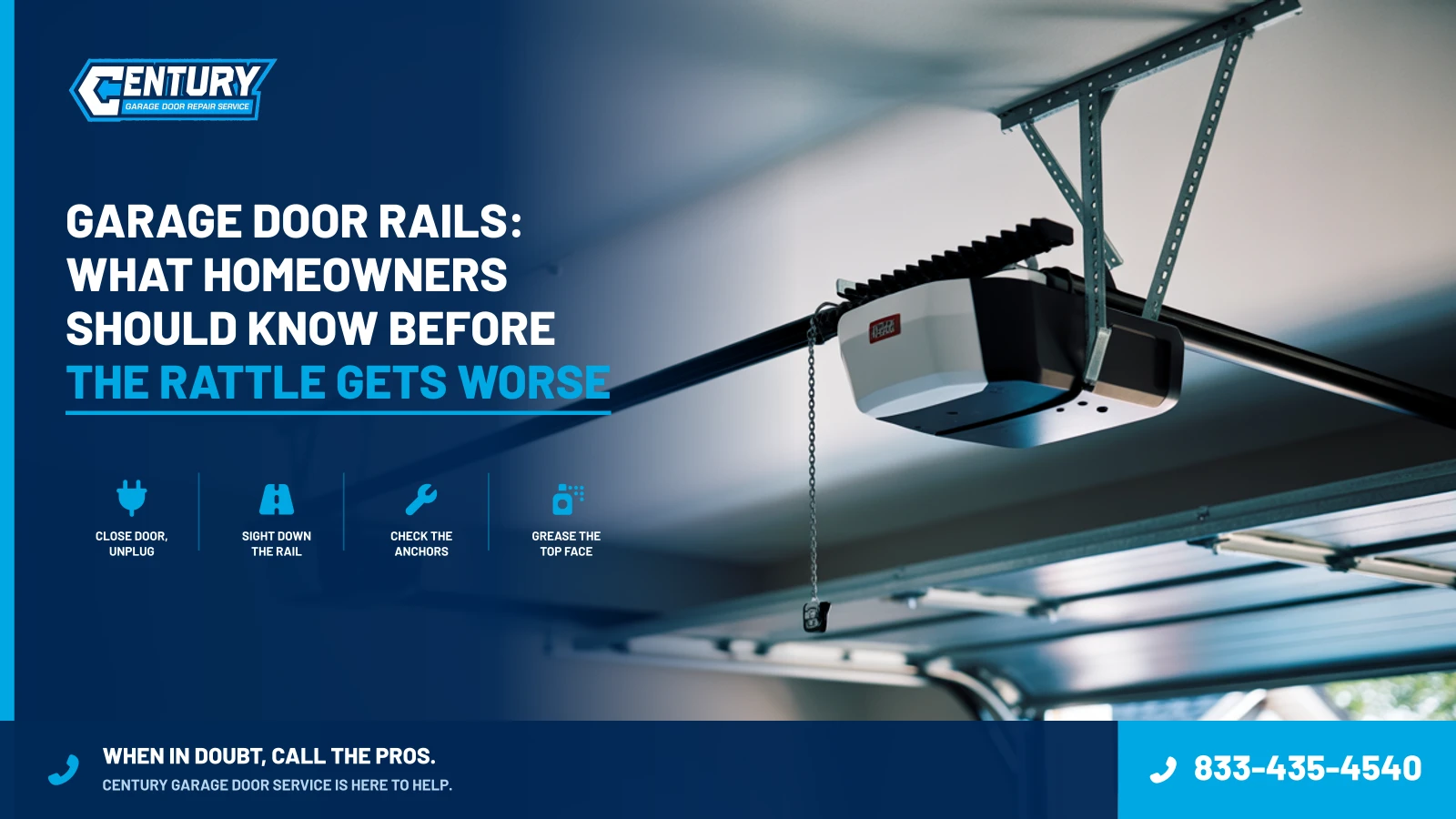
Close the door and unplug the opener
Both, every time, before your hands go near the assembly.
Sight down the rail from the motor end
Look for a droop at the front, a twist, a section sitting proud at a joint, or a bolt backing out. Your eye beats a level.
Put a wrench on the anchors
Work the header bracket lags, then the hanger strap bolts, then the bolts at each rail joint, and finish at the door arm.
Check the drive member
Chain slack against the manual's figure. On a belt, look for slack that wasn't there last year.
Grease the top face of the rail
A thin film of white lithium along the surface the trolley rides, and nothing on a rubber belt. Our garage door lubricant guide covers the rest of the door.
Plug in and run two full cycles
Stand clear and listen for what changed. Garage door rails that sound the same after a full pass have a mechanical fault rather than a dry one.
Maintenance that changes nothing has still told you something.
What drives the cost of garage door rails work
Rail sections, trolleys, sprockets, and idler pulleys are all serviceable parts, so a bad rail rarely means a new opener.
But the rails for garage door openers aren’t universal. Section profiles, trolley shapes, sprocket sizes, and mounting patterns vary by unit, so a rail from one manufacturer won’t drop onto another’s head. Once a unit is old enough that its parts have dried up in the supply chain, replacing the opener is the honest answer rather than an upsell. Drive gear damage inside the head points the same way, since that’s internal work. So does a door running out of square, because a new rail under an unbalanced door gets to fail again. And if the opener won’t run at all, the rail probably isn’t your problem, so garage door opener not working works the powerhead side instead.
Which part failed, the drive type, the anchoring above the door, and whatever the door itself needs to stop chewing the new part all move the number, so call Century Garage Door Service at 833-435-4540, describe the noise and say when it started, knowing a good technician works from the operator guidance published through the DASMA technical data sheets on residential garage door operators (dasma.com).
FAQs: garage door rails
Are garage door rails the same thing as the tracks?
No, and this one trips up almost everybody. The tracks are the vertical and horizontal steel your rollers ride in, and they belong to the door. Garage door rails are the single overhead channel carrying the opener’s trolley back to the motor unit. Different parts, different repairs.
Can I straighten a bent garage door rail myself?
Don’t. Kinked steel has a memory and takes the same shape again the moment the trolley loads it, so that section gets replaced instead. Alignment then has to be reset against the door, which is measurement work rather than muscle. Call Century Garage Door Service at 833-435-4540 and describe where the bend sits.
Why does my opener hum while the door doesn't move?
Usually the trolley is sitting uncoupled. Somebody worked the emergency release during an outage and the inner trolley never re-latched onto the outer one, so the motor runs a chain along a rail connected to nothing. Closing the door and running a cycle re-latches it on most units. A grinding hum means drive gear trouble inside the head instead.
How often should garage door rails be greased?
Twice a year suits most garages, and the top face of the rail is the surface that wants it. A thin film of white lithium is plenty, since heavy grease collects grit and turns into a paste the trolley has to plow through. Skip a rubber belt entirely, because a slick belt slips instead of driving.
Does a belt drive really run quieter than a chain?
Yes, and the gap is widest at start-up. A chain slaps where a belt just goes. Under a bedroom that’s worth having. That said, a chain unit on a tight rail with fresh grease beats a neglected belt unit. Installation and upkeep matter as much as the drive type you picked.
How do I know if my opener chain is too loose?
Check it by hand rather than by ear. Close the door, then unplug the unit before your fingers go near the drive. Press down on the chain at the middle of its run and see how far it gives. Your manual prints the target, and it’s a smaller number than most people expect, since garage door rails vary in length and the figure moves with them.
How long do garage door rails last before anything needs replacing?
The channel itself usually outlives everything riding inside it. Sprockets, idler pulleys, trolleys, and drive members are the wear items, and each one gets replaced on its own while the rail stays where it is. What actually shortens the life of garage door rails is a header bracket working loose or a door that has drifted out of balance, since both load the steel sideways.
Get your garage door rails running straight
A rattle overhead is easy to live with right up to the morning it isn’t. If sighting down your garage door rails turned up a droop at the header or a step at a joint, get somebody up a ladder who does this daily. Century Garage Door Service answers live around the clock at 833-435-4540 and gives you a two-hour arrival window with a text when the truck rolls. Our trucks carry trolleys, sprockets, rail hardware, and opener stock, so most visits finish in one trip, and the workmanship is warrantied. You get a written quote before anybody picks up a tool, and only the quoted trip fee if you decline it. Seniors and military get a standing discount. So do first responders. Book a garage door safety inspection if you’d rather have the whole system looked over at once.
Table of Contents
Emergency Repair?
Did a loud bang follow a door that won't lift? Don't risk injury. We offer rapid emergency response.