
Manual Release: How to Manually Open Garage Door in 5 Steps
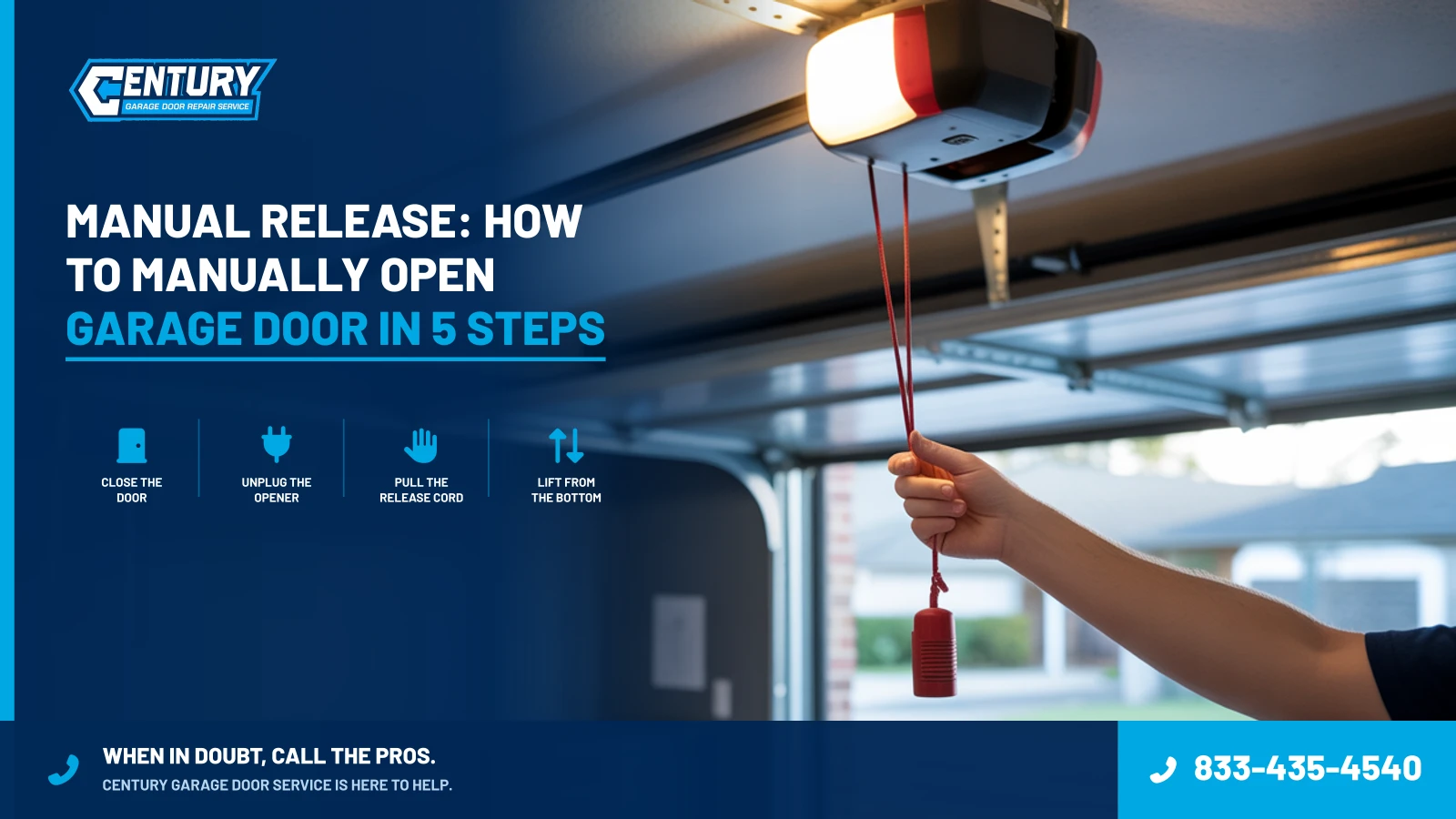
The short answer
Close the door, unplug the opener, then pull the red cord straight down. That's the manual release doing its job, and if the door feels heavy when you lift it, stop and call Century Garage Door Repair Service at 833-435-4540.
Pull the red cord hanging from the trolley rail, then lift the door evenly from the bottom edge with both hands. That cord is your manual release, and knowing how to manually open garage door hardware gets you out of the driveway in about two minutes during an outage, with no tools at all. The catch is the order of operations, because pulling the manual release at the wrong moment is how people get hurt.
Close the door before you release it whenever you have the choice. A door already up, disconnected from the opener, with a broken spring behind it, comes down fast.
That’s the whole warning. The rest is straightforward.
Table of Contents
What the manual release actually does
Your opener doesn’t lift the door. The springs do that, and the opener just supplies the nudge that starts the motion and controls where it stops. Between the two sits the trolley, a small carriage riding the rail overhead, and the manual release is the lever that uncouples that carriage from the chain or belt.
Pull it and the door becomes a hand-operated door again, exactly as it was before anyone motorized it.
One cord, one lever, no electronics anywhere in the path. That’s why the manual release still works when the power is out and the wall button is dead.
There’s a second use nobody advertises. Working the manual release is the only way to test whether the door itself is balanced, and balance is what tells you the springs are healthy. A properly counterweighted door weighs 8 to 10 pounds at your hands. The door itself might weigh 200.
Some manuals label it the emergency disconnect. Others print manual garage door release in full, which is the same cord under a longer name.
How to manually open garage door in 5 steps
Read step one twice before you start, because everything after it depends on getting that part right. One look comes even earlier than that. Check the spring on the shaft above the door. If the coil shows a visible gap anywhere along it, stop right there. Call 833-435-4540 rather than touching the cord.
Close the door if it isn't already closed
Use the remote or wall button while you still have power. If the door is stuck partway open, don't touch the release, call 833-435-4540.
Unplug the opener from the ceiling outlet
Pull the plug rather than flipping a breaker, so nobody restores power while your hands are on the door. A motor that kicks on mid-lift will fight you.
Pull the manual release cord down and toward the door
One firm pull disconnects the trolley. You'll hear a distinct clunk. People yank it sideways or straight out toward themselves, which can bind the mechanism, so pull down first and then angle it.
Lift from the bottom edge with both hands, evenly spaced
Squat, keep your back straight, and raise the door with steady pressure. Grab the bottom panel near the middle rather than the sides, because side grips near the hinges pinch fingers.
Check that it stays up before you walk under it
Raise the door to about waist height and let go. It should hold roughly in place. If it slides down or rockets up, the springs are out of balance and the door isn't safe to leave open.
Most of the safety in this job lives in step five. A balanced door parks where you put it. An unbalanced one is a falling object waiting for a reason.
Those five steps are how to open garage door manually during an outage, and how to open a garage door manually is the same drill on any opener built in the last thirty years. Anybody teaching a teenager how to manually open a garage door should spend most of the lesson on step five and on the checklist further down.
How to open garage door without power
An outage is the ordinary case, and nothing about it changes the sequence. The door is already closed, so you skip straight to unplugging and pulling the cord. Unplugging still matters, because power can return without warning while the door is halfway up and your hands are on the panel.
If your opener has a battery backup, it may still run a cycle or two. Try the wall button before you touch anything mechanical.
The one time you must not pull the cord
The manual release is an emergency device, not a convenience feature. Pulling it separates the door from the opener so the door moves freely on its springs and cables, and that freedom is the entire risk.
Never pull the release cord while the door is open or jammed, because a door with a weak or broken spring has nothing holding it up once the opener is uncoupled. It will slam.
So the sequence matters more than the technique. Close, unplug, then release.
Need a Professional Tune-Up?
Skip the ladder. Our local technicians perform full safety inspections and comprehensive lubrication to keep your system running silently.
Using the manual release from outside
Detached garages with no side entry create a real problem, because the cord is inside and you aren’t. The answer is an exterior manual release kit, a keyed lock mounted through the top panel with a cable running down to the trolley lever. Turn the key, pull the cable, and the trolley disconnects while you stand in the driveway.
If your detached garage has no side door and no kit, that’s worth fixing before the next outage rather than after. Any technician can add one in a single visit, and it converts a lockout into a ten-second job.
Without a kit, the honest answer is that you can’t open garage door manually from outside, not without damaging something. Prying at the bottom panel bends the section and knocks rollers out of the track, which turns a lockout into a repair.
Signs you should not lift the door at all
Walk this checklist before your hands go near the bottom panel. Any single yes means stop, and leave the cord alone.
- A visible gap or separation in the torsion spring coil above the door
- You heard a loud bang from the garage earlier, which is the classic broken spring sound
- A lift cable is frayed, slack, or hanging loose off its drum
- The door sits crooked in the opening, or a roller has left the track
- The door feels far heavier than one person should be lifting
- A bottom panel is crushed or bent where you’d normally grip it
A broken spring changes the math completely. With no counterbalance you’re lifting the door’s full weight, and residential doors run from roughly 150 pounds for a light single up past 400 for an insulated double. If a spring is broken, don’t run the opener at all and don’t try to lift the door by hand, because nothing is counterbalancing the door’s full weight and the motor will strip its drive gear attempting it.
Off-track doors deserve the same respect. Never touch a door that has come off its track, because it weighs upward of 200 pounds and can drop or twist without warning. That’s a job for somebody with the right clamps. Our garage door spring repair page covers what spring and cable work involves, and the standards behind these warnings are published through the International Door Association safety resources (doors.org).
Never adjust, wind, unwind, replace, or release the tension on the torsion springs above the door or the lift cables running down the sides, because they hold hundreds of pounds of stored energy and get replaced with winding bars by a trained technician. Drive gear internals and main power wiring are technician work too. Nobody should learn what that energy does firsthand.
Re-engaging the manual release when power comes back
Reconnecting is easier than disconnecting, and it’s the step people forget. Close the door by hand first, then pull the manual release cord back toward the motor unit, or plug the opener in and run one cycle. The trolley slides until the lever catches the chain carriage and latches with a click.
Test it before you trust it. Run a full open and close from the wall button and watch the trolley travel the whole rail.
If the trolley won’t re-latch, or the door runs rough afterward, the travel limits may have shifted. That’s an adjustment rather than a repair, but it needs doing before the door goes back into daily service. And if the door refuses to move under power at all, our guide on a garage door wont open door walks through the likely causes.
FAQs about the garage door manual release
Can I pull the release while the door is moving?
No. Use it only with the door fully closed and the opener unplugged. Releasing a door in motion leaves you holding a load with nothing holding it back, which is how people get hurt and how sections get bent. If the door is stuck partway open, leave the cord alone and call 833-435-4540.
Where is the manual release on a garage door?
It hangs from the trolley, the carriage that rides along the rail between the motor unit and the door. Look for a short rope with a red handle, usually within arm’s reach when you stand under the rail. Pull it down and toward the door opening. Some older units use a lever on the trolley body instead of a cord.
How do you open the door from outside without power?
You need an exterior manual release kit, a keyed lock through the top panel with a cable running to the trolley lever. Turn the key and pull the cable to disconnect. Without that kit there is no safe outside method, and prying at the panel bends sections and derails rollers, turning a lockout into a repair bill.
Will using the manual release damage my opener?
No, the manual release exists for exactly this. Disconnecting the trolley is a normal mechanical function, not an override you’re abusing. Damage comes from forcing the door against a jammed track. Never pull the release cord while the door is open or jammed, because a door with a weak or broken spring has nothing holding it up once the opener is uncoupled.
How can I tell if my garage door is balanced?
Pull the manual release, raise the door to about waist height, and let go. A balanced door stays roughly where you left it. If it slides down or springs upward, the springs are mistuned or failing, and the door needs service before regular use. The test takes ten seconds and tells you more than any other check.
The release cord snapped off. Can it be replaced on an older opener?
Usually yes. The cord and handle are a generic pull assembly rather than a model-specific part, so a technician can fit a new one to most trolleys, older units included. What matters more is the lever inside the carriage. If that lever is cracked or its return catch is worn, the trolley gets replaced instead of the cord. Either way the manual release works the same afterward.
How much does it cost to repair a manual release that won't re-engage?
Nobody can quote that blind, and any shop that tries is guessing. The price turns on which part failed, whether that’s the cord assembly or the trolley lever itself, plus the age of the opener and how the rail is built. A technician looks first, then hands you a written quote and gets your approval before a tool comes out. If you decline, no work is done. Call 833-435-4540.
When the door still won't move
Sometimes you work the manual release correctly and the door still won’t budge, or it lifts and then refuses to stay up. That’s the door telling you the springs, cables, or track alignment need attention, and none of those are homeowner repairs. Century Garage Door Repair Service answers live around the clock at 833-435-4540, rolls trucks carrying spring and cable stock so most jobs finish in one visit, and puts a written quote in your hand before anybody picks up a tool. Seniors and military get a standing discount. So do first responders. Start with our garage door off track repair page if you’re locked out right now.
Table of Contents
Emergency Repair?
Did a loud bang follow a door that won't lift? Don't risk injury. We offer rapid emergency response.