
Commercial Garage Door Services
Rarely is a door the only thing that stops when a commercial garage door stops working. Trucks back up to the dock, the shop is open to the street overnight, and the crew waits around. Century Garage Door Service provides commercial garage door services for warehouses, body shops, fire stations, self-storage facilities, restaurants, dealerships and retail loading bays, including rolling steel, sectional overhead doors and the operators that run them. We fix what can be fixed, and we tell you when a door has reached the end of its service life, rather than selling you a part that will fail again in a month.
- Commercial garage doors, roll up garage doors, sectional doors, rolling steel doors serviced by technicians who service commercial doors every week
- Commercial grade parts used for springs, cables, drums, bearings, tracks, panels, curtains, slats and bottom bars
- Commercial garage door opener repair, replacement and installation — jackshaft, trolley and hoist operators
Talk to a technician, not a call center script. Tell us what kind of door it is, approximately how big it is, and what it is doing now.
Request an Estimate
We’ll get back to you within 15 minutes.
Who’s Actually Coming to Your Building
Many of the phone numbers you find for commercial garage door repair are not actually garage door companies. They are lead brokers. You describe your problem, they sell that description to whoever bid highest that morning, and a subcontractor you’ve never heard of shows up with no accountability for the price he quotes. Century Garage Door Service is the company that picks up the phone, the company that sends out the crew and the company that stands behind the work. If something goes wrong when we’re gone, you call the same number, you get the same people.
Our process is centered around commercial buildings where the door is part of an operation, not just an opening. We start with questions on the phone – door type, width and height, spring or counterbalance style, operator brand and whether the door is currently open, closed or stuck partway – as this dictates what the technician loads before heading out. The technician checks the whole system on site, not just the part that failed: springs, cables, drums, bearings, track alignment, condition of panels or slats, operator, safety reversing devices and door balance. Findings, choices and the price are given before any work is begun. If we have to temporarily secure a door so the building can close up, we do that first and then finish the repair when we have the parts in hand.
The vans are loaded with parts used on real commercial doors: torsion springs in a variety of wire sizes and lengths, aircraft cable, cable drums, end bearing plates, roller and hinge assortments, bottom astragals and weather seal, track hardware, chain and sprockets, limit switches, contactors, photo eyes, safety edges, remotes and receivers. We stock and service LiftMaster, Genie, Chamberlain, Craftsman, Clopay, Amarr, Wayne Dalton and Overhead Door parts. Doors and operators that require ordering – custom widths, insulated steel garage doors, high-cycle spring packages, specific curtain profiles – are measured on site and ordered to spec.
What it Looks Like
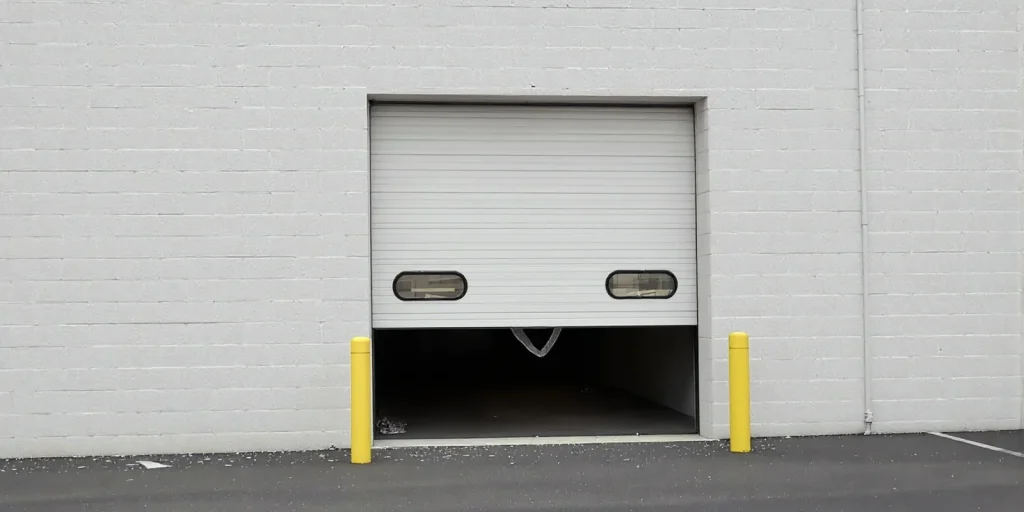
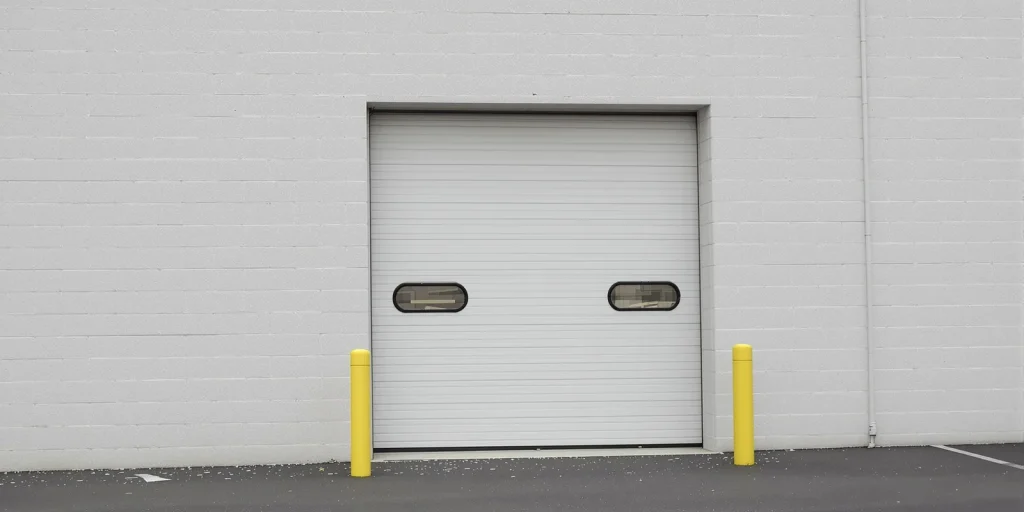
Damage to a rolling steel door at a distribution warehouse caused by a forklift. The curtain took the hit, the guides got out of alignment and the door would only travel about four feet before binding. Replaced the damaged slats and bottom bar. Realigned and re-anchored guides. Re-tensioned counterbalance and set operator limits. The door was again working on its original barrel and brackets.
What Breaks on Commercial Doors & What We Do About It
A commercial garage door might cycle forty or fifty times a day compared to four times a day for a residential garage door. Everything wears out faster, and failures are apt to happen in a few obvious spots. These are the four we are most often called out for and what commercial garage door repair really means in each case.
Broken springs, cables and counterbalance failure
The counterbalance bears the weight of the door, and with commercial doors that weight can sometimes be hundreds of pounds. If a garage door spring breaks, it will sound like a gunshot and the garage door either won’t go up or will be really heavy. On rolling steel doors the springs are inside the barrel, out of sight, so the first symptom is usually a door that drifts, slams or stops holding position. We measure wire size, inside diameter and length, replace springs in matched sets, replace frayed or off-drum cables at the same time and re-tension the counterbalance so the door balances at every point in its travel. For high traffic openings, we can quote a high-cycle garage door spring replacement that will last many times longer than standard commercial springs.
Bent guides, impact damage, doors out of track
Box trucks, pallet jacks, delivery drivers and forklifts derail commercial doors far more often than time does. On a sectional overhead door that shows up as bowed or creased panels, rollers jumping out of the track, and a door hanging crooked in the opening. On a roll up door the curtain comes out of the guides and binds part way. We straighten or replace the track and guides, replace single panels or slats where the rest of the door is sound, re-anchor guide angles to the jamb, and re-square the door in the opening. Running a damaged door “just until Friday” turns a panel problem into a curtain replacement. We like to look at it early.
Operator, motor and control failures
Commercial garage door openers are a different breed than residential units — jackshaft operators mounted on the shaft, trolley operators, hoist operators with chain hoist backup, wired to three-button stations, safety edges, photo eyes, timers, loop detectors or card readers. When a door won’t run, the problem is usually not the garage door motor but rather a contactor, limit switch, safety edge or a photo eye knocked out of alignment by a pallet. We check the control circuit before blaming the operator. When the unit is truly finished we do garage door opener installation sized to the door weight, duty cycle and mounting style, and properly set the limits, force and safety devices.
Rollers, bearings, hinges, seals and daily wear and tear
Most commercial door failures can be prevented and they start with noise. Dry bearings squeak, worn rollers clatter and gnaw the track, loose hinges let panels move and a squashed bottom seal allows water, dust and pests into the building. This is the cheapest work we do and the work that saves the most money, because a seized bearing that costs a modest part today takes the shaft, drums and cables with it later. A garage door tune up includes roller, hinge, bearing, fastener, chain tension, lubrication, seal condition, balance testing and safety device verification for all overhead doors on the property.
Repair or Replace: How to Choose
Most commercial doors that we see can be repaired and we will tell you that. But there comes a time when it costs more to keep fixing old door over two years than replacing it and there comes a time when a door is truly unsafe to keep in service. Here’s the honest breakdown.
Restoration and repair
-
When the door structure is sound and a component has failed or worn out, repair is the right call.
-
Broken springs, cables, drums or bearings on a door with straight track and solid panels or slats
-
One or two damaged panels or slats on a curtain that is otherwise square and true
-
Operator faults, worn chain and sprockets, failed limit switches, safety edges or photo eyes
-
Rollers, hinges, seals, hardware and balance — garage door tune up work to keep a good door running for years
Replacement
-
The right move when the repair keeps recurring or the door no longer fits what the building does.
-
Extensive damage to panels or slats, rust-through at bottom or curtain that will not run true after repair
-
A door that's been repaired repeatedly over the last year and keeps breaking in new places
-
An opening that has outgrown its door — more traffic, larger vehicles or a duty cycle the door was never designed forseal bonded across the opening where the concrete is low, sloped or cracked
-
Insulated steel garage doors or a new garage door specified for the opening — a full garage door installation with matched springs, track and operator
What You Can Check Safely Before Calling
Many commercial door “failures” are not failures. Before you call in a commercial garage door repair company, there are five checks that a maintenance person or manager can safely make in a few minutes each. First, read the safety box below. There are three jobs on this list that no one should be doing without commercial door tools and training.
-
1
Check the disconnect and power.
Ensure power is reaching the operator at the outlet/panel, check for a tripped breaker, and verify whether the operator has been left in manual or disconnected mode. On jackshaft units a pulled chain hoist or an engaged disconnect will cause the motor to run but nothing will happen at the door. Reset the breaker once. If it trips again, stop and call, a repeating trip is an electrical fault and not a nuisance.
-
2
See the photo eyes and the safety edge.
Sensors at the bottom of the opening get bumped by pallets, covered in dust or blocked by stacked inventory. Clear any obstructions, clean the lenses and check that both LEDs are on and steady. If you have doors with a pneumatic or electric safety edge, look for a cut, a crushed or a hanging edge along the bottom bar — a damaged edge will stop the door from closing and may cause it to reverse for no apparent reason.
-
3
Clear the opening and floor track.
Sweep the threshold & both guide channels. A dropped bolt, a frozen pool of water, gravel, banding, shrink wrap, all will stop a door partway and make it look like a mechanical failure. While you are down there check out the bottom seal, if it is flat, torn or missing make note of it for the technician.
-
4
Visual hardware walk, hands off.
Step back and look at the door from the inside with the door closed. You are looking for a loose cable or a cable hanging off the drum, a gap in a spring, rollers that are out of the track, a bent guide, a cracked hinge or a bracket that is pulling away from the wall. Take note of what you see and report it on the phone. See safety box — do not touch, adjust or tighten any of it.
-
5
Listen and record.
Note what the door does and when. Does it fail cold in the morning, after a certain number of cycles, only on the way down, only from one control station? Does it squeal or grind or bang or hesitate at the same height every time? A technician can figure out what’s wrong with a door much faster from a specific history than from “it stopped working.” And usually that means fewer trips and a lower bill.
Don’t attempt to do this yourself: garage door spring replacement, cable replacement or putting a door back on track.
People search everyday for information on how to replace a garage door spring, how to fix a garage door cable and how to get a garage door back on track and we are not going to write those instructions. This isn’t us being careful for legal reasons. A commercial torsion spring stores enough energy to break bones and has killed people. On a rolling steel door that spring is hidden inside the barrel where you cannot see its condition or tension. Cables under load will take fingers. A heavy sectional door that is off track is not supported by anything predictable and the second you lever it, it can fall down.
These jobs require winding bars, the correct replacement parts by wire size and length, and someone who does it weekly. Broken spring, loose or frayed cable, off track? Keep people and vehicles out from under it, leave the door in whatever position it is in, and call 833-435-4540. Do not attempt to repair.
Selecting a Commercial Garage Door Company
Commercial work is not just residential work with a bigger door. The math is different for counterbalance, the operators are wired into building controls and safety devices, the doors are heavier, and the bad repair consequences land on your employees and your insurance. Ask if this is something the company does regularly in commercial doors or if yours would be an exception this month. If you have a fifteen foot rolling steel door on your dock, a garage door repair company that mainly works on two car residential garages can be very good at what they do and still be the wrong choice for you.
Ask what happens after repair. Who is responsible for the warranty: the company you called, or a subcontractor you never selected? Are the parts commercial grade, or the closest residential equivalent that fits? Will you have an itemized invoice with parts and labor broken out so you can compare it against the next quote and file it away for your maintenance records? If they’re vague about prices over the phone, that’s a sign that they’ll make you a price once someone’s standing in your building and your door’s already apart.
Two questions to ask before anyone touches your door: does the person who shows up work for the company I called, or is he a subcontractor bidding on my job? And will I get a written, itemized quote for the full scope of work, before work begins, not after?
Commercial Garage Door Questions & Answers
What are the differences between residential garage doors and commercial garage doors?
Weight, duty cycle, and construction. Residential garage doors are typically insulated sectional doors that are designed for a few cycles a day. Commercial doors are built for volume, so they feature heavier gauge steel, commercial track and hardware, high cycle spring options and operators rated for continuous use. Roll-up doors that wrap around a barrel above the opening are almost entirely a commercial format, as is rolling steel. One of the most common reasons a “fixed” door fails again in a few months is using residential parts on a commercial opening.
How long do commercial garage door springs last?
Springs are rated in cycles, not years. The usual commercial spring is rated for about 10,000 cycles. A door that opens and closes 40 times a day will burn through that in about 1.5 years. A door that opens 5 times a day can go a decade on the same spring. If you’re experiencing more spring failures than you’d think you should, the solution is most often a high-cycle spring package, sized to your actual traffic, which costs more up front but less over the life of the door.
Can I repair just one panel or slat, or will I have to replace the whole door?
Often the correct thing to do is to change out individual sections and slats, and that’s typically what is done for impact damage. The question is, is the rest of the door still square and is the section still available in a matching profile and gauge? Older or discontinued doors may be unavailable, and heavy damage to multiple sections may be more expensive to repair than a garage door replacement. We are going to tell you both numbers, and you will decide.
Do you do commercial garage door openers as well as doors?
Yes. We service and repair jackshaft, trolley and hoist operators, control stations, safety edges, photo eyes, timers and receivers. We handle garage door opener installation when a unit needs to be replaced. In commercial work, size is more important than brand – an operator has to match the weight of the door, the mounting available at the opening, and how many cycles a day it will be operating. We service and carry parts for LiftMaster, Genie, Chamberlain, Craftsman, Clopay, Amarr, Wayne Dalton and Overhead Door.
How often do you need to service a commercial overhead garage door?
Twice a year is a reasonable minimum for a door in daily use. Quarterly for high-cycle doors on a busy dock. A garage door tune up includes lubrication, rollers & bearings, tightening hinges & fasteners, chain tension, inspection of cables & drums, balance testing, and safety device verification. It is the cheapest work on this page and is the reason that some buildings never call us for an emergency and others call every quarter.
Get Your Commercial Door Working Again
Tell us the type of door, how wide and high it is, and what it’s doing now — stuck open, stuck closed, running rough, or making a noise you don’t like. That is usually enough for us to tell you what is likely wrong, what the repair path looks like and what it should cost. If the door is unsafe to operate, we’ll tell you that on the phone before anyone tries to move it again.
Commercial garage door services, repair, tune ups, openers and full door replacement. One company, one number, one bill.
Related Garage Door Services
Emergency Garage Door Repair
The door is stuck open, jammed shut or unsafe to operate and cannot wait for a scheduled visit.
Garage Door Spring Replacement
Replace broken or worn torsion springs, matched sets, high-cycle options for doors that are used a lot.
Garage Door Opener Repair and Installation
Repairing, replacing and diagnosing garage door openers, controls and safety devices.