
How to Replace Garage Door Spring: The Honest Answer
The short answer
A broken garage door spring is the one repair on your door that isn't yours to make, because the part holding the door up is also the part that can hurt you in a fraction of a second. Call Century Garage Door Service at 833-435-4540 and leave the door where it stands.
Type how to replace garage door spring into a search box and you get a lot of video and very little honesty. Here it is. Swapping a garage door spring is not homeowner work, and no page anywhere, ours included, should be handing you a procedure for it.
That’s the short answer. The rest of this page is the useful part.
You’ll still see how to replace a garage door spring in every autocomplete list, so let’s take the question seriously.
The spring isn’t an accessory. It’s the counterbalance that makes a slab of steel heavier than most people can lift feel weightless.
Table of Contents
How to replace garage door spring, the straight answer
Call someone. It’s the entire answer, and I would rather have it here than under a parts list.
Here’s the reasoning, because “call a pro” with nothing behind it is worthless. A wound garage door spring holds up one particular door weight, and all of that force stays locked in the coil whether the door is up or down. Moving it into a fresh spring takes purpose-built tools and a door weight somebody measured rather than guessed. Get that wrong and the failure isn’t a scraped knuckle. It’s steel moving faster than you can react.
This page carries no turn count and no sequence for taking the tension out of a spring, and that’s deliberate. You can search how to replace spring on garage door all you like, but the answer doesn’t change.
How to tell a garage door spring has broken
Four signs, and usually more than one at once.
The bang. A torsion spring at full tension lets go with a crack people describe as a gunshot. Plenty of homeowners call us about a suspected break-in.
The gap. A failed torsion spring shows a clean separation on the shaft above the opening. The most reliable indicator is a gap visible in the coil.
The weight. Anybody who already put a hand under the door calls it immovable, because the counterbalance is gone.
The straining opener. The motor hums and the chain keeps moving. The door climbs a few inches, then stalls. Some units quit and reverse. Others keep hauling until a part inside the drive lets go.
| What you notice | Likely cause | Your next move |
|---|---|---|
| A loud crack, then nothing looks wrong | Torsion spring let go | Stop using the door, call |
| Daylight showing in a coil overhead | Spring has separated | Leave the opener off, book service |
| Door lifts a few inches then slides back | No counterbalance left | Cut power to the opener, call |
| Door rises crooked, one side lagging | One spring of a pair gone | Technician, same day |
A door that won’t rise at all has a short list of causes with a failed spring at the top, and our garage door wont open guide covers the rest.
Torsion springs versus extension springs
Two systems exist and your door runs one. Both kinds of garage door spring do the same job, offsetting the door’s weight so the opener only has to move it.
Torsion springs mount on a steel shaft above the opening, wound tight, turning a cable drum at each end. Nearly every door built in the last few decades uses them.
The extension springs are stretched along both horizontal tracks and become longer as the door descends. Older doors and some light singles still run them.
Now the part that matters most. An extension spring is supposed to have a safety cable inside it, anchored at each end, so a break while the spring is stretched leaves the pieces captive rather than loose in the garage. Spot a stretched spring with nothing threaded inside it and that’s a call worth making today. Cables are a subject of their own, and our garage door cables guide has them.
Need a Professional Tune-Up?
Skip the ladder. Our local technicians perform full safety inspections and comprehensive lubrication to keep your system running silently.
Why a garage door spring fails when it does
Cycles, not calendar years. That’s the most useful line on this page.
A garage door spring wears out from being used, so one on a house where the garage doubles as the front door burns through several times the cycles of one that opens twice a day. Two identical springs fitted the same day in two houses part ways by years, and the busy door loses first.
Rust comes second, and it does two jobs. It puts friction between the coils every time they wind and unwind, and the pitting it leaves turns into the exact place the steel splits. A garage door spring gone orange is not a cosmetic problem.
Lubrication is the piece homeowners can genuinely affect, and almost nobody touches it. A light spray of garage door lubricant on the coils twice a year keeps them sliding rather than grinding.
Then there’s a spring sized wrong for the door. Four numbers have to match the weight hanging under it, so a spring built for something lighter is overworked from day one. That turns up after a door replacement where somebody reused the old counterbalance on a heavier door.
The cold is often blamed. It doesn’t break a healthy spring, it just finds the fatigued one.
Why both springs get replaced together
It’s a plain opinion, not an upsell. On a two-spring door the pair came out of one production run and went up on one day, so both have absorbed the same number of cycles. One broke first by a margin measured in weeks.
Replace only the broken one and you have a new spring beside a tired one, and a counterbalance that no longer shares the load evenly.
So both get replaced. Every time.
Cycle rating, and how long a new garage door spring lasts
A cycle is an up-and-down trip. Cycle rating is the tested count a spring should reach before fatigue sets in, and it’s the closest thing to an honest lifespan figure this trade has.
On plenty of residential doors the stock spring sits right around the 10,000 cycle mark, while higher rated options carry roughly double to quadruple that. Which suits you depends on your household, not the door.
| Trips per day | Around 10,000 cycles | Higher rated spring |
|---|---|---|
| Two | Comfortably past a decade | Longer than you’ll own the door |
| Four | Roughly six or seven years | Well over a decade |
| Six | Roughly four or five years | Around a decade or more |
| Eight or more | A few years at best | Roughly a decade |
Anyone asking how to replace a spring on a garage door is really asking how to stop doing it again in four years, and cycle rating is that answer.
What the technician actually does
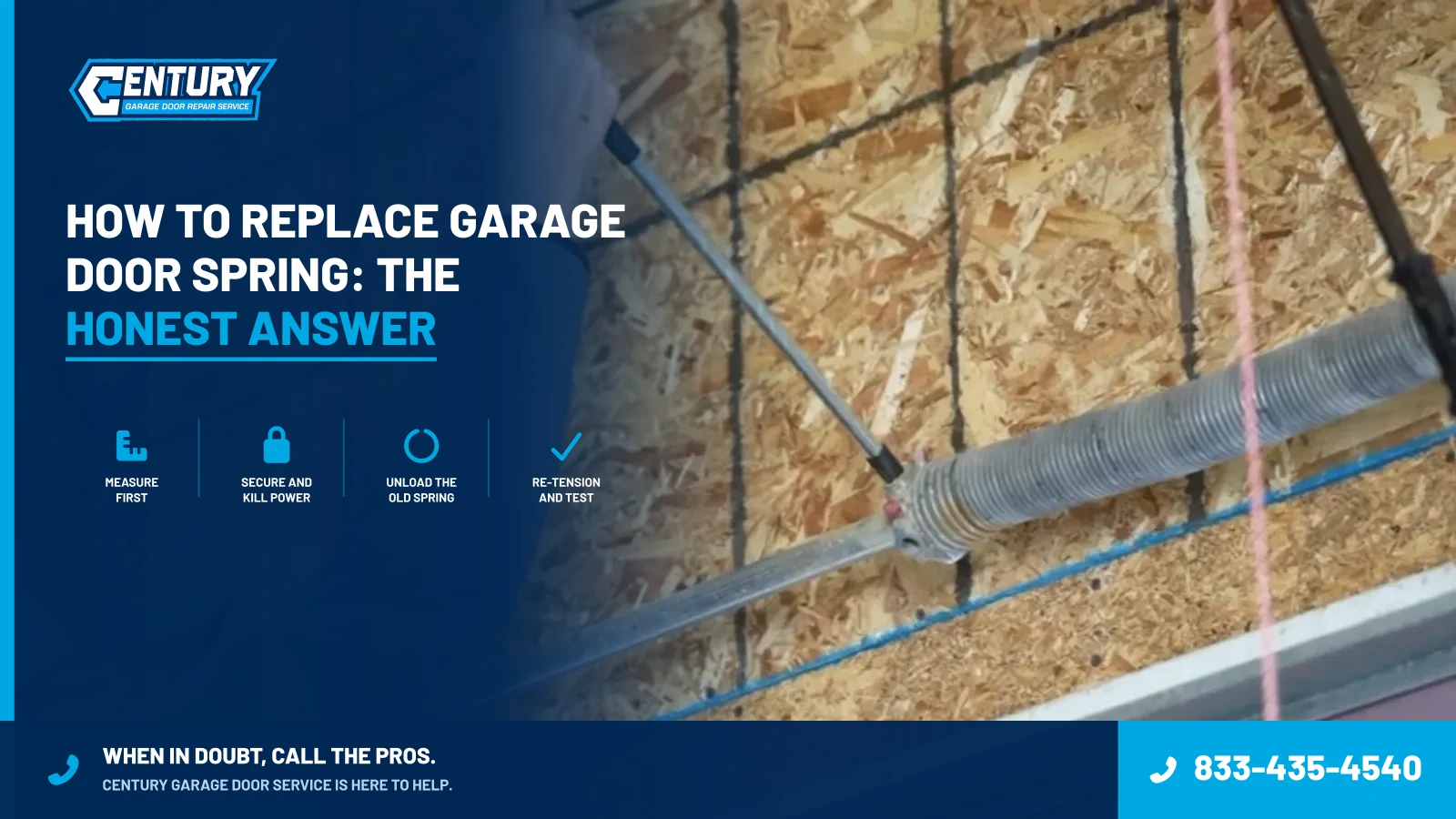
Here’s how to replace the spring on a garage door as the work is genuinely done, so you know what you’re paying for. It is not a list of instructions.
Measures first
Wire diameter, inside diameter, overall length, and wind direction get read off the old spring, and the door's weight gets confirmed rather than guessed, because a garage door spring matched to the wrong weight fails early.
Secures the door and kills the power
at the opener, so nothing moves mid-job.
Takes the load out of the old spring under control
, with tools built for that one purpose.
Strips the spring and its cones off the shaft
, then inspects the end bearings, the cable drums, the shaft, and both lift cables.
Fits the matched replacement
to the measured specification.
Re-tensions to the door's weight
, then trues both cables on their drums so the door hangs square.
The balance test, and why it comes last
Every step before this one is fitting. This is the proof.
With the opener uncoupled so the motor holds nothing, the door gets walked up by hand to about waist height and let go. A correctly counterbalanced door stays put. It moves under light hand pressure in either direction and stops when the hand stops. Going up takes about the same effort as coming down, and none of it feels like lifting.
Fail it and the door says which way the counterbalance is off. Sinking toward the floor means the spring is carrying too little, so the opener takes the difference on every trip and the drive gear pays for it. Creeping upward, or refusing to sit down on the slab, means it’s carrying too much, which fights the down travel and can leave the reversing system reading resistance that isn’t there.
It goes last because the opener’s travel and force settings get dialed in against a balanced door. Set them first and you’re aiming at a moving target.
And it stays a technician’s test rather than yours. Uncoupling the opener takes away the one thing steadying the door, and our garage door manual release guide covers when that’s the right move.
What to do the moment a spring lets go
Work this in order. Two minutes of it protects the door and the next person who walks in.
Stop pressing buttons
Wall control, remote, keypad, car button, all of them. Leave the door where it is.
Cut power to the opener
Unplug it at the ceiling outlet or switch off its breaker, so nobody runs it out of habit.
Clear the opening
Keep kids and pets away from a door sitting partway up.
Leave the car
If it's parked inside it stays there until a technician has the door under control.
Look from a distance
and note whether the shaft carries one spring or two. That decides what rides on the truck. Century Garage Door Service answers live around the clock at 833-435-4540.
What drives the cost of garage door spring work
Four things move the number, and none is a mystery.
Whether the door runs a single spring or a pair, since a two-spring door gets a matched set. The cycle rating you choose, because a longer-life garage door spring uses more steel. Whether the lift cables, the drums, the end bearings, or the shaft go on the same ticket, which happens often on a door old enough to break a spring. And the door’s weight, which sets the specification, because a light single panel door and an insulated double are different animals.
You get a written quote before any work, and the price is approved before a tool comes out. Only the quoted trip fee is owed if you decline.
Safety, and why this one stays with a technician
Two rules, no exceptions. It’s why no procedures appear above.
Never adjust, wind, unwind, replace, or release the tension on the torsion springs above the door or the lift cables running down the sides, because they hold hundreds of pounds of stored energy and get replaced with winding bars by a trained technician. Drive gear internals and main power wiring are technician work too.
If a spring is broken, don’t run the opener at all and don’t try to lift the door by hand, because nothing is counterbalancing the door’s full weight and the motor will strip its drive gear attempting it.
Look at it as long as you like. Photograph it, describe it on the phone, point at it when the technician arrives, and ask what failed. Just keep tools and hands off. The standards behind residential counterbalance systems are published, and the DASMA technical data sheets on residential counterbalance systems (dasma.com) are what the trade works from. Our garage door spring repair page covers the work.
There’s no version of this job where a homeowner comes out ahead by trying it.
FAQs: garage door spring replacement
Can I replace a garage door spring myself?
No, and this is the one repair where the answer never softens. A wound spring holds enough force to break bones whether the door is open or closed, and releasing it safely needs purpose-built tools plus a known door weight. Call 833-435-4540 instead.
How do I know which spring on my door has broken?
Look at the shaft above the opening from a safe distance. A separated spring shows a clean gap in the coil, an inch or two of daylight, while its partner still reads as one continuous coil. Only one normally breaks, and the other is close behind.
How long does a garage door spring replacement take?
A straightforward pair swap on a residential door is generally a single visit, not a multi-day repair, and our trucks carry common specifications so the part is usually on board. What stretches it out is finding worn cables, scored drums, dry bearings, or a bent shaft to do too.
Why do you replace both springs when only one broke?
Because both went on the same day and have taken the same number of cycles, so the survivor sits weeks behind its partner rather than years. One new spring beside one tired spring leaves the counterbalance uneven and buys you a second service call.
How long should a new garage door spring last?
Count your real traffic first. Cycles decide this and the calendar barely matters. A garage door spring rated near 10,000 cycles suits a door opened once or twice a day, and it gets spent inside a few years on a garage used as the family entrance.
Can a broken garage door spring be repaired instead of replaced?
Replaced, always. A garage door spring that has split has fatigued along its whole length, and nothing brings that temper back, so the halves come off the shaft and a matched new spring goes on. Anyone offering to weld one is selling you a second failure. The cable ends get inspected in the same pass.
What should I have ready when I call about a spring?
Not much. Whether the shaft above the opening carries one spring or two, roughly how wide the door is, whether it’s insulated, and what the opener did when the door quit. A photo of the coil from a safe distance helps as well. Then call 833-435-4540 and leave the door alone.
Get your garage door spring handled today
A broken garage door spring turns a working door into a locked one, on the morning you needed to be somewhere. Century Garage Door Service answers live around the clock at 833-435-4540 and gives you a two-hour arrival window with a text when the truck rolls. Our trucks carry garage door spring stock, cables, drums, and bearings, so most visits finish in one trip, and the workmanship is warrantied. You get a written quote before any work starts, and only the quoted trip fee if you decline it. Seniors and military get a standing discount. So do first responders. Or ask to have the whole system gone over while the truck is there.
Table of Contents
Emergency Repair?
Did a loud bang follow a door that won't lift? Don't risk injury. We offer rapid emergency response.