
How to Install a Garage Door: What Garage Door Installation Really Involves
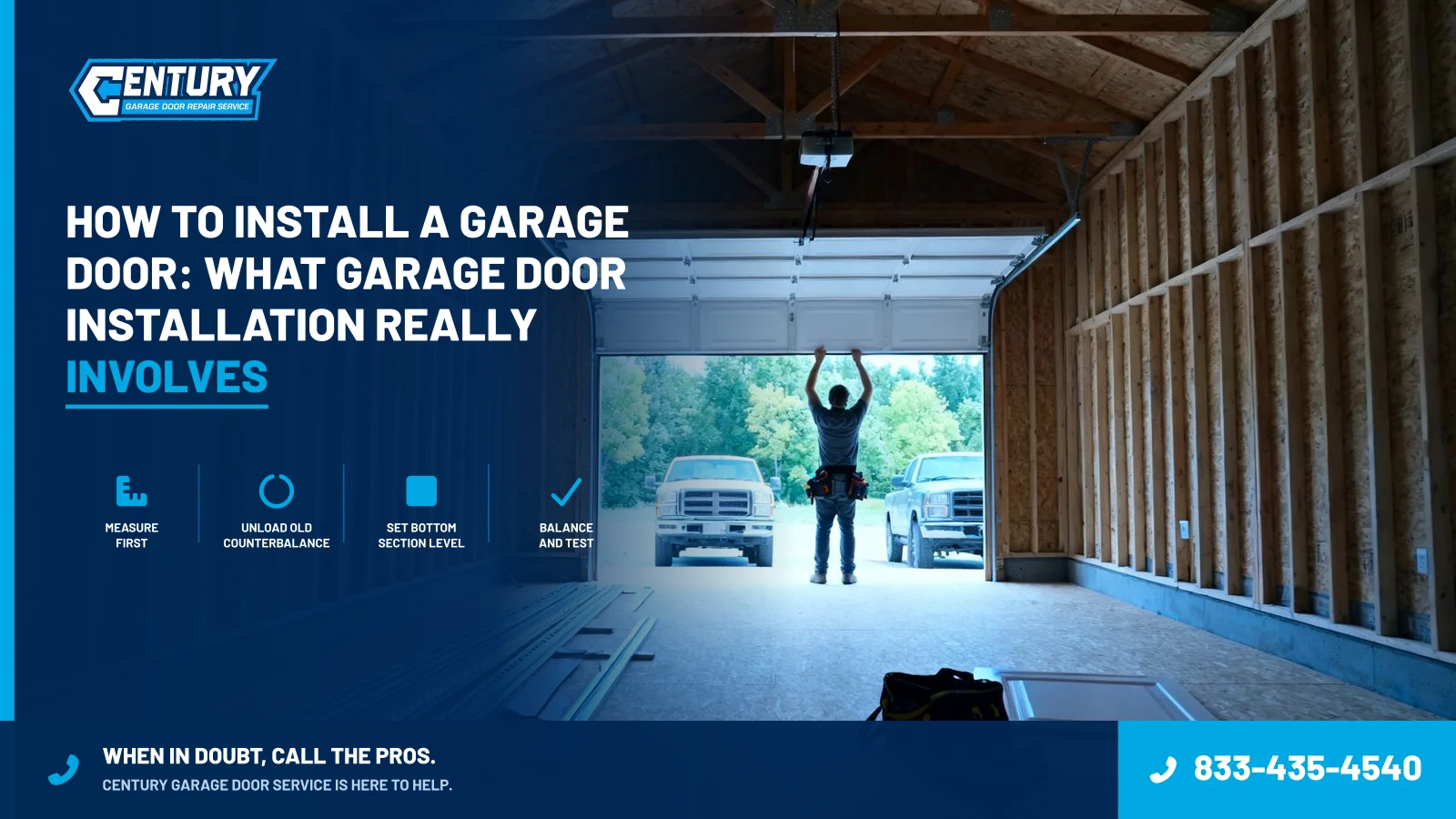
The short answer
A garage door installation is technician work, because the counterbalance above the opening gets sized and wound to the weight of your particular door. Call Century Garage Door Service at 833-435-4540 and have it fitted by a crew that does it daily.
A garage door installation is one of the few jobs on a house where the hard part is invisible from the driveway. Panels are the easy half. The counterbalance above the opening has to be matched to the weight of the door you chose and then wound to it, and that one step decides whether the door runs quietly for years or fights you from week one.
So the answer to how to install a garage door is that you hand it to somebody with the tools and a measured door weight.
None of it is a procedure. A garage door installation isn’t a weekend project, and no honest page treats it like one.
Table of Contents
How to install a garage door, the straight answer
Hire it out. That’s the whole answer, and I’d rather put it at the top than bury it.
Here’s the reasoning, because “call a pro” with nothing behind it is worthless. A door is a stack of sections that has to hang plumb, run in track set to a tolerance you can’t eyeball, float on a counterbalance built for one weight, and seal against a slab that’s rarely dead level. All of it is measurable, and all of it goes wrong quietly. A door hung slightly out of square still opens on day one. It just chews rollers, drags on one side, leans on the opener, and shows you a crooked strip of daylight sooner or later.
Nothing below is a sequence to follow at home. A page on how to install garage door hardware would need turn counts for the counterbalance, and no honest one prints them, which is why how to install garage doors is a hiring decision rather than a procedure.
What a garage door installation actually involves
Six blocks of work, and only one is the part people picture.
- Reading the opening. Width and height at the opening, the headroom above it, the depth behind it, and the clearance at each side. Those decide the track and hardware package. How openings get measured is covered at garage door sizes.
- Stripping out what’s there. On a replacement the load comes out of the old counterbalance before anything comes down, then the sections come off from the top.
- Checking the timber. Jambs and header carry every bracket, so split or rotten wood gets sorted before a fastener goes near it.
- Building the door up. Bottom section set dead level, then hinges, rollers, vertical track, horizontal track hung off the framing, then the shaft, bearing plates, and drums.
- Fitting the counterbalance. Springs specified to the door’s measured weight, then cables trued so each side pulls the same.
- Setting the opener and the safety functions. Travel limits, force settings, photo eyes near the floor, and a reversal test before anyone signs off.
That last block is where plenty of decent work falls down, because a door can hang beautifully and still leave you with an opener strong enough to push through an obstruction.
Why the counterbalance decides the whole job
Your door isn’t lifted by the motor. It’s balanced by the springs and nudged by the motor, which is why the counterbalance is the part a garage door installation lives or dies on.
Four figures set the specification. Wire diameter, inside diameter, overall length, and wind direction all have to suit the weight hanging below, and that weight moves with section count, with steel gauge, with glass, and with insulation. An insulated door with windows is a different animal from a single-skin panel of the same size, so it wants a different spring.
Then the door gets balanced, which is the last thing a correct job does. The technician verifies that balance before signing off, and our garage door spring replacement guide is where the balance test itself gets explained.
The thing that makes me grind my teeth is a new insulated door hung on the old spring because the spring “looked fine”. It was fine, for a lighter door.
Need a Professional Tune-Up?
Skip the ladder. Our local technicians perform full safety inspections and comprehensive lubrication to keep your system running silently.
What garage door installation day looks like
Below is a garage door installation as it’s genuinely done, written so you know what you’re paying for. It’s a description, not a set of instructions.
Measures before anything comes off the wall
The opening, the headroom, the backroom, and the side room get checked against the quote, since a surprise there changes the hardware package.
Takes the load out of the old counterbalance under control
, with tools built for that purpose, then brings the sections down.
Reads the timber and sets the bottom section level
Every bracket fastens into the jambs and header, so bad wood gets replaced rather than shimmed, and the bottom section goes down dead level because everything stacks off it.
Builds the stack
Sections, hinges, rollers, plumbed vertical track, horizontal track hung off the framing, plus rear supports into structure not drywall.
Fits and winds the counterbalance to the measured weight
, then trues both cables so the door hangs square and rises level.
Balances and tests
The counterbalance gets verified first, then travel limits, force settings, photo eye height, and a reversal test on an object across the opening.
Seals and finishes
Bottom seal, side stops, top seal, and a pass or two while somebody watches.
Most straightforward replacements run as one visit, because the trucks carry hardware for common specifications.
New construction versus a replacement garage door installation
Two different jobs share one name. On a new build the opening is a decision. On a replacement it’s a constraint.
| What differs | New construction | Replacement |
|---|---|---|
| The opening | Framed to a chosen door, so size is still up for discussion | Fixed, so the door works to the opening you have |
| Jambs and header | New timber, checked square before the door goes near it | Read for rot and splits first, sometimes rebuilt |
| The old door | Nothing to strip out | Load comes out of the counterbalance before anything comes down |
| The opener | Fresh mount and fresh photo eye wiring, on a clear ceiling run | Reused when it’s sound and suits the new door’s weight |
| Finishing | Stop molding and trim usually go on afterward | Existing trim gets worked around, or replaced |
Swapping a single damaged section is a smaller job than a garage door installation, and if that’s your situation it belongs with garage door panel replacement instead.
What you can do before the truck arrives, and where that stops
Genuine help, and it does shorten the visit.
- Clear the floor along the opening. A crew needs the full width plus room to lay sections flat.
- Move the cars out the night before. A door mid-install can’t be opened, and a car inside stays inside.
- Settle the choices early. Insulation, glass, panel profile, and hardware look get decided before the truck is loaded rather than on the driveway. Styles are covered at garage door styles.
- Be reachable. Somebody who can approve a written quote should be at the end of a phone.
- Say what’s already there. Whether the shaft above the opening carries one spring or two, and whether the opener stays, decides what rides on the truck.
Where the help stops is anything carrying load or setting a safety function. Winding a spring, handling a lift cable, opening a drive gear housing, wiring a circuit, and dialing an opener’s force setting by feel all sit on the far side of that line. Force settings are the sneaky one, because an opener set too strong will drive a door into an obstruction.
So do the sweeping and the deciding. Leave the tensioning and the testing to the garage door installation crew.
What drives the cost of a garage door installation
Seven things move a garage door installation quote, and none is a mystery.
Door size and section count come first, since a double opening carries more of everything. Construction is second, because an insulated door with a steel back skin costs more to build and weighs more, which changes the counterbalance too. Then glass and decorative hardware, which are pure choice. Then condition, meaning whether the jambs or the header timber need rebuilding before a new door can hang. Whether the opener gets replaced or reused sits in there too, along with hauling the old door away and any wind-load requirement your local code applies.
So when you ask how much to install a new garage door, the honest answer is that the figure comes out of your opening and your choices rather than off a chart. You get a written quote before any work, the price is approved before a tool comes out, and if you turn it down you owe only the trip fee quoted up front. Century Garage Door Service answers live around the clock at 833-435-4540. Our new garage door cost guide walks through the drivers one at a time.
Torsion springs, lift cables, and the line nobody crosses
There’s one line on this page with no exceptions, and it’s the reason no procedure appears above.
Never adjust, wind, unwind, replace, or release the tension on the torsion springs above the door or the lift cables running down the sides, because they hold hundreds of pounds of stored energy and get replaced with winding bars by a trained technician. Drive gear internals and main power wiring are technician work too.
A new garage door installation doesn’t change that. A fresh spring is under load the moment it’s wound, and the lift cables carry the door’s weight from that point on. New hardware isn’t safe hardware. It’s just unworn hardware.
Watch the whole thing if you like, and ask questions. Ask what the door weighed, ask what wire size went on the springs, ask to see the balance test, and ask where the opener’s force setting ended up. A technician worth hiring likes those questions. The standards behind residential doors and their counterbalance systems are published, and the DASMA technical data sheets on residential garage door installation (dasma.com) are what the trade works from.
Signs a garage door installation went wrong
Five things to look at early, before a small error wears into a big one.
- Daylight at one bottom corner with the door shut. The bottom section isn’t level, or the cables aren’t trued.
- The door won’t stay where it’s left. The counterbalance is off one way or the other.
- The opener grunts on the way up. It’s carrying weight the springs should be carrying.
- A roller pressed hard against one flange as the door travels. Track spacing or plumb needs correcting.
- The bottom seal touching on one side only. Sometimes the slab, more often the door.
But none of that is cosmetic. Each one is a load going somewhere it wasn’t meant to go, and every cycle makes it worse. A garage door installation gets checked and adjusted rather than argued about, so say something while it’s still an adjustment.
FAQs: garage door installation
Can I handle a garage door installation myself?
No, and the answer doesn’t soften on this one. Panels are manageable. The counterbalance isn’t. It gets specified and wound to your door’s measured weight with tools built for that purpose, and a mistake there moves faster than anyone reacts. Call Century Garage Door Service at 833-435-4540 and have the whole thing fitted properly.
Do I need a new opener with a new door?
Not always. A sound opener that suits the new door’s weight can carry on, and a technician checks the travel limits, the force settings, the photo eye height, and the reversal test before signing off. What forces a change is a unit already struggling, or a much heavier door replacing a light one.
How much to install new garage door, and what moves it
Nobody can give you a real figure sight unseen. The drivers are the opening size, the door’s construction, the glass or hardware you choose, and whether the jambs or the opener need work. You get a written quote before work starts, and only the quoted trip fee is owed if you decline.
How long does a garage door installation take?
Think in visits rather than hours. Stripping the old door out, hanging the new sections, winding the counterbalance to the measured weight, and setting the opener normally happen on one trip, because the truck arrives loaded for the specification you approved. A garage door installation stretches when the jambs or header timber have to be rebuilt before a new door can hang.
Can a new door reuse my old track and springs?
Usually not, and reusing them is where a lot of early failures start. Track sets are matched to the door’s height and the radius it turns through, while the counterbalance is sized to the weight hanging on it. Put a heavier door on a spring built for a lighter one and it’s overworked from day one.
Will my garage sit open while the old door comes off?
Not overnight in the normal case. A residential garage door installation is usually one visit from start to finish, so the opening is only standing open while the crew is in front of it working. If something behind the old door turns the job into two visits, nobody just drives off. You’ll agree how the opening gets closed up before the truck leaves.
Does the crew take the old door away?
Yes, when removal is written into the quote you approve, and it’s a normal part of a garage door installation. The old sections and the hardware that came off the wall leave with the truck rather than stacking up beside your driveway. Ask for haul-away as its own line on the written quote, and say early if you want to keep a section for shelving.
Book your garage door installation
A garage door installation is the biggest visual change you can make to the front of a house, and it’s also a mechanical system that has to be right the first time. Century Garage Door Service answers live around the clock at 833-435-4540 and gives you a two-hour arrival window with a text when the truck rolls. Our trucks carry sections, track, hardware, and spring stock, so most jobs finish in one visit, and the workmanship is warrantied. You get a written quote before anybody picks up a tool, and only the quoted trip fee if you decline it. Seniors and military get a standing discount. So do first responders. If your door was fitted by somebody else and you want it looked over, book a garage door safety inspection instead.
Table of Contents
Emergency Repair?
Did a loud bang follow a door that won't lift? Don't risk injury. We offer rapid emergency response.