
Garage Door Won't Open: Causes & Fixes
The short answer
You pressed the button and the motor pulled for a second against the door before it quit with a click. Or nothing happened at all. Walk inside first and look up at the spring on the shaft above the door before you press that button again, because a garage door won't open with a broken spring and every extra press chews up the drive gear. Century Garage Door Service answers live at 833-435-4540.
There’s a short list of reasons a garage door won’t open, and the first item on it is both the most common and the most dangerous. A torsion spring lets go, the counterweight vanishes with it, the door that felt like ten pounds yesterday becomes a slab of steel parked on your concrete, and the opener bolted to your ceiling doesn’t stand a chance against it. Your opener was never built to lift that. Neither were you.
The rest of the list is friendlier.
A slide lock somebody nudged with a bike handlebar. Vacation mode on the wall console. A trolley still hanging free since the last outage. A remote cell that finally gave up. Those cost you a walk around the garage with a flashlight, which is why the checks below run in a deliberate order, safest first, and why they stop cold at the two situations where a garage door won’t open for reasons you shouldn’t be touching.
Table of Contents
When a garage door won't open, start at the torsion spring
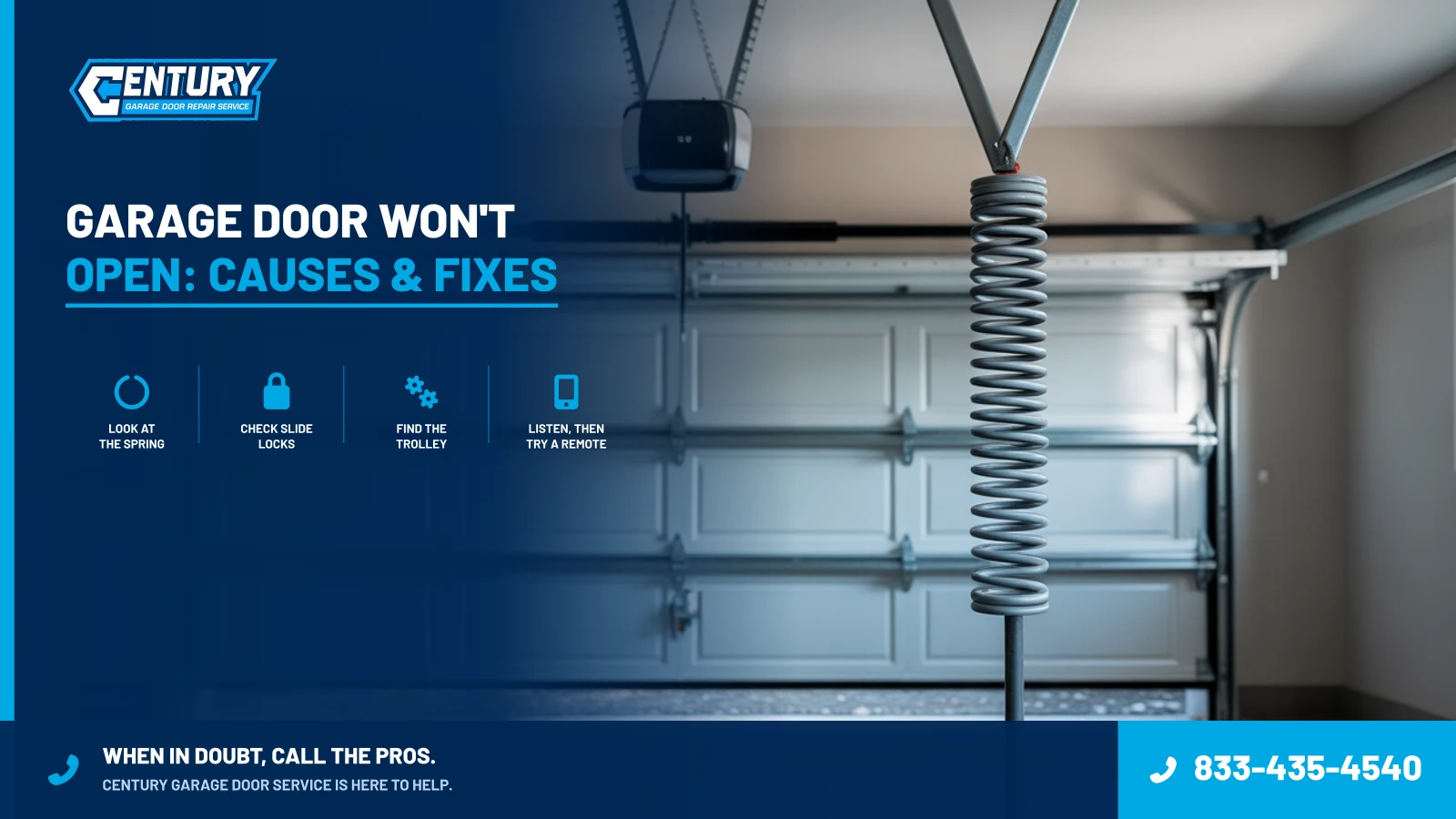
The springs do the lifting in your garage. Your opener starts the motion and decides where it stops, which makes it a positioning device with modest muscle behind it. Pull the spring out of that arrangement and you’re left with a heavy door and a motor that can’t budge it.
So the most common reason a garage door won’t open is also the one that ends the troubleshooting. Here’s how a broken spring announces itself.
- A visible gap or separation in the spring coil on the shaft above the door, usually an inch or two of daylight where the wire pulled apart
- A loud bang from the garage sometime earlier, often overnight, which people mistake for something falling off a shelf
- The opener straining for a second and then quitting with a click instead of lifting anything, because it hit its force limit against the full weight
- The door feeling far too heavy at the bottom edge, if you already tried it by hand
- The top section flexing, or the door lifting crooked and cocking in the opening
Any one of those is enough. You don’t need all five.
Two rules from here, and neither one bends. If a spring is broken, don’t run the opener at all and don’t try to lift the door by hand, because nothing is counterbalancing the door’s full weight and the motor will strip its drive gear attempting it. A garage door won’t open on a stripped gear either, so now you’re buying a gear kit alongside the spring. And the weight is the reason for the second half of that rule. A correctly counterbalanced door weighs 8 to 10 pounds at your hands, so people assume the door is light, when residential doors run from roughly 150 pounds for a plain single up past 400 for an insulated double.
Never adjust, wind, unwind, replace, or release the tension on the torsion springs above the door or the lift cables running down the sides, because they hold hundreds of pounds of stored energy and get replaced with winding bars by a trained technician. Drive gear internals and main power wiring are technician work too. That’s why this section stops here rather than teaching you the procedure. What replacement involves, and what drives the cost of it, sits on our spring repair page linked at the bottom of this guide, and a written quote comes before anybody starts work.
Run these checks in order when a garage door won't open
Work down the list and stop at the first thing that looks wrong. Most reasons a garage door won’t open show themselves in the first two checks. Nothing here asks you to touch a fastener or reach into a moving part.
Look at the spring before you press anything
Stand inside and look up at the shaft above the door, hunting for a gap in the coil. Find one and you're finished checking. Nothing else on this page matters until that spring is replaced.
Check the slide lock on both vertical tracks
Look at waist height for a bar or an L-handle sitting through the track instead of parked alongside it.
Hold the lock button on the wall console for a couple of seconds
If your console has a lock or vacation setting, this clears it. The indicator stops blinking.
Find the trolley on the rail overhead
It should be latched to the chain or belt carriage rather than sitting loose several feet away.
Press the wall button and listen, then try a remote
A working wall button with no working remote points at the console lock or a dead cell.
Note exactly where the door stops
The same spot every cycle points at hardware or a limit setting. A random spot points at force or a binding roller.
Look along the bottom of the door in cold weather
Ice bonding the seal to the slab holds harder than people guess.
Six of the seven cost nothing but attention. Most times a garage door won’t open, one of them names the reason inside a minute.
Why a garage door won't open when nothing looks broken
Two switches, and both get flipped by accident.
The first is the manual slide lock, a bar or L-handle on the inside of a vertical track that drops a pin through a hole in the track. Older doors have them and plenty of newer ones do too, since they let you secure the garage without power. Bump one with a bike handlebar or have a house sitter lock up on your behalf and the door is bolted to its own track. So a garage door won’t open with that pin dropped even though every other part of the system is healthy. Watch what the opener does about it. Either the door doesn’t move at all while the motor strains against a hard stop, or it lifts an inch until the pin catches and the whole assembly shudders back down. Walk the inside of both tracks at waist height.
The second is the lock button on your wall console, which some brands label vacation mode. It tells the receiver to ignore every remote and keypad on the system while the hardwired wall button keeps working normally. Press it once by accident, or let a kid play with the console, and every remote in the house looks dead at the same moment. Hold that button a couple of seconds and watch the indicator.
My honest opinion is that this is the most aggravating entry on the whole list, because a garage door won’t open under either switch and both look exactly like a failed opener from the driveway.
So rule them out before you spend anything.
Need a Professional Tune-Up?
Skip the ladder. Our local technicians perform full safety inspections and comprehensive lubrication to keep your system running silently.
A trolley left disengaged after the manual release
This one has a signature you can’t miss. The motor runs its full cycle, the chain or belt travels, you can watch the carriage slide along the rail, and the door doesn’t move an inch. A garage door won’t open with the trolley uncoupled no matter how new the opener is.
Somebody pulled the red cord during an outage, lifted the door by hand, and never reconnected it. Re-engaging the trolley, along with the by-hand balance test that tells you whether your springs are healthy, is covered step by step in our garage door manual release guide. Read that before you pull the cord again, because with a broken spring behind it the order of operations is the only thing keeping the door off your head.
Dead remote battery and the rest of the signal side
If the wall button raises the door and the remote does nothing, your door is fine. Coin cells fade rather than die outright, so range shrinks for a week or two before the remote quits in the driveway, and one cold snap finishes a marginal cell overnight. Keep a spare in the junk drawer.
Battery specifications, pairing, frequency matching, the learn button, and code memory belong to our program garage door opener guide rather than this one. A garage door won’t open from a dead transmitter and it won’t open from a wiped code memory either, and those two read identically from thirty feet away.
One sentence on the photo eyes, since people always ask. Sensors govern closing rather than opening, so they almost never stop a door from going up, though a shorted or badly wired pair can drop the logic board into a lockout that mimics everything else on this page, and our guide at fix garage door sensor covers that.
Up-travel limit and open force, set wrong
Sometimes a garage door won’t open all the way rather than refusing outright. It climbs most of the way, then parks a foot short of the top and sits there looking smug. That’s the up-travel limit, the setting that tells your opener where the open position lives, and it drifts on older units or gets left short after a repair. When a garage door won’t open past chest height and stops at the same measurement every cycle, that setting is the first suspect.
Open force is the other half of the same story. Set too light, the motor gives up the instant the door asks for anything extra, so a cold morning or a dry roller is enough to end the cycle early. Set too heavy and you’ve traded away a safety feature, which is why force isn’t a knob to experiment with.
Both are adjustments rather than repairs. The procedure for them lives in our garage door opener not working guide, which takes up an opener that won’t respond along with everything inside the powerhead. That means the motor, the capacitor, the drive gear, and the logic board.
When the hardware itself is binding
Rollers are the quiet culprit. Steel rollers with dry or seized bearings stop rolling and start dragging, worn nylon develops flat spots that bind at the curve, and either way the door demands more force than the opener is permitted to deliver. You’ll usually hear it coming, a grind or a screech that got worse over a couple of months while everybody in the house learned to ignore it, and then one morning a garage door won’t open at all and the noise turns out to have been a warning rather than a personality trait.
Bent track does the same thing at one specific height. A bumper tap, a shelf bracket screwed too close, a fastener that worked loose, a hinge pulling away from its section, any of it pinches the roller in the same place every cycle. The door stops at the same spot every time, which is your clue. A garage door won’t open past that height until somebody straightens or replaces the track section.
Then there’s the frozen door, a January special. Ice is the reason a garage door won’t open on exactly one morning of the year. The bottom seal bonds to the slab overnight, the grip is stronger than people expect, and the opener strains against that bond until it gives up and reverses.
Don’t keep pressing. Repeated attempts against a frozen seal tear the gasket off its retainer or strip the drive gear, so melt the ice with warm water first, then dry the slab before you run the door.
And if the door sits crooked in the opening, or a roller has left its track, stop there. Never touch a door that has come off its track, because it weighs upward of 200 pounds and can drop or twist without warning. Putting it back means controlling that weight while the hardware is already compromised.
What each symptom points to when a garage door won't open
Match what you’re hearing to the likely cause when a garage door won’t open.
| What you hear or see | Likely cause | What to do |
|---|---|---|
| Loud bang earlier, door dead now | Broken torsion spring | Stop using the opener, book spring repair |
| Motor runs while the door stays down | Trolley disengaged, or stripped drive gear | Check the trolley on the rail first |
| Door lifts an inch, then reverses | Slide lock engaged in the track | Slide the bar clear of the track, retry |
| Wall button works, no remote does | Console lock (vacation mode) or a dead cell | Clear the lock, then swap the battery |
| Door stops a foot short of the top | Up-travel limit set short | Have the limit reset, don’t force it |
| Opener strains, then reverses partway | Open force too light, or a seized roller | Have force and hardware checked together |
| Nothing breaks free at the floor in a freeze | Bottom seal frozen to the slab | Melt the ice, keep off the button |
Searches for how to fix a garage door that won’t open land on spring content almost every time, and that instinct is sound. But order matters more than the guess, because the harmless causes take seconds to rule out while the dangerous one takes a single look at the coil.
Where the line sits between a check and a repair
Everything in the ordered list above is looking and listening. That’s deliberate.
Here’s what nobody should be doing at home. Torsion springs carry several hundred pounds of load and get serviced by people who handle them daily. Lift cables carry that same load and fray from the inside out where you can’t see it. Drive-gear internals mean opening the powerhead. Main power wiring means the branch circuit feeding that ceiling outlet. Each of those four has a way of going wrong fast, and the entrapment protection standards behind these warnings are published through the International Door Association safety resources (doors.org).
Call somebody when a garage door won’t open and you can see a gap in the spring, when a cable is frayed or hanging slack off its drum, when the door is off its track or sitting crooked in the opening, or when the opener runs happily and nothing you can see explains why the door stays down.
A garage door won’t open on a convenient morning, which is why Century Garage Door Service answers live around the clock and gives you a two-hour arrival window with a text when the truck rolls. A written quote goes in your hand before work starts, and turning it down leaves you owing only the trip fee quoted up front. Our trucks carry spring, cable, roller, and bearing stock, so most visits finish in one trip, and the workmanship carries a warranty.
FAQs when a garage door won't open
My garage door won't open, where should I start?
Look up at the spring on the shaft above the door before you touch the button again. A gap of an inch or two in the coil means the spring is broken and the door is now dead weight. If the coil looks continuous, check the slide lock on the track, then the lock button on the wall console, then the trolley on the rail, then the remote battery.
Can I lift the door by hand if the spring is broken?
No, and this is the one place we won’t hedge. With the spring broken there’s no counterbalance left, so you’d be lifting the door’s full weight, roughly 150 pounds for a light single door and past 400 for an insulated double. It can drop fast enough to break bones. Leave the door closed with the opener unplugged, and call 833-435-4540.
Why does the opener run while the door stays put?
Two causes, and they sound identical from the wall button. Either the trolley is still disengaged from when somebody pulled the manual release, so the carriage slides along the rail with nothing attached to it, or the spring is broken and the motor has already stripped its plastic drive gear attempting the load. Look at the trolley first, since that takes ten seconds.
Why won't the door open all the way?
Usually the up-travel limit, the setting that tells the opener where to stop. If it drifted or was left short, the door parks low every cycle. The other candidates are an open-force setting that’s too light, a roller binding in the upper track, a bent track section catching near the curve, or ice still holding the bottom seal to the slab.
The remote does nothing but the wall button works. What now?
Start with the remote battery, since a weak coin cell is the most common answer, and cold weather makes a marginal one worse. Next, check the lock or vacation button on the wall console, because that feature blocks every remote signal while the wall button keeps working. If both check out, our programming guide covers pairing. Century answers live at 833-435-4540 around the clock.
The door worked yesterday. Why won't it open today?
A garage door won’t open the morning after a spring lets go, and springs usually break while the door sits closed overnight, so nothing warned you. Cold weather does the rest. A marginal coin cell in the remote dies on the first freezing night, and ice bonds the bottom seal to the slab hard enough to stall the motor. And a house sitter can drop the slide lock without ever mentioning it.
What does it cost to fix a garage door that won't open?
It depends on which cause turns up, which is why nobody quotes this blind. A garage door won’t open for reasons that sit at wildly different places on the scale, from a limit setting that needs resetting to a spring changeover with fresh rollers alongside it. You get a written quote first and approve the price before a tool comes out. Decline it and you owe only the trip fee we quoted. Call 833-435-4540.
When a garage door won't open, this is the call to make
A door sitting on the floor with a separated spring above it isn’t a weekend project, and a garage door won’t open safely again until somebody with the right tools has been in there. Century Garage Door Service answers live around the clock at 833-435-4540 and gives you a two-hour arrival window with a text when the truck rolls. A written quote goes in your hand before anybody picks up a tool. Decline it and you owe only the trip fee we named up front. Our trucks carry spring, cable, roller, and drum stock, so most jobs finish in one visit, and the workmanship is warrantied. Seniors and military get a standing discount. First responders do too. Start at our garage door spring repair page. Or just call and describe what the door did.
Table of Contents
Emergency Repair?
Did a loud bang follow a door that won't lift? Don't risk injury. We offer rapid emergency response.