
Garage Door With Man Door: What Homeowners Should Know Before You Specify One
The short answer
The best garage door lubricant for a residential door is a silicone spray or a white lithium grease, and the water-displacing penetrating spray most people reach for is neither one. For a full pass done by somebody who does it daily, call Century Garage Door Service at 833-435-4540.
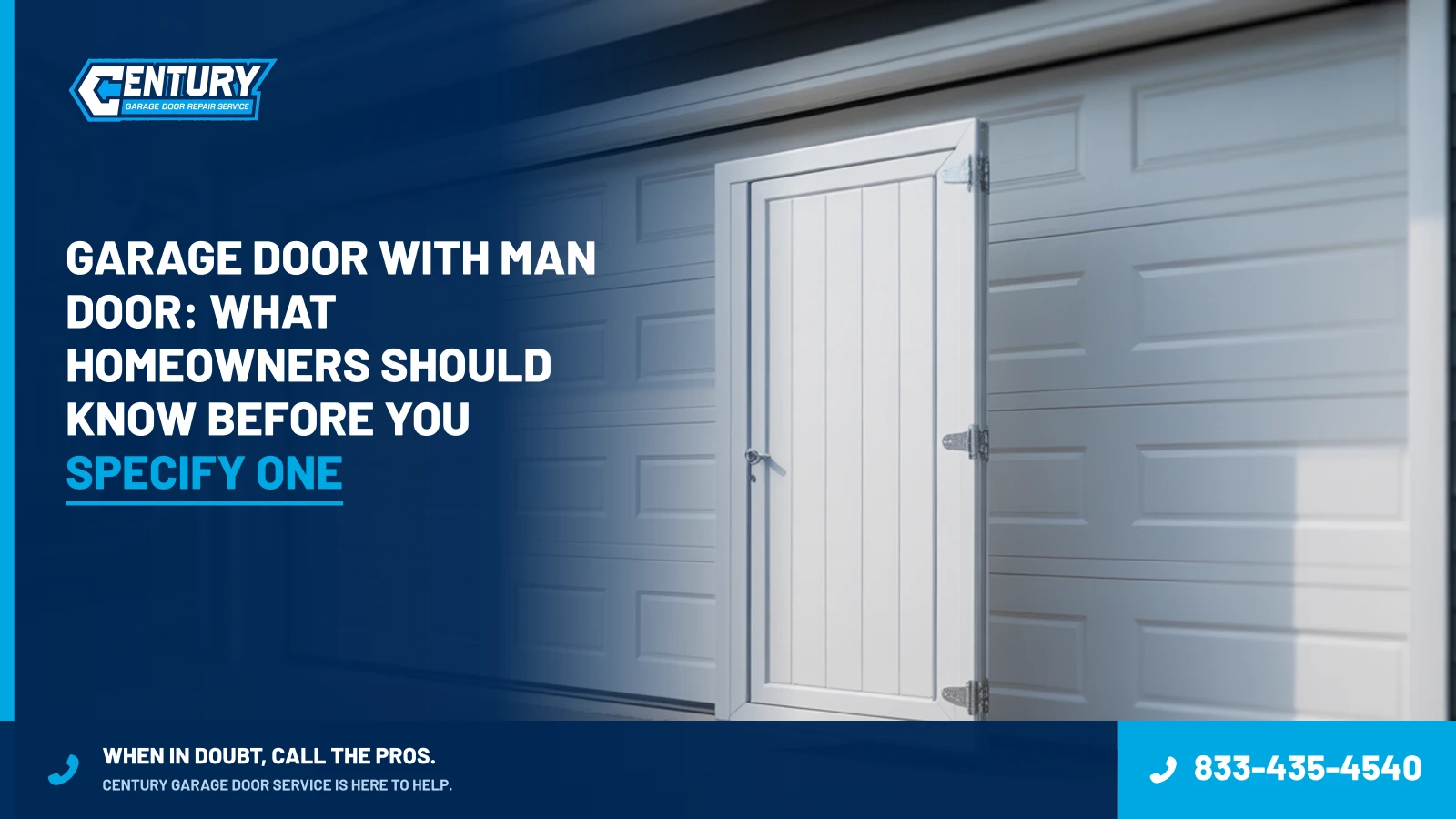
A man door is a person-sized hinged door built into one section of a garage door, so you can walk into the garage without running the whole door up. The trade also calls it a pass door or a wicket door, and a garage door with man door is a single assembly rather than two doors side by side.
It solves a real problem and it is not free. The panel has to be cut and framed, the bottom seal is interrupted, a threshold appears across the opening, and the finished door weighs more than the one it replaced. Those four consequences are the whole decision.
Table of Contents
What a man door actually is
Picture a sectional door and then picture a doorway framed inside the lower sections. That is it. The pass door swings, usually outward, on its own hinges, inside a steel or aluminium sub-frame that is built into the garage door panel and carries the load around the hole.
Two details separate a proper pass door from a hole with a door in it. The sub-frame has to transfer the load that used to travel through the panel around the opening instead. And the whole assembly still has to fold at every section joint and run through the curve of the track, which is why a pass door is only ever fitted in a way the door manufacturer has engineered for.
Why anybody fits a man door at all
The case for a pass door is genuinely strong in a few situations, and weak in most others.
- A detached garage with no side access. If the only way in is the big door, running it up every time you fetch a bag of compost is wear you are paying for.
- A workshop you use daily. Cycles are the currency a door spends. A pass door saves hundreds of them a year.
- A bay you heat. Opening a whole door dumps the air in the room. A pass door does not.
- Deep sites where the driveway is shared or blocked. Walking in without moving a vehicle.
Against that, if your garage already has a side door into the garden or a pass door into the house, a garage door with man door is solving a problem you do not have, and our garage entry door guide covers that separate door properly.
The frame is the whole engineering problem
Cutting a hole in a load-bearing panel is not a small thing, and this is where the quality difference lives.
A section of a garage door is a structural element. It resists wind pressure across its whole width, it carries hinge and roller loads at its edges, and it has to stay flat. Put a doorway in it and the panel needs a sub-frame stiff enough to do that job around a void, tied into the section’s own reinforcement.
Get it wrong and the symptoms are specific rather than vague. The section bows visibly under wind. The pass door binds when the garage door is closed and swings freely when it is open, which means the panel is flexing. Roller stems at the edges of that section wear faster than the rest. None of that is a hinge adjustment, it is the frame not doing its job.
ALT: man door sub-frame detail showing the reinforcement carrying load around the opening
Need a Professional Tune-Up?
Skip the ladder. Our local technicians perform full safety inspections and comprehensive lubrication to keep your system running silently.
The threshold, and the seal it interrupts
Here is the consequence nobody mentions in the showroom. A pass door needs its own threshold, a raised sill across the bottom of the pass door so the door has something to seal against.
That threshold sits in the path of anything you wheel in and out. A mower, a wheelbarrow, a bike, a bin. It is usually an inch or two proud, and on a garage floor that is a genuine trip point and a lip that collects grit against it.
It also interrupts the garage door’s own bottom seal. The bottom seal runs in a continuous retainer across the full width, and a man door threshold breaks that line, so the corners where the two meet are where water and draughts find their way in. This is fixable and it is not free maintenance, and how the rest of the seals work is in our garage door seals guide.
Weight, and what it does to the counterbalance
A pass door adds steel. The sub-frame, the hinges, the pass door leaf, the lock, and the threshold hardware all add up, and they add up unevenly, concentrated in the lower sections on one side of the door.
That matters because the counterbalance is sized to the finished weight of the door it is lifting. Fit a heavier door on the springs that came off a lighter one and it will not hold position, it fights the opener, and it wears its hardware. Sizing the torsion springs to the new weight is part of the job rather than an extra, and it is technician work that belongs on our garage door spring replacement guide.
The uneven distribution is the subtler point. A door carrying most of its extra mass on one side wants to rack slightly, which is why a garage door with man door is more sensitive to track alignment than a plain one.
The interlock that stops the opener
Every properly specified pass door has a switch that tells the opener the pass door is not fully shut.
The reason is obvious once stated. If the opener runs the garage door up with the pass door standing open, the pass door swings into the track, the jamb, or the ceiling, and something breaks. The interlock is a simple safety contact wired into the opener’s circuit, and it refuses to let the door move until the pass door is latched.
Check it exists and check it works. Open the pass door a couple of inches and press the remote. Nothing should happen. If the garage door starts to move, the interlock is missing, unwired, or bypassed, and that is worth fixing before it costs you a door.
Factory-built against a retrofit man door
There are two ways to end up with one, and they are not equivalent.
| Factory-built | Retrofit into an existing door | |
|---|---|---|
| Frame engineering | Designed with the section | Added to a section not designed for it |
| Wind rating | Can be rated as an assembly | Usually voids an existing rating |
| Warranty | Covered as supplied | Panel warranty commonly affected |
| Counterbalance | Sized to the finished door | Has to be recalculated |
| Seal and threshold | Detailed in | Adapted |
The wind-rating row is the one that matters in a coastal or high-wind county. A rated door is tested as a complete assembly, so cutting a hole in one afterwards means the rating no longer describes what is hanging in your opening, and our hurricane doors guide explains why that testing works the way it does.
When a separate side door is the better answer
Worth saying plainly, because a man door is often the more expensive way to solve a cheaper problem.
If a wall of the garage faces somewhere you can reach, a separate hinged door in that wall gives you the same walk-through access with no threshold across the vehicle opening, no interrupted bottom seal, no added weight on the counterbalance, and no interlock to maintain. It is the better answer whenever the building allows it.
A man door earns its place when the building does not allow it: a garage built to the boundary on both sides, a wall you cannot open up, or an opening where the only route in is the door itself. Construction standards manufacturers build to are published through the DASMA technical data sheets on residential sectional doors (dasma.com).
FAQs: man door questions
Is a man door the same as a pass door?
Yes, and as a wicket door. All three names describe a person-sized hinged door built into a larger door, and you will hear all of them from suppliers. Pass door is the tidier term and man door is the one most people search for, which is why both appear on this page.
Can a man door be cut into the garage door I already own?
Sometimes, and it is the weaker of the two options. The section was not designed with a void in it, so the sub-frame is being added to a panel that was not engineered for one. Expect the panel warranty to be affected, any wind rating to be void, and the counterbalance to need recalculating for the extra weight.
Does the threshold have to be that high?
It has to be high enough for the pass door to seal against, so some raised sill is unavoidable. What varies is how it is detailed and how it meets the garage door’s own bottom seal at the two corners. A well-detailed threshold is lower and better sealed than a generic one, and it is worth asking to see the detail.
Will the opener still work normally?
Yes, with one addition. An interlock switch stops the opener moving the door while the pass door is not latched, which prevents the pass door swinging into the track or the jamb. Test it by opening the pass door slightly and pressing the remote. If the garage door moves, the interlock needs attention before anything else.
Do the springs need changing?
If a man door is being added to an existing door, almost certainly. The assembly adds weight, and the counterbalance is sized to the weight of the door it lifts. Skip it and the door will not hold position, it strains the opener, and it wears hardware early. On a factory-built door the springs are sized to the finished weight already.
Does a man door weaken the door in a storm?
It changes how the section carries wind load, which is why the sub-frame matters so much. A factory assembly can be tested and rated with the pass door included. A hole cut into a rated door afterwards means the rating no longer describes the door. In a high-wind county, ask for the approval that covers the assembly you are actually buying.
Is a side door cheaper than a man door?
It is usually the simpler job, because it leaves the garage door completely alone: no threshold across the vehicle opening, no interrupted seal, no counterbalance change, no interlock. Where a wall can be opened up, that is normally the better answer. Call 833-435-4540 and describe the building if you are weighing the two.
Get a man door specified for your opening
A garage door with man door is the right answer in a garage with no other way in, and the wrong answer in a garage with a side wall you could open up instead. Century Garage Door Service answers live around the clock at 833-435-4540 and gives you a two-hour arrival window with a text when the truck rolls. A technician looks at the walls you actually have, checks headroom and track alignment, and tells you straight whether a man door or a separate side door serves you better before anybody quotes either. You get a written quote before a tool comes out, and only the quoted trip fee if you decline. Our trucks run stocked, so most jobs finish in one visit, and the workmanship is warrantied. Seniors and military get a standing discount. So do first responders. For panel work on the door you already own, book a garage door panel replacement visit.
Table of Contents
Emergency Repair?
Did a loud bang follow a door that won't lift? Don't risk injury. We offer rapid emergency response.