
Nylon Garage Door Rollers: What Homeowners Should Know
The short answer
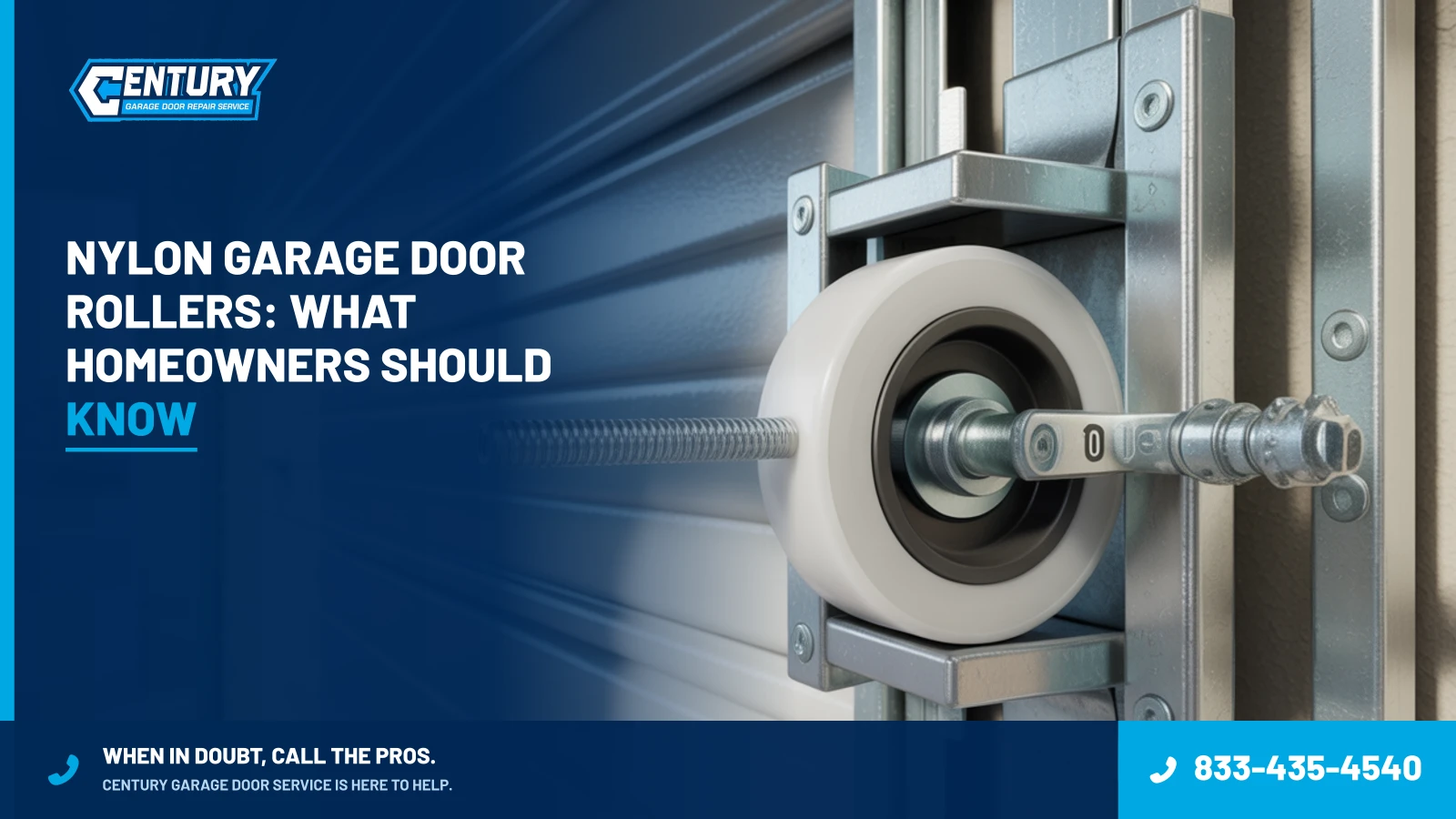
A roller is a small wheel on a stem that rides inside the track, and the nylon ones run quieter and won't rust, though what's sealed inside the wheel matters more. If yours are grinding or shuddering partway up, call Century Garage Door Service at 833-435-4540.
Rollers are the wheels your door travels on, and the nylon ones are the quieter choice because a nylon wheel isn’t steel grinding against steel track. But the thing that decides how long garage door rollers last isn’t the wheel material at all. It’s the bearing hidden inside the hub, and whether anybody bothered to seal it.
That’s the whole buying insight, and most product listings bury it under the word nylon.
Garage door rollers sit at each end of every hinge line, so a standard sectional door carries a fair few of them, and every one takes a side load thousands of times a year. When one binds you hear it long before you see it. And a door that shudders halfway up isn’t being dramatic, it’s telling you a wheel has quit turning and started sliding.
Table of Contents
What garage door rollers actually do
Garage door rollers are wheels on stems, and that’s the whole part. The stem slides into a sleeve on the hinge, the wheel drops into the track, and your door travels on about ten of them every cycle.
Here’s the division of labor. The springs above the opening carry the weight of the door vertically. Garage door rollers carry it sideways, pinning each panel into its channel so the door stays tracked while it bends from vertical to horizontal at the curve.
So a roller isn’t lifting anything. It’s guiding, under constant side load.
The two at the bottom sit in the bottom brackets, where the lift cables anchor. Remember that pair. They get their own section below, and they’re why this page isn’t written as a weekend project.
The hinges and brackets that carry garage door rollers all have names worth knowing. Our garage door parts diagram guide lays the whole assembly out.
Nylon or steel, and which belongs on your door
Nylon runs quieter and won’t rust. Steel garage door rollers are simpler to make and hold up fine in a dry garage. That’s the honest summary, and the rest is detail.
| What you’re comparing | Nylon wheel | Steel wheel |
|---|---|---|
| Noise | Quiet, because the wheel face isn’t steel on steel track | Broadcasts every seam and joint up through the ceiling |
| Rust | Doesn’t rust, which matters in a damp or coastal garage | Corrodes, and the bearing race goes first, out of sight |
| Bearings | Sold sealed or unsealed, and sealed is worth hunting for | Commonly unsealed on builder-grade doors |
| Service life | Longer, especially sealed | Respectable when dry, shorter anywhere damp or salty |
| Best use | Attached garages, and any door that runs while people sleep | Detached shop or dry climate with light use |
| How it fails | Cracks or splits when the nylon is thin and unsupported | Flat-spots, then thumps once per revolution |
The noise gap is why most people call about garage door rollers at all. A steel wheel in a steel track makes a drum out of the whole assembly, and with a bedroom over the garage you hear it at six in the morning. Rust is the other clean win for nylon, because on a steel wheel it starts inside the bearing race.
But nylon isn’t automatically the better part. A thin nylon wheel on an open bearing will crack, and a cracked wheel is worse than a tired steel one because it sheds pieces into the track. Builder-grade rollers get specified for volume rather than quiet, which is my standing gripe with new doors. Which brings us to the spec that settles the argument.
Bearing count is the quality signal nobody mentions
Count the ball bearings, then check whether they’re sealed. That single check tells you more about garage door rollers than the wheel material does.
A bargain roller carries a handful of loose ball bearings in an open race. Open means dust and moisture walk in while the grease walks out, and the bearing grinds itself flat in a season or two. A quality nylon roller runs a higher bearing count in a sealed race, which spreads the side load across more contact points and keeps the garage out of the mechanism.
More bearings and less load on each one, with a seal keeping the garage out. That’s the idea.
Fitment matters too, and it’s easy to get wrong ordering online. Stem length has to match the hinge and bracket depth, and wheel diameter has to match the track. A wheel a hair too large binds at the curve. Too small and it rattles, letting the panel wander.
Cycle ratings get printed on packaging, and I’d treat them as marketing, not a promise. A cycle is one trip up and one down, and a busy family burns through a set far faster than a couple who work from home.
Need a Professional Tune-Up?
Skip the ladder. Our local technicians perform full safety inspections and comprehensive lubrication to keep your system running silently.
What the wear looks like, and when nylon garage door rollers are the answer
Work this checklist before you blame the opener, because the signs you need nylon garage door rollers imitate a failing motor almost exactly.
- Grinding or squealing that tracks the door rather than the motor. If the noise speeds up and slows down with the panels and peaks at the curve, it’s rolling gear, not the powerhead.
- A shudder or a jerk at the same point in travel every time. One wheel has stopped turning and started sliding where the load shifts direction.
- Flat spots on a steel wheel, or visible cracks in a nylon one. Look at the wheel faces with the door open.
- A wheel that won’t spin freely by hand. Light finger pressure, door open, and it should turn without argument. Stiff means done.
- Black dust or fine metal filings on the floor under the track. That’s a bearing or a wheel face turning itself into powder.
- A door drifting sideways in the opening. Uneven wear lets the panels wander, and the gap along one jamb starts looking wider.
Two of those together and you’re past maintenance.
If the door has already jumped its track, or the track has bent and the opening is no longer square, this stops being a roller question. That’s garage door off track repair work, and running the opener again risks folding a panel.
And a door that won’t open at all needs the causes specific to that direction ruled out first. Our garage door wont open guide walks them in order.
Why one seized roller costs you other parts
A seized roller doesn’t stop the door. It drags.
That dragging is the expensive part. The panel still has to move, so the stem grinds inside the hinge sleeve, the wheel face scrapes along the channel and scores it, the hinge takes a twisting load it was never shaped for, and the opener pulls harder every cycle to beat the friction. Give that a few months and you’re no longer replacing garage door rollers, you’re replacing hinges and dressing a scored track, then wondering why the gear housing runs warm.
Left alone long enough, that’s how a door ends up off track.
The bottom roller is the one nobody should touch
Middle and top garage door rollers are technician work. The bottom roller is a hard no, and I’m not going to soften that.
The bottom roller sits in the bottom bracket, which is where the lift cable anchors. Any time the door is down that cable carries the full tension the spring system puts into it, and backing off those bracket bolts can release it with the weight of the door behind it. That bracket has taken fingers. It isn’t a homeowner part under any circumstances.
The honest answer splits by position on the door. The wheel itself is one of the simplest parts on the door. Getting to it safely is not, because the panels have to be secured and the tension controlled before anything comes apart, which is why this stays a technician job even though the part is small.
The standing rules apply here too. Never adjust, wind, unwind, replace, or release the tension on the torsion springs above the door or the lift cables running down the sides, because they hold hundreds of pounds of stored energy and get replaced with winding bars by a trained technician. Drive gear internals and main power wiring are technician work too. Never touch a door that has come off its track, because it weighs upward of 200 pounds and can drop or twist without warning. The homeowner safety checks worth knowing are laid out in the U.S. Consumer Product Safety Commission garage door safety guidance (cpsc.gov).
Lubrication that helps, and the kind that hurts
Lubricate the bearing and the stem. Leave the wheel face and the track alone.
That’s the whole rule, and people get it backwards often enough that I’d call it the most common self-inflicted roller problem. Grease smeared on a nylon wheel face does nothing useful and collects grit. Lubricant sprayed down the track is worse, because the channel then holds every bit of dust in the garage and turns it into grinding paste.
So: a garage-door-rated lubricant, and a light shot where the wheel meets the stem. Then a light film on the stem where it turns in the hinge sleeve. Wipe the excess off. Twice a year suits most doors, more often if the garage runs dusty.
If your rollers are sealed, the bearing itself needs nothing. The stems and the hinges still do.
How long garage door rollers last, and what shortens the run
Sealed nylon outlasts unsealed steel by a wide margin, and no honest answer comes as a flat year count, because usage swamps everything.
How long a set lasts depends on four things far more than it depends on the wheel.
- Cycle count. A door that runs four times a day ages its wheels four times as fast.
- Salt air. Coastal garages eat steel bearings, and it starts in the race where nobody looks.
- Door balance. An out-of-balance door leans its weight onto the wheels and the track instead of the springs, and they pay for it every cycle.
- Track condition. A bent track hammers the same wheel at the same spot until it flat-spots.
That list explains why garage door rollers on one door stay quiet for years while the set next door squeals far sooner.
Figures quoted online rarely apply to your own door. What a job turns on is how many wheels are changed, whether you’re going nylon or steel, whether the bearings are sealed or open, whether the bottom brackets need attention while the cables are off, and whether the track needs work at the same time. Those are the levers. A written quote comes before any work, and if you decline it you owe only the trip fee quoted up front, so call 833-435-4540 and describe the noise.
FAQs about garage door rollers
Are nylon rollers really quieter than steel ones?
Yes, and you notice it the first time the door runs. A nylon wheel rolls against the steel track without metal touching metal, so the seams in the track stop broadcasting up through the ceiling. Sealed bearings quiet things further, because a dry open bearing rattles even when the wheel face looks fine.
How many rollers does a garage door have?
Garage door rollers sit one at each end of every hinge line, plus the pair in the bottom brackets, so the count follows the number of panels rather than the width of the door. Replacing them as a full set is standard practice. Mixing one fresh sealed wheel in among worn neighbors just moves the noise along the track.
Can I replace garage door rollers myself?
No, and the bottom one is the reason. It sits in the bracket that anchors the lift cable, which stays under full tension whenever the door is down, and loosening it can release that cable with the door’s weight behind it. Middle and top wheels need the panels secured and the tension controlled first. Call 833-435-4540.
What does a worn roller actually sound like?
Grinding or squealing, sometimes a rhythmic clunk that speeds up and slows down with the door instead of with the motor. That timing is the tell. Motor noise stays fairly constant through the cycle, while roller noise follows the travel and peaks at the curve in the track.
Do sealed bearings still need lubricating?
The bearing itself doesn’t, which is the whole point of sealing it. The stem still wants a light film where it turns inside the hinge sleeve, and the hinges want the same treatment. Skip the wheel face, and skip the track completely. Lubricant in the channel collects grit and turns into a grinding paste, which is the opposite of quiet.
What size garage door rollers does my door need?
Two measurements settle it. Stem length has to match the depth of the hinge or bracket the stem slides into, and wheel diameter has to match your track. A wheel slightly too big binds at the curve, and one slightly too small lets the panel wander. Older doors rarely carry a label, so a technician measures the existing garage door rollers rather than guessing at a part number.
Do the hinges get replaced at the same time as the rollers?
Sometimes, depending on what the dragging already did. A wheel that seized months ago chews the sleeve it turns in, so the hinge can be past saving. How many garage door rollers get changed, whether the sleeves are worn, whether the brackets need attention, and whether the track needs dressing all move the quote. You approve a written price before any tool comes out, and only the quoted trip fee is owed if you decline. Call 833-435-4540.
Get your garage door rollers looked at
A wheel that won’t spin is a small part with a long tail of damage behind it, and the fix stays small if you catch it before the hinges and track get dragged in. Century Garage Door Service answers live around the clock at 833-435-4540. You get a two-hour arrival window with a text when the truck rolls, plus a written quote before anybody picks up a tool. Only the quoted trip fee is owed if you decline. Our trucks carry sealed nylon rollers, hinges, brackets, and track hardware, so most visits finish in one trip, and the workmanship carries a warranty. Seniors and military get a standing discount. First responders too. If the door is already riding crooked or fighting the track, book garage door off track repair and have the garage door rollers, the brackets, the track, and the balance checked in one pass.
Table of Contents
Emergency Repair?
Did a loud bang follow a door that won't lift? Don't risk injury. We offer rapid emergency response.