
How to Program a Garage Door Opener: 6 Steps
The short answer
Press and release the learn button on the motor unit, then press your remote button once inside the roughly 30 seconds of listening time that follow. That's the whole job, and if your garage door opener refuses the code after a few honest tries, call Century Garage Door Service at 833-435-4540.
Press the learn button on the motor unit, then press the button on your remote. That’s how to program a garage door opener in one sentence, and for most people it’s the entire answer. Every garage door opener built since the early 1990s uses that same two-button handshake, and the only reason it feels harder is that the learn button is almost never out in the open. Homeowners hunt across the outside of the motor unit for it, while the button itself sits under the light lens or on the back panel. Finding nothing out in plain view, they decide the opener is defective.
It isn’t. Your remote sends out a code, and the garage door opener listens for just one narrow stretch of time and stores whatever reaches it.
No app, no dealer, no special tool.
Table of Contents
What pairing does inside your garage door opener
Pairing is nothing more complicated than introducing a transmitter to a receiver. A small memory chip inside the housing holds a limited number of codes, and every remote or keypad you teach it claims one of those slots.
Modern units use a rolling code, which means the number the remote sends is different on every press and is never accepted a second time. Your garage door opener and the remote step through the same sequence, so both land on the same number at the same moment. That’s why a neighbor with an identical remote can’t open your door, and it’s why nobody can duplicate a transmitter the way they’d copy a house key.
The pairing lives in the garage door opener’s memory, not in the remote. If you swap the motor unit, all remotes in your house will stop working until they are taught again.
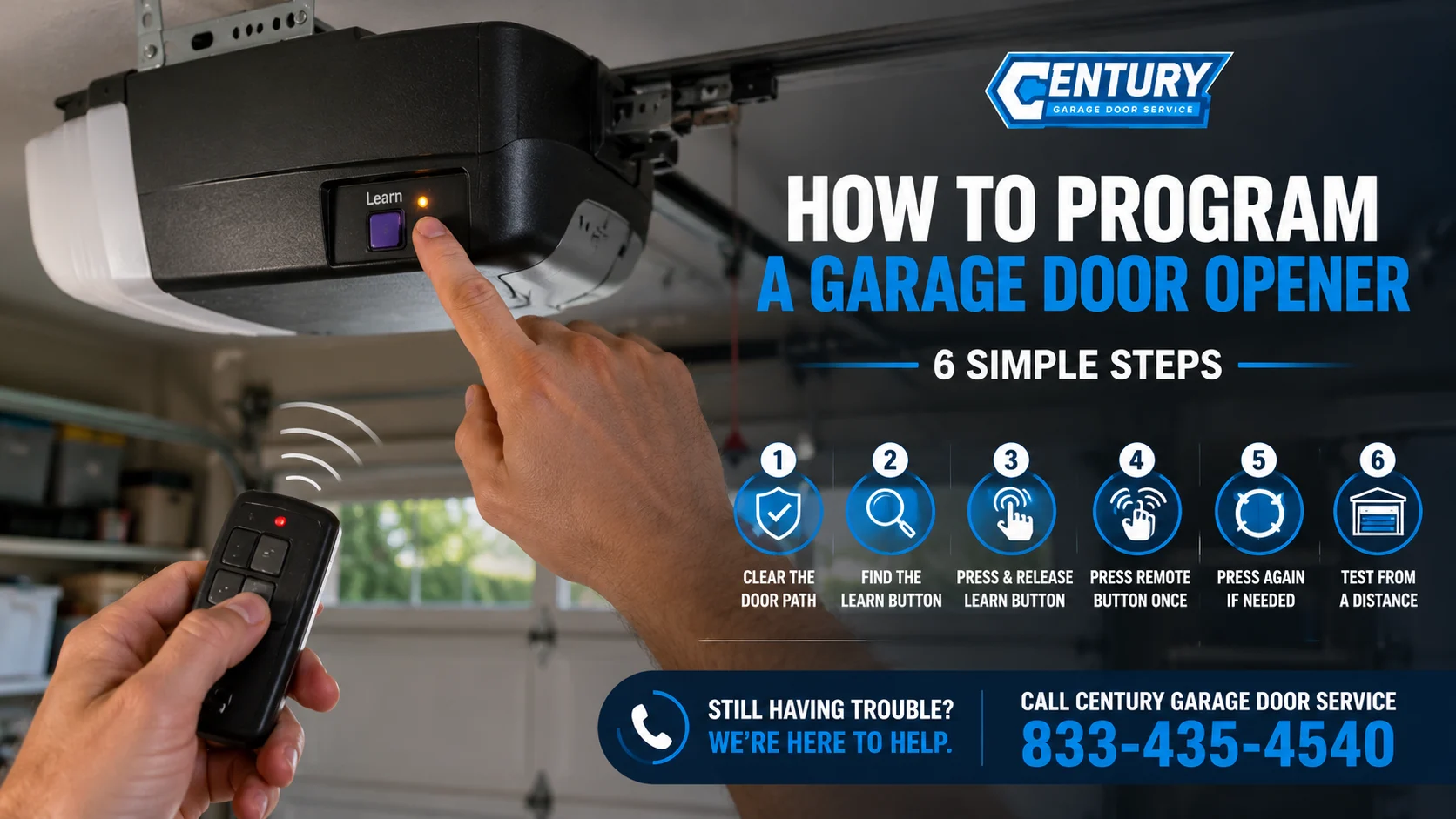
How to program a garage door opener in 6 steps
Working through these in the right order is essential. Grab a step stool and put a fresh battery in the remote before you start.
Clear the door path, but leave the power on
Your garage door opener needs live power to accept a code. Make sure the door is fully closed and nobody's standing underneath it.
Find the learn button
It's a small colored square on the back or side of the housing, often behind a hinged light lens cover. Colors run purple, yellow, red, orange, green, or gray depending on the maker and the year.
Press and release the learn button once
An indicator LED beside it lights or starts blinking. You now have roughly 30 seconds of listening time, so don't take a phone call.
Press the remote button once, firmly
Hold it about 3 feet from the motor unit. The LED will blink off, click, or the bulbs will flash to confirm it took.
Press the remote again if nothing happened
Some units want two presses inside the window. If the LED went dark and stayed dark, the code landed.
Test from a normal distance
Walk to the driveway and cycle the door twice. A remote that works at 3 feet but dies at 30 is telling you about the antenna wire, not the code.
Those six moves hold across nearly every residential garage door opener sold. Searching how to program garage door opener models brand by brand turns up the same sequence with different button colors, which is why one answer covers the whole category. If a parent calls and asks how do you program a garage door opener without being able to describe the button, have them photograph the back of the housing instead. This saves you 20 minutes.
Where the learn button hides on the motor unit
Here’s the part nobody mentions. The button is usually behind the plastic lens of the light on most belt and chain driven units. Reaching it means popping the clip loose or lowering the cover. The design choice is the cause of half your frustration in this task.
Look in this order:
- Behind or beside the light lens cover, near the bulb sockets
- On the rear panel where the antenna wire drops down
- Under a small removable panel on the side
- Next to the terminal screws where the wall button wires land
The antenna wire counts for more than most homeowners expect. It’s the thin wire dangling off your garage door opener, and it needs to hang straight down and free. If it’s wrapped around or tucked into the housing, this can decrease your range. It will look like a pairing problem, but this could actually be a reception issue. Many people will run through the entire sequence at least four times without noticing that the wire has been pinned underneath a bracket.
Need a Professional Tune-Up?
Skip the ladder. Our local technicians perform full safety inspections and comprehensive lubrication to keep your system running silently.
Keypads and older DIP switch units
A keypad follows the same handshake with one extra move, since you invent the PIN before the garage door opener stores it. Enter a 4-digit code, hold the enter button, then press learn on the motor unit while the keypad waits. Some models want learn pressed first. Pick a PIN that isn’t your house number, because anyone who can read your mailbox gets four free guesses otherwise. If the keypad still refuses a new PIN after a couple of clean attempts, worn contacts or a cracked weather seal is the usual reason rather than a programming mistake, and our garage door keypad page covers what that repair involves.
The learn button is absent from units built prior to the mid-1990s. There’s instead a small bank of switches in both the remote control and receiver. The patterns of the remote control and receiver must be physically matched.
Set them identically and the remote works.
Those fixed-code systems carry a real security weakness, since the code never rotates and can be captured. My honest opinion is that a garage door opener still running DIP switches should be replaced rather than fed new remotes, because it also predates modern entrapment protection standards, and that’s the bigger problem by a wide margin. Current requirements are laid out through the International Door Association safety resources (doors.org).
When your garage door opener won't accept the code
Nine times out of ten the procedure isn’t the problem. It’s one of these.
| What you see | Likely cause | What fixes it |
|---|---|---|
| No LED when you press learn | Failed logic board or no power | Check the outlet, then have the board tested |
| LED lights but remote won’t pair | Dead remote battery | Fresh cell matched to the remote’s spec |
| Works at 3 feet, dead in the driveway | Antenna wire tucked or coiled | Let it hang straight down, clear of metal |
| Remote worked, now nothing | Memory wiped by a power surge | Re-pair, then add a surge protector |
| Pairs, but the door reverses instantly | Photo-eye misalignment, unrelated to code | Realign the safety sensors at the tracks |
| Old remote quit when the new one paired | Memory full, oldest code evicted | Clear all codes, then re-add every remote |
That last row catches people constantly. Those code slots are finite, so an added remote takes an open one and changes nothing, while an added remote on a full memory silently pushes out the oldest code stored. For a clean slate, hold the learn button about 6 seconds until the LED goes out, which erases every remote and keypad on the system. Next, walk through each transmitter in order from oldest to latest.
Wiping memory is also the honest answer to how to reprogram garage door opener codes after somebody moves out, or after a remote goes missing from a car. Programming garage door opener memory from scratch takes a couple of minutes and it’s the only way to be certain an old transmitter no longer works.
Check the wall console before you blame the opener
Most wall consoles have a lock feature, sometimes labeled vacation mode, that blocks every remote signal while still letting the wall button work. If the wall button raises the door but no remote will, rule that lock out first, and our guide on a garage door wont open door covers how to clear it.
Match the frequency before buying a replacement remote
Residential units run on a handful of radio frequencies, and older ones sit at a single fixed frequency while newer ones scan several. A remote built for the wrong band will never pair with your garage door opener, no matter how carefully you press learn. Check the label on the back of your existing remote or on the motor unit’s data plate, then match it. Buying on price alone is how people end up with two remotes that do nothing.
Battery type trips people up too. A few visor remotes run on small alkaline cells rather than flat coin batteries. It’s better to match the printed number on the old cell than to guess. A cell that fits the holder perfectly but carries the wrong voltage produces the same symptom as a dead battery, so the remote reads as a pairing failure when the real problem is power.
Worth saying plainly, because it trips up a lot of homeowners. Wondering how to program my garage door opener and wondering why my door misbehaves are two unrelated questions. Pairing governs the signal. Travel limits, force settings, and spring balance govern the movement, and those are separate adjustments entirely. If the door reverses or won’t seal at the floor, start with our guide on a garage door wont close door instead.
Safety checks and when to call a technician
Don’t skip this. A freshly paired remote means the door is about to get used more, and the two tests below take ninety seconds combined.
Lay a flat 2×4 on the floor in the door’s path and close the door with the new remote. The door must contact the wood and reverse. If it grinds down onto it or stops without backing off, the force setting is wrong and the door isn’t safe to leave in service. Then close the door and wave a broom handle through the photo-eye beam near the floor, which should stop and reverse it immediately.
Step one assumes the trolley is still connected to the door, which is worth spelling out. If you’ve pulled the red release cord to disconnect the trolley, re-engage it before pairing anything, since a door on manual release rolls freely.
Knowing how to program garage door openers is nowhere near the same skill as servicing one. Call somebody if the learn button does nothing with confirmed power, if the logic board shows scorch marks, if the door has jumped its tracks, or if reaching the fix means opening the housing to get at internal drive gears. Never touch a door that has come off its track, because it weighs upward of 200 pounds and can drop or twist without warning. Leave it and call.
Century Garage Door Service answers live around the clock, gives a two-hour arrival window with a text when the truck rolls, and puts a written quote in your hand before work starts. Decline it and you owe only the trip fee quoted up front. Our trucks carry openers, remotes, logic boards, rollers, and spring stock, so most visits finish in one trip. For a garage door opener that’s genuinely done, a technician can price a replacement against a repair on the same visit.
FAQs about garage door opener programming
How do you program a garage door opener without the original remote?
You don’t need the original. The learn button accepts any compatible transmitter, so a universal remote or a manufacturer replacement pairs the same way. Press learn, then press the new remote within 30 seconds. Match the transmitter to your unit’s frequency and rolling code generation before buying, since a mismatched remote never pairs no matter how many times you try.
Why won't my garage door opener accept a new remote?
A dead remote battery causes most failures, so start there. The next likely culprit is full memory, because these units hold a fixed number of codes and quietly drop the oldest. Hold the learn button about 6 seconds to clear everything, then re-add each remote one at a time. If the indicator LED never lights when you press learn, the logic board itself may have failed.
How long does pairing a remote take?
Under a minute of actual work, assuming you can reach the motor unit and find the learn button. Most of the time people lose gets spent hunting for that button, which hides behind the light lens cover on many models. Budget ten minutes with a step stool for a first attempt, then about thirty seconds for every remote after that.
Does programming a new remote erase the old ones?
Not usually, though it can. Adding a remote fills one open memory slot and leaves existing codes alone. But if memory is already full, your garage door opener overwrites the oldest stored code, which is why a working remote sometimes quits the day you add a new one. Clearing all codes and re-adding every transmitter fixes that confusion permanently.
Do I need to reprogram my remote after changing the battery?
No. The code lives in your garage door opener’s memory, not in the remote, so a fresh cell doesn’t erase anything you paired. Drop the new battery in with the polarity matching the diagram inside the holder, then test from the driveway rather than from under the door. If the button still does nothing, the transmitter itself has probably failed.
How many remotes can one opener hold?
Most residential heads hold somewhere between six and a dozen devices, counting handheld remotes, wall keypads, and built-in car buttons together. Pair one past that limit and the oldest code drops off silently, which is why a remote that worked last month can stop with nothing else having changed. Count what is already paired before you add another.
What does it cost to have a technician program a remote or keypad?
We can’t quote it blind. What moves the number is whether a replacement transmitter has to be supplied and matched to your garage door opener, and whether the receiver tests bad rather than the remote. A wall keypad adds its own labor. You get a written quote before any work starts, and you approve the price before a tool comes out. Decline it and you owe only the quoted trip fee. Call 833-435-4540.
Get your garage door opener working right
A remote that pairs and then quits two weeks later is usually your garage door opener telling you something. Century Garage Door Service can test the logic board, check the travel and force settings, confirm the safety reversal actually works, and do it in one visit. We answer live around the clock at 833-435-4540 and put a written quote in your hand before anybody picks up a tool. Seniors and military get a standing discount. So do first responders. Start at our garage door remote page, or just call and describe what the door is doing.
Table of Contents
Emergency Repair?
Did a loud bang follow a door that won't lift? Don't risk injury. We offer rapid emergency response.