
Garage Door Won't Close: Causes & Fixes
The short answer
Most of the time a garage door won't close because something is breaking the safety beam near the floor. Clear the beam path and look for a blinking light on the motor unit. If a garage door won't close after that, call Century Garage Door Service at 833-435-4540.
A garage door won’t close for a short list of reasons, and the two photo eyes near the floor are the most common one by a wide margin. So start there, every time. Then work down the sequence below in order, because each check rules the next one in or out, and the whole pass takes about ten minutes with a flashlight.
The call usually opens with the same five words, my garage door won’t close, and most of the time it ends with a spider web across a lens or a leaf pile under the bottom seal.
A door that goes up fine and refuses to come down is telling you something specific.
That narrows the hunt a lot.
Table of Contents
Start here when a garage door won't close
Look at the pair of small plastic units bolted a few inches above the slab on each side of the opening. One fires an invisible beam across to the other, and anything blocking that beam, or knocking one unit out of line, tells the opener the floor is not clear, so the door stays put. Cleaning and realigning them is a job of its own with more branches than everything else on this page, and our fix garage door sensor guide walks through all of it.
So clear whatever is sitting in the beam path, then wipe both lenses with a dry cloth. Try the door again after that.
The ordered checks when a garage door won't close
Work these in order and stop at the first one that changes the door’s behavior. Stand outside the door’s path the whole time.
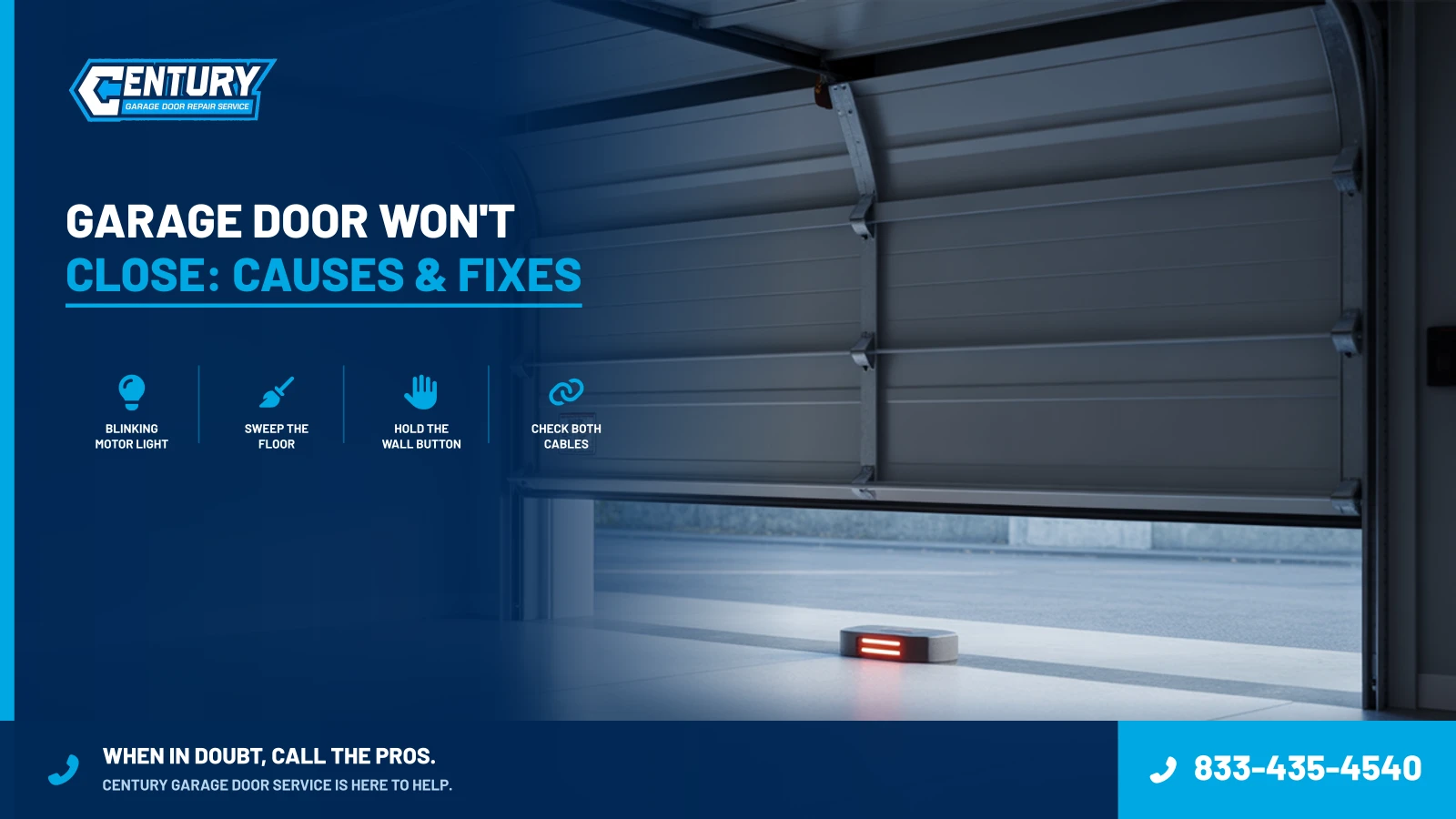
Look for a blinking light on the motor unit
A repeating blink on the powerhead almost always means the safety circuit is unhappy, which points back at the photo eyes and their wiring rather than at anything mechanical.
Sweep the whole floor under the door
A leaf pile, a pebble, a coiled garden hose, or the extension cord you meant to move is enough to bounce the door straight back up.
Hold the wall button down instead of tapping it
On most units a held wall button overrides the safety beam and drives the door down anyway, which sorts a sensor fault from a mechanical one in about five seconds. Keep kids and pets well clear while you try it.
Watch the last twelve inches of travel
A door that slows, kisses the floor, then rises again is reacting to what it touched or to a close force setting, while a door that stops short of the slab and holds there is reacting to a down-travel limit instead. The safety beam turns a door around the moment it starts down rather than at the floor, so what happens in that last foot points away from the eyes.
Compare the two lift cables with the door down
Both should sit equally tight against their drums, and visible slack on one side drops that corner early and racks the door out of square as it descends. Look only, then stop.
Run your eye up both vertical tracks
A flattened section, a loose bracket, a screw head that has worked itself proud, or a wad of packed grit will stop a roller cold and stall the door partway down.
Most homeowners find their answer in the first two steps. The rest of the list is for the ones who don’t.
My honest opinion about step three is it’s just a trick to diagnose the problem. A door you have to hold a button down to close is a door that wants looking at the same week.
Reverses on the way down, or won't start at all
Sort your symptom into one of two buckets before you go any further. A garage door won’t close for reasons that sit at opposite ends of the system, and this fork tells you which end to work on.
A door that starts down and then reverses has decided something is in the way. That’s the beam, an obstruction on the slab, a close force setting too light to finish the trip, or a roller binding somewhere in a dented track. This page covers all of them.
A door that doesn’t move at all when you press the button never got permission to start. That’s opener territory, the wall console lock, a dead remote, the logic board, the drive gear, or a travel limit that needs setting. Our garage door opener not working guide works the powerhead side in order, from the outlet to the drive gear to the logic board, and it explains what a drifted travel limit is doing before it hands the adjustment itself to a technician, so none of that gets repeated here.
And if the door won’t go up either, you’re looking at a different fault, usually a broken spring. Start with our guide on a garage door wont open door instead of this one.
Need a Professional Tune-Up?
Skip the ladder. Our local technicians perform full safety inspections and comprehensive lubrication to keep your system running silently.
What each symptom means when a garage door won't close
When a garage door won’t close, the shape of the failure is the diagnosis, so match what your door does to the row that fits. The column on the right holds the honest next move rather than a wish.
| What the door does | Likely cause | Your next move |
|---|---|---|
| Starts down, then reverses instantly with the light blinking | Photo eye blocked or knocked out of line | Clear the beam, then work the sensor guide |
| Stops several inches short and holds there | Down-travel limit set too shallow, so the opener thinks it hit the floor | Limit adjustment on the powerhead, see the opener guide |
| Touches the slab, then rises again | Close force set too light, or something under the bottom seal | Sweep the slab, then have the force setting checked |
| Sticks fast at the floor on a cold morning | Ice bonding the bottom seal to the concrete | Warm water along the seam, never a pry bar |
| One corner lands first, door looks racked | Slack on one lift cable | Stop using the door, book a technician |
| Grinds or stalls partway down | Dented track, loose bracket, failed roller, or packed grit | Technician, and don’t force it in the meantime |
When the garage door won't close all the way
A garage door won’t close all the way for two main reasons, and neither one of them is dramatic. A door that drops to within an inch of the slab and quits there, or leaves a wedge of daylight at one end, is a different animal from one that bounces straight back up to the top.
Reason one is the down-travel limit. That setting is the opener’s stored idea of where the floor sits, and once it drifts shallow the motor believes it has already arrived, so it shuts off early and leaves a gap that lets in rain, cold air, mice, and whatever else wants in. But nothing is broken here. The opener is just wrong about the floor, and correcting it is a powerhead adjustment covered in the opener guide linked above.
The second reason is physical. A bottom section that took a knock from a bumper now binds against the track on the way down, or the bottom seal is riding up over a lip of ice, a ridge of gravel, a flattened cardboard box, or that garden hose again. A bent bottom section usually shows itself this way, with the door still looking square across the top of its travel and going crooked as it nears the floor.
Why a garage door won't close in freezing weather
Winter is worth a section by itself. Water melts and trickles under the bottom seal through the day. Overnight it sets hard and locks the rubber to the concrete. The opener drives down, meets that grip, calls it an obstruction, and sends the door back to the top.
Start by pouring warm water along the seam, then run a plastic scraper into the joint to break the bond. Dry the slab once the door frees up, or you will be out here doing the whole thing again tomorrow.
Skip the metal pry bar. And don’t hold the wall button down to force a frozen door, because that’s how sections crease and how a cable jumps its drum.
Safety, and the parts you should never touch
When a garage door won’t close because a lift cable has gone slack, the job stops being yours. Never adjust, wind, unwind, replace, or release the tension on the torsion springs above the door or the lift cables running down the sides, because they hold hundreds of pounds of stored energy and get replaced with winding bars by a trained technician. Drive gear internals and main power wiring are technician work too. They are not a homeowner repair under any circumstances. Look at them, then keep your hands off. Cable and spring work is covered on our spring repair page at garage door spring repair.
No exceptions on that one.
If a spring is broken, don’t run the opener at all and don’t try to lift the door by hand, because nothing is counterbalancing the door’s full weight and the motor will strip its drive gear attempting it.
An off-track door is worse. Never touch a door that has come off its track, because it weighs upward of 200 pounds and can drop or twist without warning. And the standards published through the International Door Association safety resources (doors.org) exist to keep homeowners clear of exactly that hardware.
The cost of a repair depends on what part broke, if it rides in the truck or not, the amount of hardware that has to be removed to get to the part, and if the door requires rebalancing afterwards. You get a written quote before any work begins, and if you decline it you owe only the trip fee quoted up front. So call and describe what the door is doing, and you’ll know quickly which side of that line you’re on.
FAQs: garage door won't close
What do I check first when my garage door won't close?
Start at the two photo eyes near the floor. Look for a blinking light on the motor unit, then wipe both lenses with a dry cloth. Clear anything sitting in the beam path or under the bottom seal. If the door still bounces back up, hold the wall button down and watch the last few inches of travel. Call 833-435-4540 if it keeps fighting you.
Why does the door reverse the moment it starts down?
Something told the opener the way was not clear. A blocked or misaligned safety beam leads that list, followed by an obstruction on the slab, a close force setting too light to finish the trip, or a roller binding in a dented track. Note whether the reversal happens right at the top or down near the floor, because the timing separates a sensor fault from a mechanical one.
Can ice really stop a garage door from closing?
Yes, and it happens every freeze. Meltwater runs under the bottom seal and refreezes, bonding the rubber to the concrete, so the door meets that grip and reads it as an obstruction. Pour warm water along the seam and work a plastic scraper into the joint. Then dry the slab. Skip the pry bar, because a torn seal becomes a second repair.
Is a loose lift cable safe to leave alone?
No. Slack on one cable lets that corner of the door drop early, which pulls the door out of square and can walk a roller right out of its track. Cables and springs carry enough force to cause serious injury, so they get replaced by a technician with the proper tools. Stop using the door and book service.
Should I keep using the door until someone can look at it?
If a garage door won’t close unless you hold the wall button down, treat that as a stopgap rather than a fix, because you have deliberately overridden a safety system. If it grinds, lands crooked, shudders on the way down, or shows a gap in a spring coil, stop running the opener. Leave the door down until somebody has looked at it.
Why does the door close fine one day and refuse the next?
Something in the system is sitting right at the edge of its threshold, so a garage door won’t close on one attempt and shuts fine on the next. A lens catching low afternoon sun, a bracket loose enough to drift a fraction, a roller that binds when the metal is cold, or a close force with nothing spare in it will all do it. Intermittent is still a fault, and these rarely fix themselves.
What does a repair cost when a garage door won't close?
What drives it is which part failed, whether that part rides in the truck, how much hardware has to come off to reach it, and whether the door needs rebalancing afterward. A blocked lens and a snapped cable both read the same over the phone, so you get a written quote first and approve it before a tool comes out. Decline and you owe only the quoted trip fee. Call 833-435-4540.
Get the door closing again
A garage door won’t close for reasons that run from a leaf under the seal to a cable about to let go, and telling those two apart from the driveway is the hard part. Century Garage Door Service answers live around the clock at 833-435-4540 and gives you a two-hour arrival window with a text when the truck rolls. Our trucks carry sensors, rollers, cables, and spring stock, so most visits finish in one trip, and the workmanship is warrantied. You get a written quote before anybody picks up a tool. Seniors and military get a standing discount. So do first responders. Book a garage door safety inspection if you’d rather have the whole system looked at once.
Table of Contents
Emergency Repair?
Did a loud bang follow a door that won't lift? Don't risk injury. We offer rapid emergency response.