
Automatic Garage Door: What Homeowners Should Know Before It Quits On You
The short answer
An automatic garage door is an ordinary counterbalanced door with a powered opener added to it, and the opener is the smallest part of the machine. To have the whole system gone over by somebody who works on them daily, call Century Garage Door Repair Service at 833-435-4540.
An automatic garage door is a spring-counterbalanced door with a motor unit bolted to the ceiling, a rail, a trolley, and a pair of safety systems that decide whether the door may finish closing. The motor is not what lifts the weight. Springs handle that, and the opener only supplies the nudge that gets a balanced door moving.
Most homeowners meet their opener twice. Once on the day it goes in, and once on the day it stops.
So here is the thing laid out, piece by piece.
Table of Contents
What an automatic garage door actually is
Take the opener off the ceiling and you still have a door that goes up and down. That’s the part people have backwards. An automatic garage door is a manual door plus a machine that presses the button for you, and the machine is sized to move a door that already feels close to weightless in your hands.
The counterweight comes from the springs above the opening, or from a pair stretched along the horizontal tracks on older installs. Matched to the door, they offset a slab of steel two people would struggle to shift, and a well matched door sits still at waist height with nothing holding it. Get the match wrong and the opener spends every cycle wrestling a load it was never built to carry. That is how a drive gear loses its teeth.
That one idea saves people money.
Most garage automatic door complaints turn out to be door complaints wearing an opener’s clothes, which is the most useful thing on this page, and the full part-by-part anatomy sits at garage door parts diagram.
The parts of an automatic garage door, and what each one does
Five assemblies do all the work on a modern automatic garage door opener, and knowing which is which turns a vague complaint into a phone call somebody can act on.
- The powerhead. The box on the ceiling. Motor, gearbox, logic board, travel limits, force settings, and on newer units a backup battery.
- The drive. A chain, a belt, a threaded steel rod, or on a wall-mounted unit a shaft that turns the counterbalance bar directly. This sets how loud the door is.
- The rail and trolley. The straight run bolted from the powerhead to the header, plus the curved arm tying the trolley to the top section.
- The safety pair near the floor. Two plastic housings a few inches above the slab, one firing an invisible beam across at the other.
- The controls. A wall console inside, a remote in each car, an exterior keypad if you have one, and a phone app on units built for it.
Every fault you’ll ever have belongs to one of those five. And so does every noise.
Openers and drives, side by side
Four drive types cover nearly every automatic garage door opener, and a fifth turns up where headroom has run out.
| Drive | How it moves the door | Noise | Where it suits |
|---|---|---|---|
| Chain | A steel chain hauls the trolley along the rail | Loudest | Detached garages, or no bedroom overhead |
| Belt | A reinforced rubber belt does the same job | Quietest trolley drive | Attached garages, rooms over the garage |
| Screw | A threaded rod turns and walks the trolley along | Middling | One-piece doors, long openings |
| Wall mount, beside the shaft | Turns the counterbalance shaft, so no ceiling rail | Quiet, motor off the ceiling | Low headroom, or storage overhead |
| Direct drive, motor in the trolley | Motor rides the rail up a fixed chain | Quiet, few parts outside the head | Attached garages where vibration carries |
Power ratings get quoted in horsepower or in a force figure, and my honest view is that a balanced door barely notices while an out-of-balance door chews through the biggest unit on the shelf.
Need a Professional Tune-Up?
Skip the ladder. Our local technicians perform full safety inspections and comprehensive lubrication to keep your system running silently.
The trolley and the release cord
The trolley is the sliding block that couples your door to the drive. It rides the rail, and the curved arm bolts it to the top section. Inside the trolley sits a spring-loaded lever, there so you can break that connection by hand.
That lever is what the cord hanging off the rail pulls. Uncouple it and the door reverts to being a manual door, which is how a car gets out when the grid is down.
Do it with the door all the way down. Every time.
Never pull the release cord while the door is open or jammed, because a door with a weak or broken spring has nothing holding it up once the opener is uncoupled.
Recoupling is the half nobody explains. That same cord gets pulled back toward the door to reset the lever, or you run the unit and let the trolley catch the carriage, and garage door manual release has the full procedure.
The safety reversal on an automatic garage door
Two independent systems have to agree before an automatic garage door is allowed to reach the floor, and they work in completely different ways.
First is the pair of photo eyes down near the slab. Break that beam and the unit refuses to start down, or turns the door around instantly if it has already begun. That’s non-contact protection. Residential openers built since the early 1990s have carried a version of it, because federal rules set out in the Consumer Product Safety Commission guidance on garage door opener entrapment protection (cpsc.gov) call for a layer beyond the motor’s own sensing.
Second is force sensing inside the powerhead. The unit watches the resistance it meets on the way down, and when the door touches something solid, the motor reads the extra load and sends it back up. Contact protection, and the older of the two ideas.
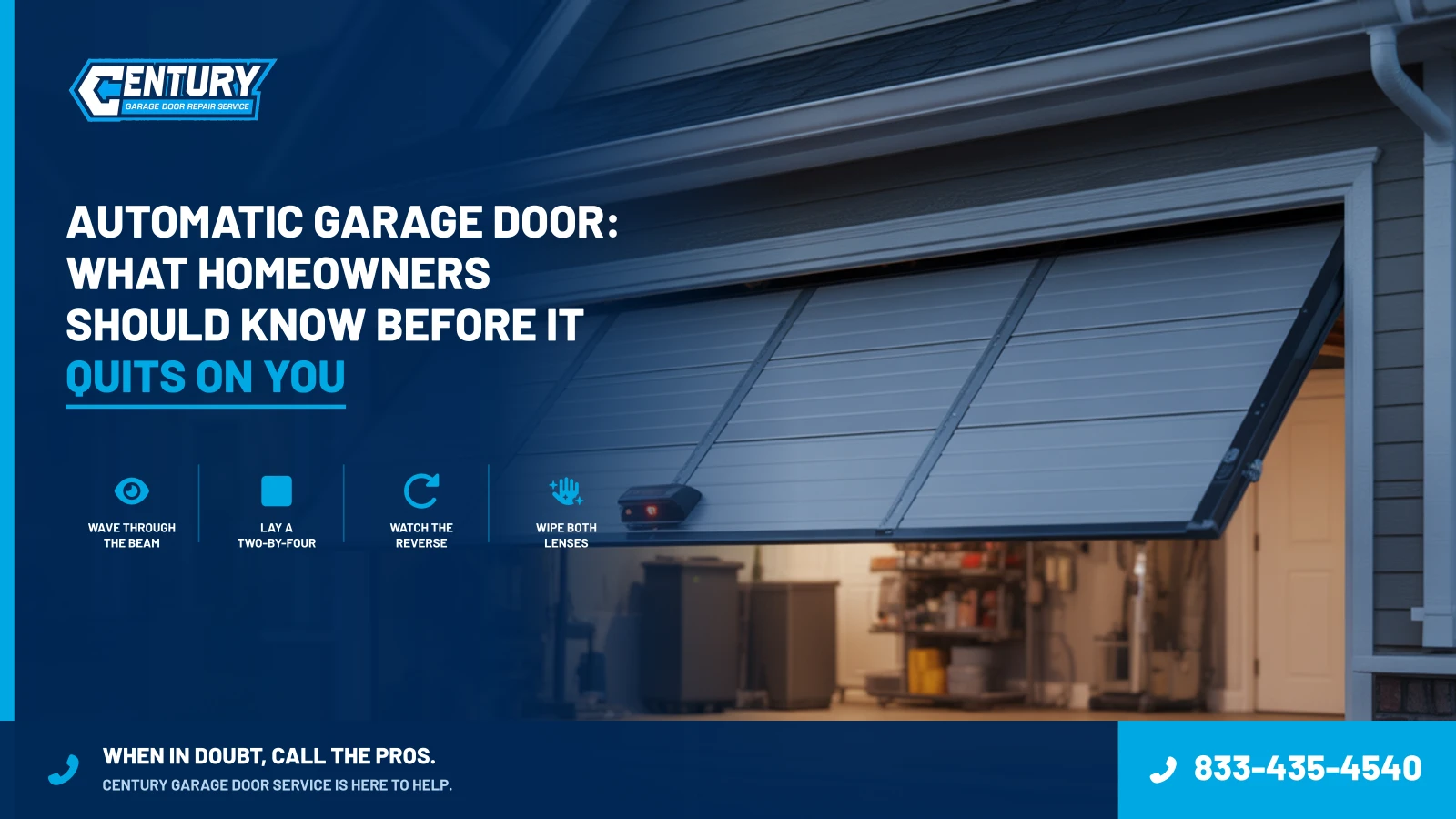
Test both seasonally. Four steps, no tools.
Wave something through the beam while the door closes
A broom handle at slab height, held from outside the door's path. The door should stop and head back to the top.
Lay a length of two-by-four flat under the middle of the opening
Then press the wall button and stand clear.
Watch what happens when the door meets the wood
It should touch and reverse without hesitating. A door that keeps pushing has a force setting out of adjustment or a logic fault behind it.
Wipe both lenses if the beam test failed
Then check neither housing has been knocked out of line.
A door that fails either test comes out of service until it’s fixed. Photo eyes branch further than anything else on this list, so our fix garage door sensor guide works through alignment, wiring, indicator colors, and the staple that has cut into a conductor.
Battery backup and a power cut
A backup battery lives inside or beside the powerhead and runs the opener for a limited number of trips when the grid goes down. That’s the whole feature. But it isn’t a generator and it won’t hold out for days.
Worth having all the same, and in a handful of states it stopped being optional on new installs some years ago. Without one, a power cut turns your automatic garage door back into a manual door, which means finding the release cord in the dark and handling the weight yourself.
The battery is a wear item. Most units flash a status light when the cell is tired, and it gets swapped rather than left until the night you need it.
What controls an automatic garage door
Four ways in, on most houses. A wall console inside the garage, a remote clipped to each visor, an exterior keypad by the door, and a button in the car’s overhead console.
Newer units add a phone app riding on the home network. Handy, and one more thing to lose the day the router gets replaced. The keypad earns its keep more often, in my view, because it still works when a phone is flat.
Every remote and keypad has to be paired to the powerhead, and current openers change their code on every press so a captured signal can’t be replayed at the door. Pairing has its own timing window and its own learn button, covered in our program garage door opener guide.
One thing to try before you buy batteries. The wall console usually carries a lock or vacation button, and it tells the powerhead to ignore every remote until somebody presses it again. Replacement remotes get handled at garage door remote, dead keypads at garage door keypad.
Keeping an automatic garage door quiet
An automatic garage door asks very little of you, and most of what it asks is that you listen to it.
- Balance. Door all the way down, and the opener unplugged so nothing can drive it while your hands are on the door. Then look up at the springs. A spring with a visible gap in its coil is broken. If you see one, or the door is already up, stop right there. Call 833-435-4540 instead. Only then uncouple the trolley, take the weight, lift the door to waist height, and let go. It should hold. If it sinks or climbs, the counterbalance needs setting, which is technician work at garage door spring repair.
- Noise. A new rattle, a knock, a squeal, or a groan near the top of travel is hardware telling you something, and garage door lubricant covers what goes where.
- The photo eyes. Wipe both lenses and check the housings are still square to each other.
- The reversal tests. Both of them, on whatever schedule you’ll actually keep.
- The hardware. Run your eye up the tracks and along the hinges for a loose bracket or a proud fastener.
If the door drops away from your hand during the balance check, leave it down until somebody has looked at it.
When an automatic garage door starts misbehaving
Fault triage has a guide of its own, so this section just points you at the right door.
- Nothing happens at all. A dead outlet, a tripped breaker, a locked wall console, or a logic board that has given up. Our garage door opener not working guide works the powerhead from the outlet inward.
- It starts down and bounces back up. The photo eyes, something on the slab, a close force setting too light, or ice bonding the seal to the concrete.
- The motor runs but the door stays put. Usually a stripped drive gear, or a trolley that never re-latched after somebody used the manual release.
- It groans and stalls partway. Mechanical rather than electrical. Something in the tracks, or a counterbalance that has lost its match.
- The wall button works and the remotes don’t. Pairing, dead remote cells, the console lock, or a receiver that has forgotten its codes.
What it costs to put an automatic garage door right moves with which component gave out. An opener part and a door part are separate kinds of work. A logic board and a bent hinge sit at different ends of that scale even when the symptom at the wall button looks the same. Whether the counterbalance has to be re-matched afterward counts as well, since balance is what the opener was sized against. An opener old enough that its board is no longer made changes the conversation too. You get a written quote before any work starts, the price is approved before a tool comes out, and if you turn the quote down, no work is done. Century Garage Door Repair Service answers live around the clock at 833-435-4540, so describe what the door is doing.
FAQs: automatic garage door
What actually makes a garage door automatic?
An automatic garage door is a counterbalanced door with a powered opener bolted to it. The opener supplies a push. A rail and trolley carry that push to the top section, and two safety systems decide whether the door may finish closing. Springs still do the lifting.
Can I get into the garage if the power goes out?
Yes. If your opener carries a backup battery it will keep cycling for a limited number of trips. If it doesn’t, the release cord uncouples the trolley so the door works by hand, and you do that with the door all the way down. Walk through it once in daylight.
How do I test the safety reversal on an automatic garage door?
Two tests, because there are two systems. Wave a broom handle through the beam at slab height while the door closes, and it should reverse straight away. Then lay a two-by-four flat under the middle of the opening and press the button. Call 833-435-4540 if either test fails.
Do automatic garage doors still need springs?
Yes, and they always will. The opener is sized to move a door the springs have already made nearly weightless, so a door out of balance wears the drive gear fast. A matched door holds still at waist height with the trolley uncoupled. Counterbalance work belongs to a trained technician.
How often should an automatic garage door be serviced?
Once a year suits most households, and heavy use pulls that forward. A door cycling several times a day, a garage doubling as the family entrance, a coastal climate, or a salted street every winter all shorten the interval. Between visits, run both reversal tests. Noise is the earliest warning you get.
How long does an automatic garage door opener last?
Plan on somewhere between ten and twenty years from the powerhead, though cycle count matters more than the calendar does. A door that runs six times a day ages its drive faster than one that runs twice. Rollers and the backup battery both wear out well before the motor gives up. Keeping the counterweight matched is what stretches an automatic garage door furthest.
Can an older door be converted to an automatic garage door?
Often, yes. The first thing a technician checks is balance, because an opener is sized to nudge a door the counterweight has already made light. Headroom for the rail gets measured, and the top section usually needs a reinforcement bracket before the arm bolts to it. Call 833-435-4540 and describe the door’s age and how it feels lifted by hand.
Book service for your automatic garage door
An automatic garage door is five systems pretending to be one machine, and the part you can hear is rarely the part that needs the work. Century Garage Door Repair Service answers live around the clock at 833-435-4540 and gives you a two-hour arrival window with a text when the truck rolls. Our trucks carry openers, rollers, sensors, and spring stock, so most visits finish in one trip. You get a written quote before anybody picks up a tool, and if you decline, no work is done. Seniors and military get a standing discount. So do first responders. To have the whole system checked at once, book a garage door safety inspection.
Table of Contents
Emergency Repair?
Did a loud bang follow a door that won't lift? Don't risk injury. We offer rapid emergency response.