
Garage Door Cables: What Homeowners Should Know Before One Lets Go
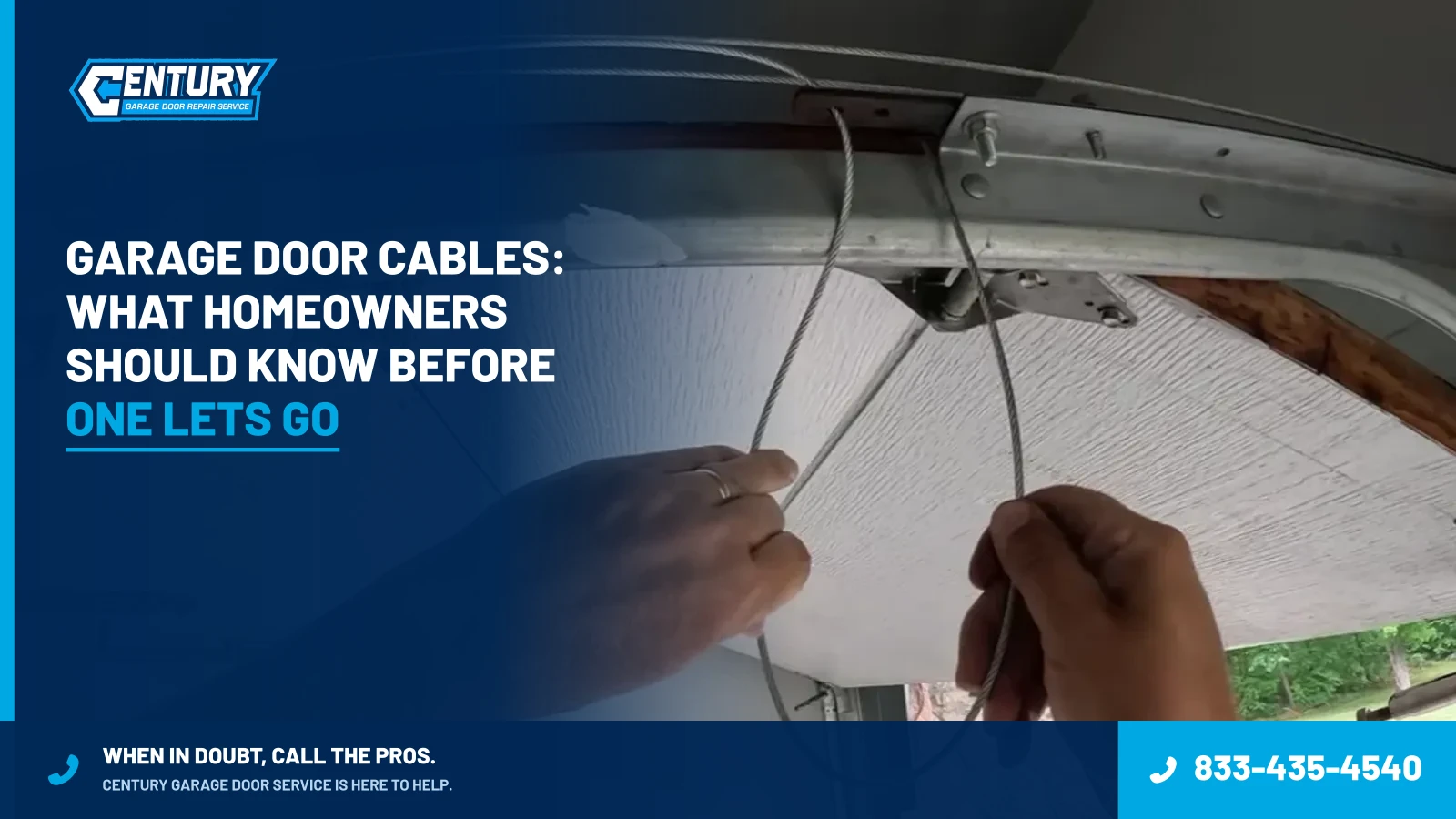
The short answer
Garage door cables are the two steel lines that hand the springs' pull down to the bottom corners of the door, and they wear out from the inside where nothing shows. If yours look slack or whiskered, stop using the door. Century Garage Door Service answers live around the clock at 833-435-4540.
Garage door cables are two lengths of galvanized steel wire rope, one down each side of the opening, and their only job is carrying the counterbalance’s pull to the bottom corners of the door. Nothing else on the door does that. So when one goes slack or parts outright, the door stops being a machine and becomes a heavy panel hanging by one corner.
Garage door cables also fail quietly. A cable can be most of the way gone and still look fine from across the garage.
So this guide is about looking, not fixing.
Table of Contents
What garage door cables do
Garage door cables don’t lift the door. They pass the lift along.
The torsion springs on almost every door built in recent decades sit on a steel shaft above the opening, with a grooved drum at each end. A cable leaves each drum, drops down the inside of the vertical track, and ends at a fitting in the bottom corner of the lowest section. Wound springs turn the shaft so the drums reel the cable in. Coming down, the drums pay it back out at a controlled rate, which is why a healthy door lands instead of falling.
Both sides have to match. Same length, same wrap count, or the door sits low at one corner and racks out of square.
And garage door cables are consumable. Sized to the door’s weight and rated in cycles rather than years, so they come due at some point in the door’s life. Nobody mentions that at the point of sale, and it’s the thing about this part that irritates me most.
The two kinds of garage door cables
Two different parts answer to the same name.
Lift cables are the working pair described above, and every sectional door has them. Safety cables only turn up on doors with extension springs stretched along the horizontal tracks. One threads through the middle of each spring and anchors at both ends, so a spring that lets go stays strung on that cable instead of leaving the wall at speed.
If you see springs beside the horizontal tracks with nothing running through them, treat that as this week’s phone call. Both spring families, and what a matched set means, are in our garage door spring replacement guide.
Extension systems also run their garage door cables over pulleys, which adds wear points a torsion door doesn’t have.
How garage door cables fail from the inside out
A cable that looks perfectly good can be most of the way through its life.
Wire rope is fine strands laid up around a core, and the wear happens between those strands where nothing shows from outside. Every cycle bends the same stretch around the same drum radius, the strands saw at each other, and wires break one at a time. Nothing shows on the surface until the survivors push out through the lay as fine whiskers you catch a glove on. A cable growing whiskers is finished.
Four places do most of the failing.
- The looped end at the bottom bracket. The tightest bend on the door, and it lives down where water sits.
- The first wraps on the drum. Same steel, same radius, every cycle.
- The stretch nearest the slab. Meltwater, road salt, snow off the car, and hose overspray all pool at floor level, and rust works inward.
- A wrap that has gone wrong. A cable jumping its groove crosses over itself, and the crossing point gets crushed flat.
Salt is patient. Garage door cables in a coastal garage work against a shorter clock than the same pair two towns inland.
Need a Professional Tune-Up?
Skip the ladder. Our local technicians perform full safety inspections and comprehensive lubrication to keep your system running silently.
Slack cable or broken spring
Slack is a symptom, and the cause usually sits somewhere else.
With the door all the way down, both garage door cables should be snug from drum to bottom bracket. If one has gone loose enough to move with a finger, something upstream changed. A broken torsion spring letting the shaft unwind is the most common answer, and a drum slipped on its shaft is next.
Telling a cable fault from a spring fault is easier than it sounds. A loud bang, then a door that feels far too heavy to shift by hand, plus a visible gap in the coil above the opening, is a spring. A bang with one corner hanging low while the other side stays tight is a cable.
| What you see | Most likely cause | Your next move |
|---|---|---|
| One cable slack, door fully down | Broken spring, or a drum slipped on the shaft | Stop using the door, book a technician |
| Both cables loose, door down | Counterbalance tension gone | Leave the door closed and call |
| Door lands one corner first, racked | Uneven wrap, or a stretched cable | Technician, and quit cycling it |
| Fine wires near the bottom bracket | Cable failing internally | Both cables replaced before one parts |
| Loud bang, then a crooked door | A cable came off its drum or parted | Unplug the opener, then call |
When a cable lets go mid-travel
A garage door cable snapped mid-travel leaves the door stopped at an angle, and that is usually where somebody is standing when they call.
One corner lost its support, the door twisted in the opening, and the load it carried went somewhere it was never meant to go, often onto a single roller. The opener has no idea. It will keep pushing on command, and that’s how a parted cable becomes a creased section and a much longer repair.
So stop.
Unplug the opener so a remote can’t send it another command. Keep people and cars out from under the opening. Leave the door wherever it stopped, and don’t walk it down by hand.
The emergency release isn’t the answer here, because uncoupling the trolley from a door that has already lost a cable takes away the last thing steadying it, and our garage door manual release guide covers when that cord is the right call.
A door that has come off its track is a separate repair, handled through our garage door off track repair page. Never touch a door in that state.
Drums, bottom brackets, and where garage door cables ride
Two pieces of hardware decide how long garage door cables last.
The drum is the grooved wheel at each end of the torsion spring shaft, clamped on with set screws and matched to the door’s height, which is why drums aren’t interchangeable between doors. Groove condition matters, because roughened grooves abrade every new cable you fit.
The bottom bracket is the fitting bolted into the bottom corner of the lowest section, and the cable’s looped end lands there. That bracket stays under load the whole time the door is down, which makes it the most misunderstood bolt on the door. Homeowners chasing a loose cable find those bolts and decide that must be the adjustment.
Don’t. It isn’t an adjustment point. Cable and bracket work is covered on our spring repair page at garage door spring repair.
A vertical track knocked out of plumb pulls the cable against the roller stems, and a cable rubbing on anything wears out early.
Looking over your garage door cables safely
Looking over your garage door cables is the whole homeowner job here. It takes a flashlight and a few quiet minutes.
- Door all the way down, opener unplugged. Stand off to the side, outside the door’s path.
- Run the light up each vertical track. The cable should read straight and snug, clear of the roller stems.
- The stretch nearest the slab. Orange staining, swelling, a stiff section, or dark pitting means water has been at it.
- The looped end at each bottom bracket. Broken wires, a flattened patch, a kink, or a shifted clip ends the inspection there.
- Both drums, up at the shaft. Cable seated in its groove. Wraps stacked tidily, none crossing another.
- The two sides, compared. One snug and one loose is the finding that matters.
Photograph whatever looks wrong. Then leave the door down and make the call.
Garage door cable replacement, and what the visit involves
Garage door cable replacement is a paired job. Both sides come off, both sides go back on, every time.
That surprises people whose left cable failed while the right one still looks new. The pair went on the same day, turned the same cycles around the same radius, carried the same weight, and sat through the same damp winters. A garage door cable repair that puts back only the broken half isn’t a repair, it’s a scheduled second visit.
A technician arriving on one of these brings the door to a controlled state first, then fits cables swaged to that door’s specification. Drums get inspected and often swapped, along with the end bearings and the shaft if the door came down hard. Then the door is balanced and both cables trued on their drums so it hangs square and lands flat, and the opener’s force settings get checked last.
Most finish in one visit, because the trucks carry cable and drum stock.
What drives garage door cable repair cost
What the job takes follows the door’s height and weight, the condition of the drums, and whether a spring or a bracket failed in the same event, so call Century Garage Door Service at 833-435-4540, describe what the door is doing, and the quote reaches you in writing before any work starts.
Safety, and where a homeowner's hands stop
Here’s the mechanical reason this work isn’t yours. On a torsion door the cable’s top end is wound onto a drum clamped to a shaft the torsion springs are pulling on, so it can’t come off until that pull has been let down in a controlled way by somebody carrying the right tools.
Never adjust, wind, unwind, replace, or release the tension on the torsion springs above the door or the lift cables running down the sides, because they hold hundreds of pounds of stored energy and get replaced with winding bars by a trained technician. Drive gear internals and main power wiring are technician work too.
No exceptions on that one, ever.
If a spring is broken, don’t run the opener at all and don’t try to lift the door by hand, because nothing is counterbalancing the door’s full weight and the motor will strip its drive gear attempting it.
Looking is fine. Photographing is fine. A socket set anywhere near that hardware is not. The trade sizes garage door cables from the counterbalance data published through the DASMA technical data sheets on residential garage door counterbalance systems (dasma.com). That data exists because guessing at it hurts people.
FAQs: garage door cables
How can I tell if a garage door cable is going bad?
Close the door and unplug the opener, then look. A healthy cable reads snug from drum to bottom bracket. Fine wires pushing out of the lay, orange staining near the slab, a flattened patch, or slack on one side all mean the pair is due.
Why does my garage door close crooked with one corner lower than the other?
Look at the garage door cables before you blame the door. One that has stretched or slipped its groove pays out farther than its partner, so the bottom section lands at an angle and the door racks in the opening. Stop cycling it, because a racked door chews at its rollers and can crease a section. Leave the door down and get a technician on it.
Can I replace a garage door cable myself?
No, and that answer carries no caveat. The cable’s top end is wound onto a drum clamped to a shaft the springs are pulling on, so it can’t come off until that pull is let down safely by a technician.
How long do garage door cables last?
Longer than most people expect and shorter than they hope. Garage door cables wear by cycles rather than the calendar, so a door opening all day ages its pair faster than one opening twice. Road salt and damp shorten things further.
What should I do the moment a cable snaps?
Stop using the door. Unplug the opener at the outlet so a remote can’t send it another command, and keep everybody out from under the opening. Don’t walk the door up or down by hand. Then call Century Garage Door Service at 833-435-4540.
Do both garage door cables have to be replaced together?
Yes, and anybody offering to do just the broken one is selling you a second call. Both went on the same day and have turned the same number of cycles around the same drum radius. The survivor is as worn as the one that failed.
Can new garage door cables be matched to an older door with no labels left on it?
Almost always, yes. Garage door cables aren’t ordered by model number, they get sized to the door standing in front of the technician. Height sets the length and the door’s weight sets the size of the pair. Drums are matched to that same height, and on older hardware the drums and end bearings often go on with the new cables.
Get your garage door cables looked at
Garage door cables are the least glamorous part on the door and the likeliest to end your morning. If yours are slack, whiskered, rusting at the bottom, or if one has already let go, Century Garage Door Service answers live around the clock at 833-435-4540 and gives you a two-hour arrival window with a text when the truck rolls. Our trucks carry cable, drums, bearings, and spring stock, so most visits finish in one trip, and the workmanship is warrantied. You get a written quote before anybody picks up a tool, and only the quoted trip fee if you decline it. Seniors and military get a standing discount. So do first responders. If you’d rather have the whole system gone over at once, book a garage door safety inspection.
Table of Contents
Emergency Repair?
Did a loud bang follow a door that won't lift? Don't risk injury. We offer rapid emergency response.