
Garage Door Lights: What Homeowners Should Know Before You Change a Bulb
The short answer
Garage door lights are the courtesy bulbs inside the opener head, and the bulb you thread in there decides whether your remote still reaches from the driveway. For a head that flashes with a fresh bulb in it, or won't light at all, call Century Garage Door Service at 833-435-4540.
Garage door lights sit inside the motor unit bolted to your ceiling, behind a plastic lens, wired straight through the board that runs the door. So the bulb going in there is a machine part rather than a decoration, and the wrong one shows up as a symptom you’d never trace back to a light. Usually a remote that quit working past the mailbox.
Vibration and radio noise are the only two things that really matter, and bulbs sold on price alone fail at both. Choose for those and garage door lights become the part of the door you never think about again.
Most people learn this standing in the driveway, pressing a button that worked fine yesterday.
Table of Contents
What garage door lights are, and where they live
Pop the lens off the side of the opener head and you’ll find one socket, sometimes two. That’s the entire fixture.
Garage door lights run off the same logic board as the motor, which is why they come on by themselves the second the door starts moving and why they switch off on a timer rather than a wall switch. The wall control button toggles them without moving the door, and some wall controls carry a motion sensor that lights the bay as you walk in.
The lens matters more than people expect. It traps heat around the glass and yellows with age until output visibly drops.
Worth saying plainly, because it saves arguing. Garage door lights are courtesy lighting. They exist so you can find the step down, your keys, the wall switch, and the car door handle. No bulb will turn them into shop lighting.
Why garage door lights wreck remote range
This is the one that generates service calls, and the fix is usually a bulb.
An LED or a compact fluorescent doesn’t run on wall voltage the way a filament does. A small switching supply sits in the base, chopping current thousands of times a second, and any chopper like that radiates radio noise into everything wired to it. Your ceiling becomes an antenna.
Now look at where the opener keeps its receiver. A bare wire hangs from the same head that holds the bulbs, inches away. When the light is on, that wire hears the bulb more clearly than the remote in your hand.
The symptom is distinctive once you’ve met it. The remote works from the street while the garage is dark, then quits at a car length once the light is burning. Same remote, same battery, same patch of driveway. Only the light changed.
Four things to try, in this order.
- Put a filament bulb back in. Any plain incandescent, purely to prove the point. If range returns, you’ve found your culprit.
- Buy an LED that says it’s filtered. A few carry suppression for exactly this and say so on the box. Most don’t.
- Straighten the antenna wire. Let it hang free and vertical so it sits clear of both the bulbs and the steel rail.
- Move the light out of the head. Leave the sockets empty and hang a separate fixture down the bay on its own switch.
If range doesn’t budge when the bulbs change, the fault sits in the remote or the receiver, and our garage door remote page covers that half. Household radio interference is common enough that the FCC consumer guidance on radio frequency interference in the home (fcc.gov) exists to explain it.
Picking a garage door opener light bulb that survives a ceiling
A garage door opener light bulb has a harder life than any lamp in your house. The head jerks every time the trolley starts and stops, the enclosure holds heat with no real ventilation, and the whole assembly hangs over a parked car.
So judge a bulb on four things.
- Vibration. Rough service or vibration resistant on the label means the filament is braced. An LED has no filament to break, so it wins this outright.
- Enclosed fixture rating. Heat kills LED drivers, and an opener lens is precisely the sealed box most of them aren’t rated for. If the packaging doesn’t say enclosed, expect a short life.
- Shatter resistance. A coated bulb holds its glass together if something clips it. Over a car roof, that matters.
- Radio quiet. Covered above, and the trait nobody checks at the shelf.
Two details decide whether the bulb even fits. Check the base size, because plenty of heads take something smaller than a table lamp. And read the maximum printed on the socket housing before going brighter, because that figure protects the lens and the board.
Need a Professional Tune-Up?
Skip the ladder. Our local technicians perform full safety inspections and comprehensive lubrication to keep your system running silently.
Garage door lights, bulb by bulb
There’s no perfect answer in this aisle, which is why the aisle is confusing.
| Bulb family | Handles the shaking | Effect on remote range | Worth knowing |
|---|---|---|---|
| Standard incandescent | Filament breaks early | None, it’s radio silent | Quietest on the airwaves, shortest lived overhead |
| Rough service incandescent | Braced filament, built for it | None | Runs hot, so respect the socket maximum |
| Compact fluorescent spiral | Survives it, starts dim when cold | Often the worst offender | The winter warm-up is a genuine annoyance |
| General purpose LED | No filament, so no issue | Frequently cuts range badly | Usually not rated for an enclosed lens |
| LED rated enclosed and suppressed | No filament | Usually leaves range alone | The box must make both claims |
So the safest light bulb for garage door opener duty is either a rough service filament bulb or an LED whose packaging claims an enclosed fixture rating and interference suppression together. One claim without the other leaves you guessing. Broader advice on LED lamps sits with the Department of Energy consumer guidance on LED lighting (energy.gov), though none of it was written with a vibrating steel box in mind.
How to change garage door lights, step by step
Six steps, and the last one is the one everybody skips.
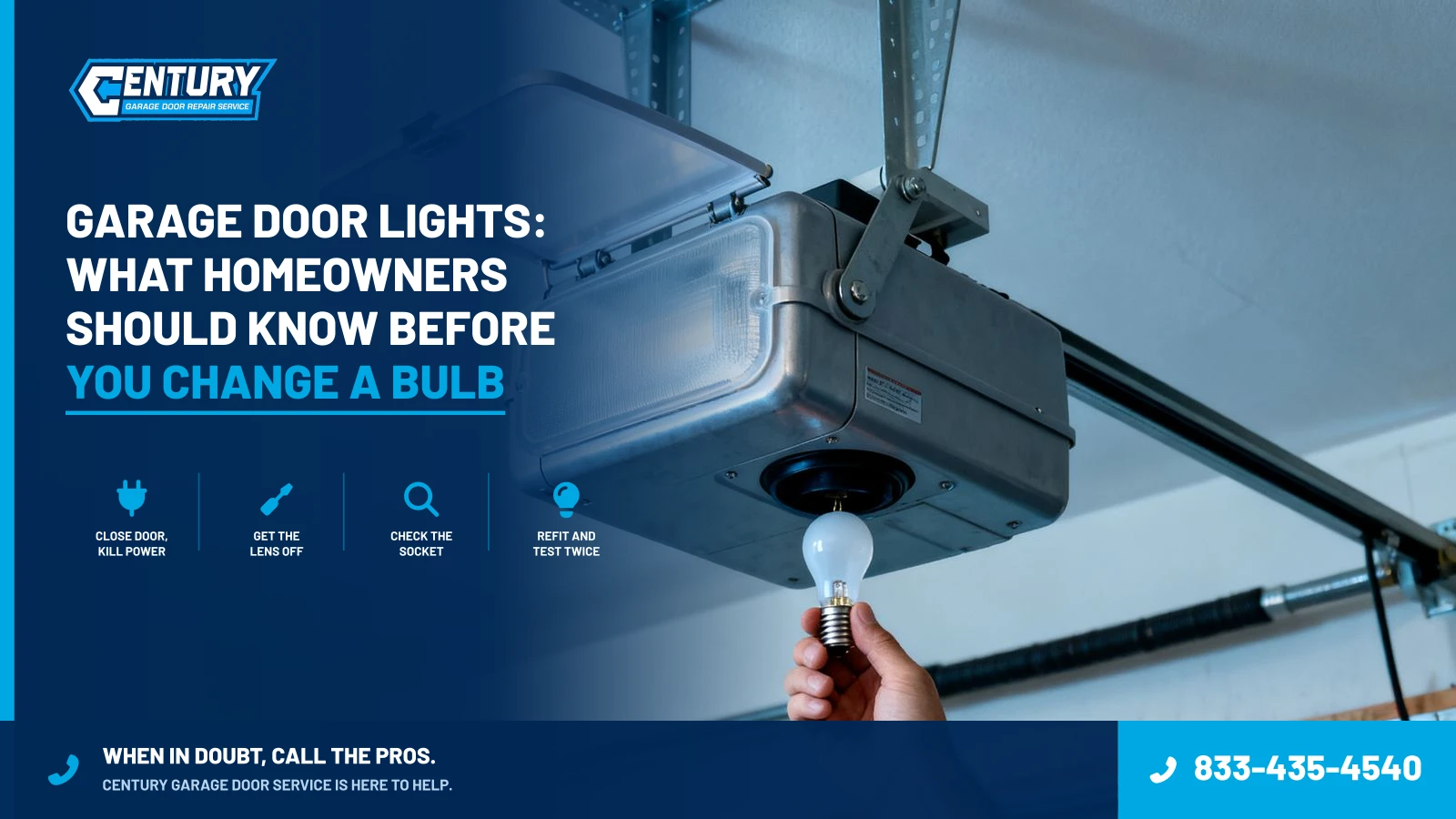
Close the door and kill the power
Put the door all the way down, then unplug the head at the ceiling outlet. A hardwired head means switching the breaker off instead, and leaving the wiring itself alone.
Get the lens off
Most pop free at a tab on each end, and some hinge downward. Old plastic goes brittle, so work it slowly.
Back the old bulb out
Support the socket with your other hand so you aren't twisting the fixture against its mount.
Look at the socket before anything goes back in
Browned threads, or green corrosion around the center contact, means stop. A fresh bulb in a damaged socket just fails again.
Thread the new bulb in gently
Finger tight and no further. Cranking a bulb into an opener socket is how the contact tab gets flattened.
Refit the lens, restore power, and test twice
Run the door once to confirm the light comes on. Then walk to the end of the driveway with the light burning and press the remote.
Wipe the inside of the lens while it’s in your hand. Years of dust there costs more light than a brighter bulb gives back.
Courtesy light timing on garage door lights
The light stays on for a few minutes after the door stops moving, then drops out on its own. That interval lives in the board.
Some heads let you change it from the wall control with a button sequence. Others fix it in firmware, where nothing you press will move it. Your manual is the only honest answer on which you own.
The light button on the wall control is the useful one. Press it and garage door lights come on with the door standing still, which turns them into ordinary room lighting whenever you want.
One quirk catches people out constantly. If your wall control has a lock or vacation mode, switching it on disables every handheld remote in the house, and on plenty of heads the light flashes the whole time that mode is engaged. So a flashing light and a door that ignores all the remotes is often nothing worse than a button somebody leaned on.
Blinking garage door lights are talking to you
A steady light is a light. A blinking one is a message.
Most modern heads use the courtesy bulbs, or a small indicator beside them, to flash a fault code. The pattern matters and the count between pauses matters more, which is why people search for a blinking opener light instead of hunting down a code chart. Two causes cover the bulk of it. Either the safety beam across the floor is blocked or knocked out of aim, or the lock mode described above got switched on.
Beam trouble wins by a wide margin and has a guide of its own, so start at fix garage door sensor and get the receiving eye showing a steady light again.
Everything past that belongs to the opener rather than the bulbs. Travel limits that wandered, a board that forgot its learned remotes, a drive gear worn round, and a motor that hums without turning all produce patterns of their own, and they’re covered in garage door opener not working. Blinking garage door lights are a symptom, never the cause, so a new bulb changes nothing.
Garage door lights and the rest of the bay
Once you accept the head is only courtesy lighting, the rest of the garage gets easier to plan.
Ceiling-mounted LED shop fixtures are what actually lights a garage, and they carry a second advantage. They hang farther from the receiver, so whatever noise they make reaches the antenna weaker than a bulb sitting inches from it. Weaker, not absent. If your range drops the week new shop lights go up, you know where to look first.
A garage ceiling fan with light is a fair addition in a hot climate, with two conditions. It has to clear the door’s travel arc and the opener rail through a full cycle, checked with the door open rather than closed, which usually means mounting it behind the head or off to one side. And the fixture wants a damp location rating, because a garage swings through far more humidity than a living room.
Finish surfaces do some of the work as well. A light grey garage door bounces courtesy light back into the bay where a dark stained finish swallows it.
What a visit runs depends on whether the trouble is a bulb, a socket, a cracked lens, or the board behind them, and on whether the head is plug-in or hardwired. You get a written quote before any work starts, the price is approved before a tool comes out, and if you decline it you owe only the trip fee quoted up front. Century Garage Door Service answers live around the clock at 833-435-4540.
FAQs: garage door lights
Why do LED garage door lights shorten my remote range?
The switching supply inside an LED base radiates radio noise, and the opener’s receiving antenna hangs inches from the bulb, so it hears that noise over your remote. Thread a plain filament bulb in and test again from the driveway. If range comes back, the bulb was the problem, and an LED sold with interference suppression is the cure.
What light bulb for garage door opener heads lasts longest?
Either a rough service filament bulb, which has a braced filament made for fixtures that jolt, or an LED stating an enclosed fixture rating and interference suppression together. Skip a standard household LED, because a sealed lens cooks the driver. Check the base size and the maximum printed on the socket housing first.
Can I put a brighter bulb in the opener head?
Only up to the maximum printed on the socket housing, and no further. That figure protects the lens and the board behind it, because the enclosure has nowhere to dump extra heat. Brighter garage door lights also won’t turn the bay into a workshop. If you want real light out there, hang a shop fixture down the bay on its own switch.
How long do garage door lights stay on after the door moves?
A few minutes on most heads, timed by the logic board rather than by any switch. Some models let you shorten or lengthen that interval with a button sequence on the wall control, and others fix it in firmware. The light button brings the bulbs up any time, without moving the door.
My garage door lights are blinking. What does that mean?
A blink pattern is a fault code rather than a bulb fault. The two usual causes are a blocked or misaligned safety beam near the floor, or lock mode switched on at the wall control, which disables the handheld remotes. Clear the beam first, then check that button.
The socket stays dark with four different bulbs in it. Now what?
Then the trouble sits behind the socket, in the wiring or on the board, and a fifth bulb won’t change it. Look for browned threads or corrosion and stop right there. Call Century Garage Door Service at 833-435-4540 and describe what the light did before it quit.
Do garage door lights work when the power is out?
Only if the opener carries battery backup, and then usually at reduced brightness for a limited run. Heads without a backup go dark with the rest of the circuit, which is why a wall switch fixture on its own circuit, or a battery lantern kept in the bay, is worth having. Check the head for a backup indicator.
Get your garage door lights working properly
Most of this is yours to do from a step stool. Pick the right bulb, keep the socket clean, and your garage door lights will outlast the remote. But a head that flashes with nothing wrong at the beam, or a socket browned around its threads, has a wiring or board fault behind it. Century Garage Door Service answers live around the clock at 833-435-4540, and you get a two-hour arrival window with a text when the truck rolls. Trucks carry openers, wall controls, safety beams, and remotes, so most visits finish in one trip, and the workmanship is warrantied. You get a written quote before anybody picks up a tool, and only the quoted trip fee if you decline it. Seniors and military get a standing discount. First responders too. To have the head, the beams, the hardware, and the counterbalance checked in one visit, book a garage door safety inspection.
Table of Contents
Emergency Repair?
Did a loud bang follow a door that won't lift? Don't risk injury. We offer rapid emergency response.