
Garage Door Safety Sensor: What Homeowners Should Know, and What the Rules Require
The short answer
A garage door safety sensor is the low pair of eyes that throws an invisible beam across the opening and sends a closing door back up the moment anything interrupts it. To have yours tested by somebody who checks them daily, call Century Garage Door Repair Service at 833-435-4540.
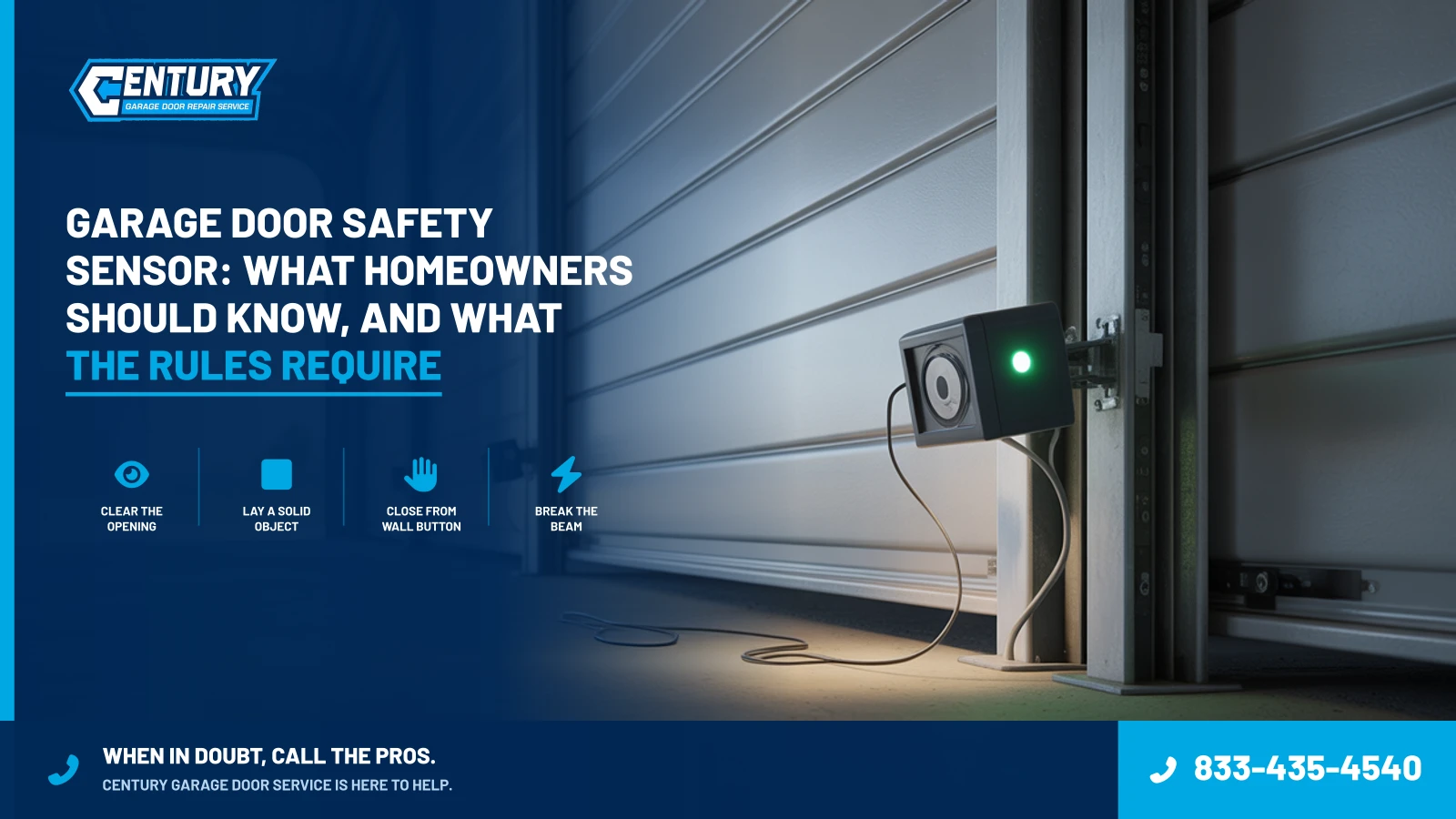
A garage door safety sensor is a matched pair of units mounted low on both sides of the opening, and the pair does one job. It stops a closing door and drives it back to the top whenever something breaks the infrared beam strung between them.
Protection of that kind is required equipment on a residential opener, so the two housings bolted to your jambs aren’t an accessory somebody upsold your builder.
This guide covers what the pair is, what the rules ask of it, how high it belongs, and how you prove it still works. Fault-finding and realignment belong to a different afternoon.
Table of Contents
What a garage door safety sensor is, in plain terms
Two small housings, one on each jamb, both a few inches off the concrete and wired back to the opener on thin low-voltage cable. One sends. One watches.
The sending unit throws a beam of infrared light straight across the opening at ankle level, and its partner holds a steady signal back to the opener for as long as that light keeps landing on its lens. Break the light and the confirmation stops with it. Your opener reads a missing confirmation as something standing in the doorway, so it abandons the close and lifts the door instead.
That’s the entire mechanism. No camera, no software making a judgment call. A garage door safety sensor is a lamp plus a photocell watching for the lamp, which is why the trade calls the pair photo eyes.
It’s worth being clear about what the pair isn’t. It’s no security device, and it can’t tell a toddler from a recycling bin.
All it knows is whether light is landing on a lens.
Why a garage door safety sensor is on your door at all
Because a powered door is strong and stupid, and those two traits together are the whole problem.
A sectional door is heavy. Weight climbs from a light uninsulated single up to a wide insulated two-car door two people struggle to lift, and the motor behind it moves all of that without effort. The motor has no idea what’s underneath. It knows travel and it knows resistance. It pushes downward until one of the two tells it to stop.
Children are the reason the requirement exists. A small body on the slab barely resists a descending door, so a good deal of weight can settle before force sensing alone notices anything is wrong. Pets fall in the same category.
So the answer became two layers rather than one. The opener has to feel an obstruction and back off it, and something has to catch that obstruction before the door ever arrives. The second half is where a garage door safety sensor earns its bracket.
What the rules ask of a garage door safety sensor
Residential openers have to carry entrapment protection, and the requirement comes in two halves. The head itself must reverse when the closing door meets resistance. Beyond that, a second device has to spot an obstruction without touching it, working independently of the first.
A garage door safety sensor is the common answer to that second half. The other permitted device is a pressure-sensitive edge along the bottom of the door, which turns up on commercial and gated work far more often than on a house.
Two things people get backwards.
The requirement follows the opener, not the door. A door you lift by hand has no powered force behind it, so there’s nothing for a beam to guard against. Fit an opener to that same door and the pair becomes part of the job.
And the protection isn’t yours to switch off. For the background on the entrapment hazard itself, see U.S. Consumer Product Safety Commission guidance on garage door opener entrapment protection (cpsc.gov).
Need a Professional Tune-Up?
Skip the ladder. Our local technicians perform full safety inspections and comprehensive lubrication to keep your system running silently.
Contact reversal and the beam, side by side
Both systems reverse a closing door. They act at different moments, and that gap is the argument for carrying both.
| What you’re comparing | Contact reversal in the opener | The beam across the opening |
|---|---|---|
| Where it lives | Inside the head, in force sensing plus the down limit | Two units low on each jamb, wired to the head |
| What sets it off | Resistance building as the door presses on something | Anything solid enough to break the infrared light |
| When it acts | After the door has already made contact | Before the door reaches the obstruction |
| Its weak spot | Something soft or small that never builds much force | Anything above the beam or outside its narrow line |
| How you test it | A solid object laid flat on the floor | Breaking the beam by hand while the door travels |
Read that twice and the design logic falls out. The beam keeps a child from being touched at all, and contact reversal is the backstop for everything the beam cannot see.
So taping a pair face to face doesn’t shorten anything. It deletes a layer.
How high a garage door safety sensor sits, and why the height is fixed
Low. A garage door safety sensor belongs no more than roughly six inches above the finished floor, and both garage door safety sensors go at the same height so the light crosses level.
That height isn’t arbitrary. A standing adult breaks a beam at any height, while a crawling infant only breaks one strung close to the concrete. Raise the brackets a foot for a quieter life and you’ve built a crawl space underneath the light.
I keep meeting brackets somebody has slid up the track. The reason is always the same, a nuisance reversal nobody chased to its cause, and moving the eyes did stop the reversals. It also turned a protection device into a decoration.
Square to each other matters as well, because a beam landing on the edge of a lens drops out the first time a truck rumbles past. If nuisance reversals are pushing you toward the wing nuts, our guide on how to fix garage door sensor walks the lenses, the aim, the wire run, and the impostors that pass for bad aim.
The solid object test, step by step
Once a month, and it takes two minutes.
Clear the opening and keep everybody back
Nobody under the door, no pets loose in the garage, no hands near the tracks, and nothing stored where the door lands.
Lay a solid object flat on the floor
A length of two-by-four laid flat under the middle of the opening is what the trade reaches for. Never a foot, and never a hand.
Close the door from the wall button and stand clear
Watch the bottom seal rather than the opener.
The door has to stop and go back up
Contact, then a full reversal to the top. A door that settles onto the wood, or that lifts a few inches and quits, has failed.
Now break the beam
Start the door closing, then pass a broom handle through the beam path from outside the opening. The close should be abandoned at once.
Note what you saw both times
There's no partial credit on a device whose only purpose is stopping a door.
Here’s why that second test earns its place. A garage door safety sensor can be aimed beautifully, hold a rock-steady light, and still fail to interrupt a close, because the fault sits between the receiver and the head rather than in the optics.
Fail either one and the door goes out of service until it’s sorted. Leave it up. Keep cars and children out of the opening. And if the door reverses when nothing is in its way, that’s a different puzzle, one our guide to a garage door wont close door takes in order.
What a garage door safety sensor does not protect
Here’s where the physics and the reassurance part company. The beam is one straight line at ankle height, and it watches that line only.
Above it, nothing at all. A hand resting on a moving section, fingers in the gap where two panels fold as the door rolls up, a handlebar hooked over a lower panel, somebody leaning through the opening at chest height while the door comes down. None of that interrupts light traveling six inches off the floor, and the pinch points between sections have no sensor at all.
A garage door safety sensor also gets no vote on the way up.
And it holds nothing up. The springs above the opening and the cables down each side carry the weight of a door, and they’re under load every hour of the day. That hardware gets replaced by a trained technician with the right tools rather than on a Saturday, and the work lives at garage door spring repair.
When a garage door safety sensor isn't doing its job
Four states put a pair out of action, and none of them is rare.
Defeated deliberately. Taping the two units face to face on one bracket, twisting the conductors together so the circuit never opens, aiming a unit into a mirror, or wedging the wall button down with a broom handle. Each of those hands you a powered door closing over an opening that nothing is watching, and there’s no acceptable version of it, including a temporary one over a weekend.
Moved out of position. A raised bracket is a defeated pair with better manners.
Missing outright. Heads built before entrapment protection was required never had terminals for a beam, so there’s nothing to plug a pair into. No adapter makes an old head compliant, which means the honest answer on one of those is a newer opener.
Dead or intermittent. A failed unit, a chewed wire run, a corroded splice at the terminals, or a bracket hanging off one screw. If the head is dark rather than protesting about a beam, that’s opener trouble, and our guide on a garage door opener not working opener covers it.
What a visit runs depends on which of those four you’ve got, whether the wire from the head down the jamb has to be replaced, and whether the opener’s logic board is answering at all. You get a written quote before any work starts, and the price is approved before a tool comes out. If you decline, no work is done. Century Garage Door Repair Service answers live around the clock at 833-435-4540.
FAQs: garage door safety sensor questions
Are garage door safety sensors required on every opener?
Entrapment protection is required on residential openers, and a beam across the opening is how most makers meet the non-contact half of it. The permitted alternative is a pressure-sensitive edge along the bottom of the door, seen far more on commercial work. What no opener may do is close with force sensing alone behind it.
How often should the reversal test be run?
About once a month, which is roughly the rhythm you already keep for smoke alarms. Run it again after anything that could have knocked a bracket, and that list includes a bumper, a bicycle, a ladder stored against the track, or any trade working in the garage. Test it before selling the house too.
My opener has no eyes at all. Can a pair be added?
Only where the head was built to accept them. Openers old enough to predate the requirement have no terminals for a non-contact device, and no adapter makes one of them compliant, so the real answer there is a newer opener. Call Century Garage Door Repair Service at 833-435-4540, describe the head, and somebody will tell you which side of that line yours falls on.
Does the beam cover the whole doorway?
No, and it’s the biggest misunderstanding about the pair. It’s a single line of light a few inches off the concrete, so it catches a body on the floor and sees nothing above that. A hand on a moving panel, fingers at a panel joint, a load hooked over a lower one, or a shoulder leaning in all pass unnoticed. Contact reversal is the backstop for those.
What happens if a garage door safety sensor gets unplugged?
Most openers refuse to close the normal way and flash the courtesy light in a repeating pattern. Many will still travel down under constant pressure on the wall button, which exists so a door can be shut while somebody stands there watching the opening. That’s a fallback for a technician mid-job, never a way to live.
Can I install a garage door safety sensor pair myself?
It’s low-voltage work with no spring or cable tension involved, so the wiring end of it is the friendly part. The height and the squaring are where homeowners come unstuck. A pair mounted crooked or slid up the jamb reads as working while guarding nothing, which is the worst outcome on offer. Whoever mounts one has to finish with both reversal tests before the door goes back in service.
What does replacing a garage door safety sensor cost?
Nobody can quote that blind, and it isn’t evasiveness. Whether one unit failed or the pair did, and whether the low-voltage wire down the jamb has to be pulled and rerun, both move the number. An older head with no terminals for a beam changes the conversation. You get a written quote before any work, the price is approved before a tool comes out, and if you decline, no work is done. Call 833-435-4540.
Get your garage door safety sensor tested and signed off
Two minutes with a piece of lumber tells you where you stand, and plenty of homeowners have never run the test once. If yours failed it, or if you can’t tell whether your garage door safety sensor is doing anything at all, Century Garage Door Repair Service answers live around the clock at 833-435-4540. You get a two-hour arrival window with a text when the truck rolls, plus a written quote before any tool comes out. If you decline, no work is done. Trucks carry sensor pairs, brackets, low-voltage wire, and mounting hardware, so most of these finish in one visit. Seniors and military get a standing discount. First responders too. To have the beam, both reversal tests, the balance, and the hardware looked over in one pass, book a garage door safety inspection.
Table of Contents
Emergency Repair?
Did a loud bang follow a door that won't lift? Don't risk injury. We offer rapid emergency response.