
Manual Garage Door: What Homeowners Should Know About Living Without an Opener
The short answer
The best garage door lubricant for a residential door is a silicone spray or a white lithium grease, and the water-displacing penetrating spray most people reach for is neither one. For a full pass done by somebody who does it daily, call Century Garage Door Service at 833-435-4540.
A manual garage door is one with no opener fitted, lifted and lowered by hand every time. It is still counterbalanced by springs, still runs in track on rollers, and still weighs what it weighs. The only thing missing is the motor.
That absence changes what matters. On a powered door a slightly heavy door is an opener working harder. On a manual garage door it is your back, every single time, which is why balance is the first and last thing on this page.
Table of Contents
What counts as a manual garage door
Manual garage doors and powered doors on their release get confused constantly, and they are different situations with different rules.
A manual garage door has no opener. Nothing was ever fitted, or the opener was removed. Lifting by hand is the normal way it works.
A powered door, uncoupled is a motorised door temporarily disconnected from its opener. That is a different subject with its own precondition, and our garage door manual release guide owns it. Nothing on this page is about pulling a release cord.
The distinction matters because a door designed to be hand-operated is set up for it: lighter construction, lift handles in the right places, and a balance that is checked as part of normal service. A powered door on its release is none of those things.
Balance is everything when nothing is motorised
On a correctly balanced manual garage door, the springs carry essentially all the weight. What you supply is the push to start it moving and the guidance to keep it straight, not the lift.
The test is simple and it is worth doing every few months. With the door closed, raise it to about waist height and let go. A balanced door stays roughly where you left it. A door that slides down wants more torsion spring. A door that pulls upward out of your hands has too much.
Neither of those is a homeowner adjustment. Never adjust, wind, unwind, replace, or release the tension on the torsion springs above the door or the lift cables running down the sides, because they hold hundreds of pounds of stored energy and get replaced with winding bars by a trained technician. Drive gear internals and main power wiring are technician work too.
What you can do is notice. A manual garage door that has become heavy over a season is telling you the springs are tiring, and that is a service call rather than something to push through.
Lifting and lowering without hurting yourself
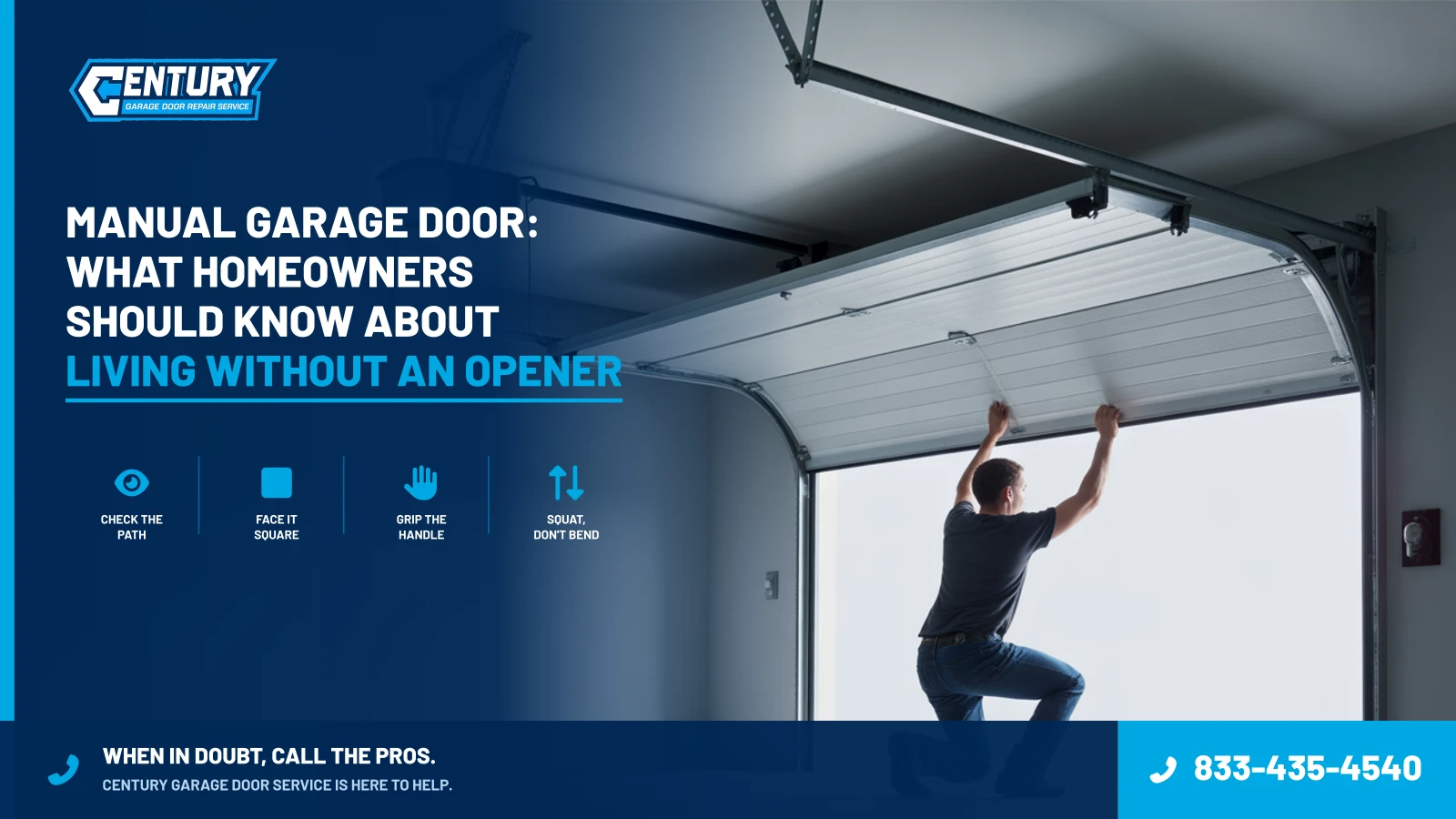
The technique matters more here than on any powered door, because you do it several times a day.
That last step is where injuries happen. A door that is allowed to drop the final foot will do it fast, and fingers end up between sections or under the bottom rail. Hands stay clear of section joints throughout, which is why the handle exists.
If any of that feels heavy, the door is out of balance rather than you being out of shape.
ALT: manual garage door lift handle and step plate positioned clear of the section joints
Check the path is clear, both the floor and the track above
Put the door all the way down, then unplug the opener so nothing can start a cycle while your hands are in the hardware.
Face the door square, feet apart, one foot slightly forward
Put the door all the way down, then unplug the opener so nothing can start a cycle while your hands are in the hardware.
Grip the lift handle or the bottom section edge with both hands, spaced roughly shoulder width
Put the door all the way down, then unplug the opener so nothing can start a cycle while your hands are in the hardware.
Squat rather than bend
Put the door all the way down, then unplug the opener so nothing can start a cycle while your hands are in the hardware.
Move with the door as it takes over, rather than throwing it upward and stepping back
Put the door all the way down, then unplug the opener so nothing can start a cycle while your hands are in the hardware.
Lowering is the dangerous half
Put the door all the way down, then unplug the opener so nothing can start a cycle while your hands are in the hardware.
Need a Professional Tune-Up?
Skip the ladder. Our local technicians perform full safety inspections and comprehensive lubrication to keep your system running silently.
Handles, step plates, and where to put your hands
A door meant for hand operation carries hardware a powered door often lacks, and the garage door manual handles are the part that matters most.
- Lift handles. One or two on the bottom section, positioned clear of the joint above so fingers cannot be pinched as the door folds.
- A step plate. A flat plate to push against with a foot when lowering, so you are not bending to floor level.
- An interior pull. A handle or rope on the inside for closing from within.
- A rope pull on the top section, on some doors, for reaching a door that is fully up.
If a manual garage door is missing these, adding them is straightforward and it changes daily use more than anything else on this page. What matters is placement: anything fitted across a section joint locks two sections together and the door will tear it out.
Locking a manual garage door
With no opener there is no console lock and no rolling code, so the lock is entirely mechanical, which is arguably simpler.
Most hand-operated doors carry either a slide bolt through the vertical track or a keyed T-handle with side bars into the jambs. Both hold without power, because they are steel through steel. There is no radio to defeat and nothing to reprogram.
The one advantage a manual garage door has over a powered one on security is that it cannot be opened by a captured or copied signal, because there is no signal. What it gives up is the console lock’s ability to ignore every remote at once. Lock hardware and what each type actually stops is covered in our garage door lock guide.
What still needs servicing with no opener
Removing the motor removes about a third of the maintenance and none of the important parts.
| Part | Still needs attention? |
|---|---|
| Springs and cables | Yes, and more than on a powered door |
| Rollers and hinges | Yes, they carry the same loads |
| Track and brackets | Yes |
| Bottom seal | Yes |
| Balance | Yes, this is the critical one |
| Photo eyes and reversal test | Not applicable, no opener |
| Drive gear, board, remotes | Not applicable |
The row that matters is balance. On a powered door the opener quietly compensates for a door drifting out of balance until something fails. On a manual garage door you feel it immediately, which is genuinely an advantage: the door tells you before the springs do anything dramatic.
When adding an opener is worth it
A fair question, and the answer is usually about the people rather than the door.
The case for motorising is strongest where somebody in the household should not be lifting a door, where the door is used many times a day, or where getting out of a car in weather to lift by hand has become the reason nobody uses the garage.
Two things have to happen first. The door needs to be in balance, because an opener fitted to an unbalanced door inherits the problem and hides it. And the door has to be suitable, since some older hand-operated doors were never built for a trolley arm. Sizing the unit is covered in our garage door opener size guide, and the point made there applies doubly here: a bigger motor does not fix a heavy door.
Manual against powered, honestly
Neither is the better door. They suit different situations.
A manual garage door has fewer parts, nothing electrical, no remotes to lose, no codes, no board to fail, and it works in a power cut without a thought. It also asks something of you every time, and it asks more of whoever is least able to give it.
A powered door removes the effort and adds a system: a motor, a receiver, safety devices that must be tested, and a dependency on mains power unless a backup is fitted. Battery backup and outage behaviour sit in our garage door battery guide.
The honest summary is that a manual door is simpler to own and harder to use, and a powered one is the reverse. Homeowner maintenance guidance is published through the DASMA technical data sheets on residential garage door maintenance (dasma.com).
FAQs: manual garage door questions
How heavy should a manual door feel to lift?
Light. On a correctly balanced door the springs carry almost all the weight and you supply the push to start it moving, not the lift. Raise it to waist height and let go: a balanced door stays roughly there. If it feels like real work, the door is out of balance rather than you being unfit.
Is a manual garage door the same as uncoupling a powered one?
No, and it is worth keeping them separate. A manual door has no opener at all and is built to be hand-operated, with lift handles and a balance checked as part of service. A powered door on its release is temporarily uncoupled and has its own precondition, which our manual release guide covers properly.
Where should I put my hands?
On the lift handle, or on the bottom section edge with both hands spaced about shoulder width. Never across a section joint, because the door folds there as it opens and fingers get pinched. That is exactly what the handle exists to prevent, and adding one to a door without it is a small job.
Which is more dangerous, lifting or lowering?
Lowering, clearly. A door allowed to drop the last stretch travels fast and that is where fingers end up between sections or under the bottom rail. Keep both hands on it and control it the whole way down. Never let it run, however many times you have done it without a problem.
Can I add an opener to a manual door later?
Usually, with two conditions. The door has to be in balance first, because an opener fitted to an unbalanced door inherits the fault and masks it until something breaks. And the door has to be built to take a trolley arm, which some older hand-operated doors were not. Call 833-435-4540 to have both checked.
Does a manual door still need servicing?
Yes, and the springs need it more than on a powered door because you are relying on them completely. Rollers, hinges, track, brackets and the bottom seal all wear the same way. What drops off the list is the opener side: no photo eyes, no reversal test, no board, no remotes.
Is a manual door more secure?
In one specific way, yes. There is no radio signal to capture or copy, because there is no receiver. What it gives up is the console lock that makes a powered opener ignore every remote at once. Security on a manual door is entirely mechanical, which means the bolt or the T-handle is doing all of it.
Get your manual garage door balanced
On a manual garage door, balance is not a maintenance detail, it is the whole experience, and a door that has quietly become heavy is a spring problem rather than something to push through. Century Garage Door Service answers live around the clock at 833-435-4540 and gives you a two-hour arrival window with a text when the truck rolls. A technician checks the balance at waist height, looks at the rollers, hinges and track that carry the same loads a powered door’s do, and fits lift handles or a step plate where the door is missing them. You get a written quote before a tool comes out, and only the quoted trip fee if you decline. Our trucks run stocked, so most jobs finish in one visit, and the workmanship is warrantied. Seniors and military get a standing discount. So do first responders. To have the whole door gone over at once, book a garage door safety inspection.
Table of Contents
Emergency Repair?
Did a loud bang follow a door that won't lift? Don't risk injury. We offer rapid emergency response.